Is OCD Neurodivergent? Here’s the Answer Nobody Wants to Give You
July 20, 2026
False Memory OCD: Why Intrusive Doubts Can Feel So Real
July 31, 2026Here’s what nobody tells you about OCD and ADHD:
Doctors get asked to untangle these two almost every week. Not because they’re the same condition wearing different masks, but because from the outside, they can look identical.
Someone with OCD can’t focus because intrusive thoughts have hijacked their brain. Someone with ADHD can’t focus because their attention won’t sit still for five seconds. Different engines. Same symptom: a person who can’t get things done and feels like they’re failing at basic life admin.
Here’s the reality: these are two distinct conditions with two distinct causes. Confuse them, and you risk chasing the wrong treatment for years.
This article breaks down exactly where OCD and ADHD overlap, where they split apart, whether you can have both, and what actually helps.
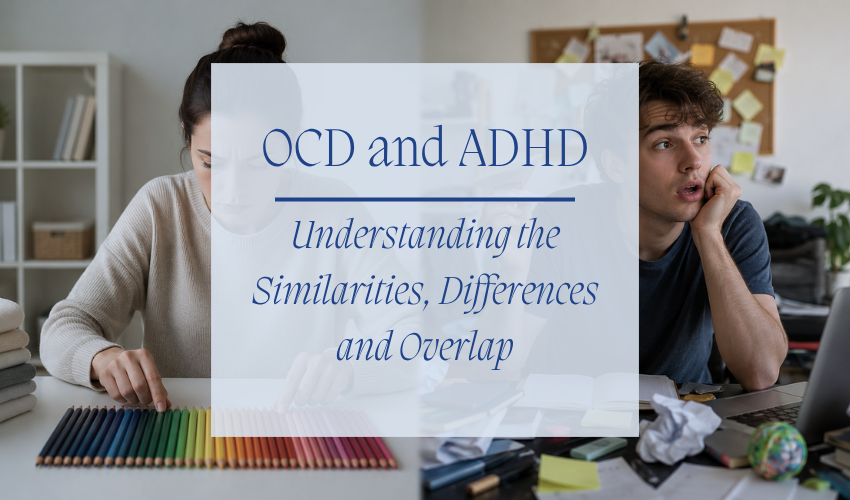
Why OCD and ADHD Keep Getting Lumped Together
Procrastination. Half-finished tasks. Forgetfulness. A brain that feels permanently overwhelmed.
Sound familiar? That’s the trap. Both conditions can produce all of the above, so people, and sometimes clinicians on a first pass, assume one condition is behind it.
The short answer: OCD and ADHD share some surface-level features, but they run on completely different engines. OCD is driven by intrusive thoughts and anxiety. ADHD is driven by attention regulation, impulsivity, and executive functioning differences.
Here’s what this guide covers: what each condition actually is, where they overlap, where they diverge, whether they can show up together, how they’re diagnosed, and what treatment looks like.
What OCD Actually Is
OCD is built on two moving parts: obsessions, persistent, unwanted thoughts, images, urges, or fears, and compulsions, repetitive behaviours or mental rituals performed in response.
Here’s the part most people miss: the person almost always knows the thoughts are excessive. That doesn’t make them go away.
Obsessions tend to circle around contamination, harm, mistakes, uncertainty, or moral responsibility. Compulsions show up as checking, washing, counting, repeating, arranging, or hunting for reassurance. The goal is always the same, reduce the distress, prevent the feared outcome. The relief never lasts.
The cost: OCD eats time and energy. It can hit work, study, relationships, self-care, and confidence. Someone might avoid entire situations that trigger obsessions, burn hours on rituals, or freeze on tasks because “good enough” isn’t good enough.
What ADHD Actually Is
ADHD is a neurodevelopmental condition. That means it’s wired in early, persistent patterns of inattention, hyperactivity, and/or impulsivity that interfere with functioning across multiple settings, not just one bad week at work.
It shows up in three flavours: predominantly inattentive, predominantly hyperactive-impulsive, or combined. And here’s something adults especially need to hear: the physical hyperactivity often fades with age. The internal restlessness doesn’t.
The day-to-day friction: sustaining attention, organising tasks, managing time, remembering appointments, resisting distractions, regulating impulses. Executive functioning takes the hit, planning and finishing things becomes a genuine uphill fight.
Where OCD and ADHD Actually Overlap
Concentration. Both conditions can wreck it. In OCD, intrusive thoughts and anxiety hijack attention. In ADHD, the attention-regulation system itself is the problem.
Emotional regulation. Frustration, overwhelm, irritability, stress sensitivity, both conditions bring these to the table. The reactions can look disproportionate to an outsider. The reasons underneath are different.
Executive functioning. Planning, prioritising, starting tasks, finishing tasks, hard in both conditions, for different reasons. OCD gets someone stuck in checking or perfectionism loops. ADHD gets someone distracted, or the task simply falls out of memory.
Real-world overlap: rereading the same email five times, assignments that take three times longer than they should, appearing absent-minded, missing deadlines, a house that never quite gets organised. This is exactly why the two get confused.
Where OCD and ADHD Actually Diverge
The motivation is the tell. OCD behaviour is driven by anxiety and the urge to kill distress. ADHD behaviour is driven by impulsivity, boredom, distraction, or a broken brake pedal on inhibition.
Perfectionism versus distractibility. OCD leans into perfectionism and fear of mistakes. ADHD leans into inconsistency and difficulty sustaining effort on anything that isn’t stimulating enough.
Decision-making tells a story too. Someone with OCD might spend twenty minutes on a decision, terrified of choosing wrong. Someone with ADHD might decide in two seconds without weighing the options, or stall out completely because the task feels boring or overwhelming.
Routines split the two apart. OCD often builds rigid routines and reacts badly when they’re disrupted. ADHD struggles to maintain any routine consistently, even when the person genuinely wants structure.
Can You Have Both OCD and ADHD?
Yes. Straightforward answer. This is called comorbidity, and it’s more common than chance would predict, though exact numbers shift across studies and age groups.
Here’s why that makes diagnosis harder: when both are present, the symptoms start feeding each other. Inattention could be intrusive thoughts, ADHD, or both at once. Restlessness could be anxiety, hyperactivity, or a compulsive urge. Untangling the source requires a careful assessment, no shortcuts here.
And they don’t just coexist quietly. ADHD-driven disorganisation can spike anxiety and trigger more checking behaviour. OCD rituals can eat the time ADHD already struggles to manage. Understanding how the two interact is what lets a clinician build a treatment plan that actually works instead of chasing one condition while the other sabotages it.
Why OCD and ADHD Get Misdiagnosed
Poor concentration. Procrastination. Unfinished tasks. Forgetfulness. Restlessness. Underperformance at work or school. Every one of these can come from either condition, that’s the overlap doing its damage.
Here’s where clinicians dig deeper: the purpose behind the behaviour, whether obsessions are present, the role anxiety plays, developmental history, and whether the pattern has existed since childhood.
That’s why a proper assessment matters. It typically means interviews, symptom history, developmental background, functional impact, and sometimes questionnaires, filled out by the person and by people who know them well.
How OCD and ADHD Are Actually Diagnosed
OCD Diagnosis comes from a qualified mental health professional, using recognised diagnostic criteria. Questionnaires can support the picture. They cannot deliver a diagnosis on their own, no test replaces clinical judgment here.
For ADHD, childhood onset matters, the symptoms need to trace back. For OCD, clinicians look at when the obsessions and compulsions started and how they’ve evolved.
Screening tools have one job: flagging whether further assessment is worth pursuing. They cannot tell you whether you have OCD, ADHD, both, or neither.
Clinicians also rule in or out other conditions that like to hide in the same symptoms: anxiety disorders, depression, autism spectrum conditions, tic disorders, trauma-related difficulties.
Treatment: What Actually Helps
For OCD: Cognitive Behavioural Therapy, specifically Exposure and Response Prevention (ERP), is the front-line psychological treatment.
For ADHD: psychoeducation, coaching, behavioural strategies, organisational skills training, and psychological therapy aimed at executive functioning and emotional regulation.
When both are present, medication gets more complicated. ADHD medication can improve attention and organisation for a lot of people. OCD is commonly treated with specific antidepressants, SSRIs. Clinicians need to watch both conditions closely, because treating one can shift the other.
The bottom line: there’s no universal treatment plan. Severity of each condition, personal goals, side effects, lifestyle, and any other co-occurring difficulties all shape the decision.
Living With OCD and ADHD
Practical moves that help: calendars and reminders, breaking tasks into smaller steps, realistic schedules, cutting distractions, and practising whatever skills therapy has taught.
Structure helps, until it doesn’t. Routines should support functioning, not calcify into compulsions. A therapist can help draw the line between a healthy habit and an OCD-driven ritual.
At work or university: reasonable adjustments might include extra time on tasks, written instructions, quieter workspaces, flexible deadlines where appropriate, or access to wellbeing support.
Family and friends matter more than people admit. Learning about the conditions, resisting the urge to over-reassure, backing the treatment plan, and encouraging healthy routines all make a real difference.
Common Myths, Corrected
Myth: OCD and ADHD are the same thing. They’re not. Separate conditions, separate mechanisms, even with the symptom overlap.
Myth: You can’t have both. You can. Recognising that improves treatment, not confuses it.
Myth: Poor concentration always means ADHD. It doesn’t. Anxiety, OCD, depression, sleep problems, stress, and physical health conditions can all wreck concentration on their own.
Why this matters: an accurate diagnosis prevents the wrong treatment, sharpens understanding, and gets support pointed at the actual cause.
When to Get Professional Help
Consider it if symptoms are interfering with work, study, relationships, self-care, sleep, or emotional wellbeing. An assessment is worth booking if you’re dealing with persistent intrusive thoughts, repetitive behaviours, longstanding attention problems, impulsivity, disorganisation, or genuine uncertainty about which condition is driving things.
Questions worth bringing to a healthcare professional:
- Are my concentration problems more consistent with anxiety, OCD, ADHD, or something else?
- Could I have both conditions?
- What treatment options fit my symptoms?
- What practical strategies could help at work or university?
Frequently Asked Questions
Can someone have both OCD and ADHD?
Yes. Co-occurring OCD and ADHD is possible and may call for an integrated treatment approach.
Which condition is usually diagnosed first?
It varies. ADHD is often picked up in childhood; OCD may surface later. Either can come first.
Can ADHD medication affect OCD symptoms?
It depends on the person. Some notice better attention with no change to OCD symptoms. Others notice shifts in anxiety or obsessive symptoms. This is exactly why clinician monitoring matters.
Are OCD and ADHD both neurodevelopmental conditions?
No. ADHD is classified as neurodevelopmental. OCD sits in its own category, obsessive-compulsive and related disorders.
Can OCD develop later than ADHD?
Yes. ADHD symptoms typically start in childhood. OCD can emerge in childhood, adolescence, or well into adulthood.
Key Takeaways
OCD and ADHD are separate conditions, but they can occur together. Distinct diagnoses. Overlapping possibility.
Some symptoms overlap. The causes underneath usually don’t. Poor concentration, disorganisation, and emotional difficulty show up in both, for different reasons entirely.
A comprehensive assessment is what separates the two. No shortcut replaces careful clinical evaluation, especially when co-occurring conditions are in the mix.
Individualised treatment changes outcomes. Tailored therapy, medication where it fits, practical strategy, and a supportive environment can move the needle significantly.
Early recognition opens the door to the right support. If OCD, ADHD, or both sound like they might be in play, getting a professional opinion is the step that actually moves things forward.