
ADHD Assessment for Child: What Parents Can Expect From the Process
October 8, 2026
OCD Rumination: 7 Signs Your Thinking Has Become a Trap (And Why Thinking Harder Won’t Fix It)
October 22, 2026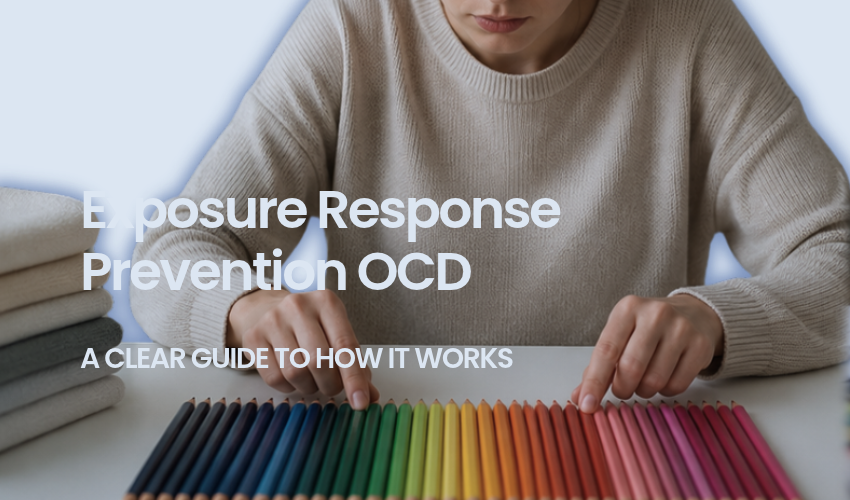
Here’s what most people get wrong about ERP Exposure Response Prevention OCD:
They think the goal is to stop the thoughts.
It isn’t. ERP doesn’t try to eliminate every intrusive thought. It changes what you do when one shows up.
If you’ve spent months or years stuck in a loop of unwanted thoughts, doubts, urges and rituals, you already know how exhausting it is. This guide explains how Exposure and Response Prevention works, what it feels like, what it can’t promise, and how to tell whether it’s the right fit for you.
It won’t hand you a quick fix. But it will give you a clear picture of what the most widely used psychological treatment for OCD involves.
What ERP Actually Means
ERP stands for Exposure and Response Prevention. It’s a structured psychological approach used in treating OCD, and it’s generally considered a form of cognitive behavioural therapy (CBT).
Two parts, two jobs.
Exposure means deliberately approaching a situation, thought or sensation that triggers your obsessive fear or distress.
Response prevention means resisting the usual response: the compulsion, the ritual, the avoidance, the reassurance-seeking.
Here’s what that looks like in practice. Someone with contamination-related OCD might gradually practise touching an object they consider contaminated, without washing their hands straight afterwards. The exact exercise depends entirely on the person and is planned as part of OCD treatment.
CBT looks at how thoughts, feelings and behaviours feed each other. ERP applies that idea directly. It helps you experience feared situations without automatically reacting through compulsions or avoidance.
Here’s the truth about intrusive thoughts: they’re a common part of human experience. Having an unwanted thought doesn’t mean you want it, agree with it or will act on it.
ERP also doesn’t try to prove that every feared outcome is impossible. It helps you build a different relationship with uncertainty. You learn you don’t have to answer every intrusive thought with a ritual.
The OCD Cycle: Why You’re Stuck
To understand why ERP works the way it does, you need to see what’s keeping OCD going.
It starts with an obsession. That could be an intrusive thought, an image, an urge or a persistent doubt. The content varies hugely from person to person: contamination, making a mistake, causing harm, responsibility, morality, relationships, and many other themes.
Here’s what matters, though. It’s often not the subject itself. It’s the distress and uncertainty attached to it.
Then comes the compulsion. These are behaviours or mental acts you perform in response: checking, washing, counting, repeating, seeking reassurance, or mentally reviewing events. Avoidance joins the cycle too.
And here’s the trap.
These responses can bring temporary relief. When they do, your brain learns that the ritual worked. So next time the same anxiety appears, the urge to repeat it gets stronger.
The relief is short-lived, but the lesson sticks: “I needed to do that.” The feared situation keeps feeling threatening, and the cycle tightens.
ERP breaks that pattern. It creates opportunities to feel the distress or uncertainty without performing the usual response.
What Happens in ERP Exposure Response Prevention OCD, Step by Step
Let’s break it down.
Step one: mapping your OCD. Treatment usually starts with understanding your specific pattern. A therapist may explore your triggers, intrusive thoughts, compulsions, avoidance, reassurance-seeking, and how all of it affects daily life. That shows which patterns are keeping the problem going and where exercises will help most.
Step two: building your hierarchy. Together with your therapist, you may create a ladder of situations, from less distressing to more challenging. It’s a structured way in, rather than throwing yourself at everything at once.
And it’s personal. A situation that feels manageable to one person can be extremely difficult for another.
Step three: gradual exposure. Depending on your OCD, exposure can involve real-life situations, imagined scenarios, bodily sensations or intrusive thoughts themselves. The aim isn’t to create unnecessary distress. Exercises are chosen so you can practise responding differently to your triggers.
Step four: resisting the ritual. During exposure, you practise not doing what OCD demands. With repeated practice, you learn that anxiety and uncertainty can be tolerated without a ritual to rescue you.
Exposure: The Different Forms
Exposure simply means coming into contact with a trigger instead of automatically avoiding it. The trigger might be external, like touching an object. Or internal, like letting an intrusive thought sit there without analysing it.
There are a few types:
In vivo exposure uses real-life situations.
Imaginal exposure means deliberately engaging with a feared scenario in your imagination.
Interoceptive exposure, used where appropriate, helps you experience physical sensations that have become tied to fear.
Why gradual and carefully planned? Because ERP is not one-size-fits-all. Your therapist considers your symptoms, circumstances, readiness and goals. Working step by step lets you build confidence and skills before moving to harder situations.
Response Prevention: The Hard Part (Let’s Be Honest)
Response prevention means practising not doing the ritual OCD is demanding. That might mean cutting back on checking, washing, reassurance-seeking, mental reviewing or other repetitive responses.
The goal isn’t to make anxiety vanish on the spot. It’s to learn that you can sit with uncertainty without automatically reacting to it.
OCD craves certainty. So you check, ask, or replay events in your head because you want to feel completely sure. ERP asks for something different: let the uncertainty exist, and stop trying to neutralise it.
Let’s be honest: that can feel uncomfortable, even frightening. Compulsions can be deeply established habits, and resisting them is hard at first.
But difficulty doesn’t automatically mean treatment is going badly. It’s often part of learning a new response. Exercises should still be appropriate and professionally supported.
What ERP Can Be Used For
ERP can be adapted to many different OCD presentations. The theme of your obsession doesn’t decide whether ERP is suitable. Treatment targets the underlying cycle of obsession, distress, avoidance and compulsion.
Contamination, checking and reassurance-seeking. ERP may be used for contamination fears, excessive checking and repeated reassurance-seeking. Treatment might involve gradually cutting back on checking, or practising tolerating uncertainty without asking someone else to reassure you.
Intrusive thoughts and hidden compulsions. Not every compulsion is visible. Some people carry out mental rituals: reviewing memories, analysing thoughts, mentally repeating phrases, or trying to reach a particular feeling of certainty. ERP can address these too. You learn to notice the urge to perform the mental ritual and practise responding differently.
What Does ERP Feel Like?
Here’s what nobody tells you up front: anxiety or discomfort may go up before it comes down.
That’s because you’re deliberately approaching something OCD has taught you to avoid or neutralise. The experience varies. Some people notice anxiety easing during an exercise. Others keep feeling discomfort but become better at tolerating it.
This is where a therapist earns their place. They help choose appropriate exercises, explain why response prevention matters, and support you when anxiety gets hard to manage. They can also help tell the difference between productive discomfort and an exercise that needs adjusting.
The right pace and type of ERP depend on you. Treatment should account for co-occurring mental health difficulties, practical responsibilities and individual needs.
Three Myths About ERP
“ERP deliberately makes OCD worse.”
No. ERP involves carefully planned exposure to triggers while reducing compulsive responses. The purpose is to show you that you can tolerate distress and uncertainty without relying on rituals or avoidance.
“ERP means facing your biggest fear on day one.”
Also no. You don’t have to confront your most difficult fear in the first session. Treatment is structured around your circumstances and usually progresses gradually. Exercises should be meaningful and clinically appropriate.
“ERP is just willpower.”
This is where most people get it wrong. ERP takes more than gritting your teeth. It requires understanding OCD, identifying your patterns and practising alternative responses, repeatedly. Professional support helps you understand why compulsions occur and how to build response prevention into treatment.
How Well Does ERP Work?
ERP is an established psychological treatment for OCD and has been studied extensively. It’s commonly recommended as an important psychological intervention for people with OCD.
But let’s be realistic. People respond differently. Symptom severity, how long you’ve had OCD, co-occurring difficulties, engagement with treatment and access to the right support can all shape progress.
If you don’t see improvement quickly, that doesn’t necessarily mean treatment can’t help. It’s worth talking it through with your treating professional.
And here’s the part that surprises people: finishing treatment doesn’t necessarily mean you’ll never have an intrusive thought again. Everyone has unwanted thoughts. ERP isn’t aiming to wipe them out.
What it can do is reduce the importance you give those thoughts, and reduce your reliance on compulsions, avoidance and reassurance.
ERP, Medication and Other Treatment Options For OCD
ERP isn’t always used alone. For some people, psychological treatment is combined with medication. Selective serotonin reuptake inhibitors (SSRIs), for example, may be considered in appropriate circumstances.
Medication may be considered when symptoms are significantly affecting your functioning, or when psychological treatment alone isn’t sufficient or suitable. A qualified clinician can talk you through the potential benefits, side effects and alternatives before any decision is made.
The bottom line: there’s no single plan that suits everyone with OCD. Decisions should be based on your symptoms, preferences, medical history and clinical needs. A comprehensive assessment helps identify the right mix of psychological, medical and practical support.
When ERP Might Not Be the Right Fit
Let’s be straight about this. ERP is an established treatment, but it isn’t automatically right for everyone, or right in every form, at every moment.
Suitability has to be considered individually. A clinician can look at your symptoms, any co-occurring conditions and your practical circumstances before recommending an approach. And ERP is best understood as a structured therapeutic approach, not a self-help challenge you set yourself.
After ERP: Keeping What You’ve Gained
Treatment ending isn’t the finish line. It helps to stay aware of familiar OCD patterns. Spotting early signs lets you apply the skills you built in therapy.
Setbacks happen. A spike in intrusive thoughts doesn’t mean your progress has vanished.
Go back to the ERP principles you’ve learned, and talk to a professional if you’re struggling. That can stop a temporary wobble from turning into a return to old routines.
Those skills also carry over into everyday life. The emphasis stays the same: respond differently to intrusive thoughts and uncertainty, instead of chasing complete certainty.
When to Get Professional Help for OCD
Sound familiar?
Professional help may be appropriate when OCD interferes with work, education, relationships, sleep, personal routines or other important parts of your life. An assessment can help determine whether your symptoms are consistent with OCD and which treatment approaches may suit you.
It’s also worth reaching out when avoiding situations, repeatedly asking others for reassurance, or spending large amounts of time on rituals is becoming hard to manage. Those patterns can signal that OCD is having a significant impact, and they’re worth discussing with a qualified mental health professional.
Why assessment matters: it can help distinguish OCD from other conditions with overlapping symptoms, and identify co-occurring difficulties that may need attention. That’s especially true when symptoms are complex or have been present for a long time.
Your Questions About ERP, Answered
How long does ERP take?
There’s no fixed duration. It depends on the severity and complexity of your OCD, how you respond to treatment, and how the therapeutic programme is structured. Some people need a relatively focused course. Others need longer-term support.
Can ERP be done online?
For some people, yes. It depends on your symptoms, circumstances and access to appropriate clinical support. Remote treatment should still offer structured guidance and appropriate monitoring.
Is ERP suitable for everyone with OCD?
ERP is an established treatment, but suitability should be considered individually. A clinician can assess your symptoms, co-occurring conditions and practical circumstances before recommending an approach.
Can ERP make symptoms feel worse temporarily?
Yes. Exposure can temporarily raise anxiety or discomfort because it involves approaching situations that normally trigger OCD responses. That should be expected and managed within an appropriate treatment framework. It’s not a sign the treatment is failing.
What should I look for in an ERP therapist?
Look for appropriate professional qualifications and specific experience treating OCD with evidence-based approaches. It’s also worth asking how they structure ERP, how they monitor progress, and how they adapt treatment to individual needs.
The Bottom Line
ERP targets the cycle, not the thought. It focuses on changing how you respond to intrusive thoughts, uncertainty and feared situations, instead of trying to eliminate every unwanted thought.
Good ERP is structured and personal. It’s planned around your symptoms and circumstances, with exercises that are purposeful, appropriate and introduced at a manageable pace.
Discomfort doesn’t mean failure. Exposure can be hard, especially when you’re resisting long-established compulsions. The purpose is to build tolerance of uncertainty and cut your dependence on rituals.
Professional guidance matters. ERP is a structured therapeutic approach, not a self-help dare. A professional assessment can help determine whether it’s right for you and how it should be delivered.
And it’s an established treatment. ERP can form an important part of evidence-based OCD care. The best approach depends on your symptoms, needs, preferences and wider circumstances. If OCD is running your days, the next step is a conversation with a qualified professional. That’s where clarity starts.