Private Diagnosis for ADHD: What to Know Before Seeking a Comprehensive Assessment
October 4, 2026
ERP Exposure Response Prevention OCD: What Exposure and Response Prevention Actually Is (And What It Isn’t)
October 19, 2026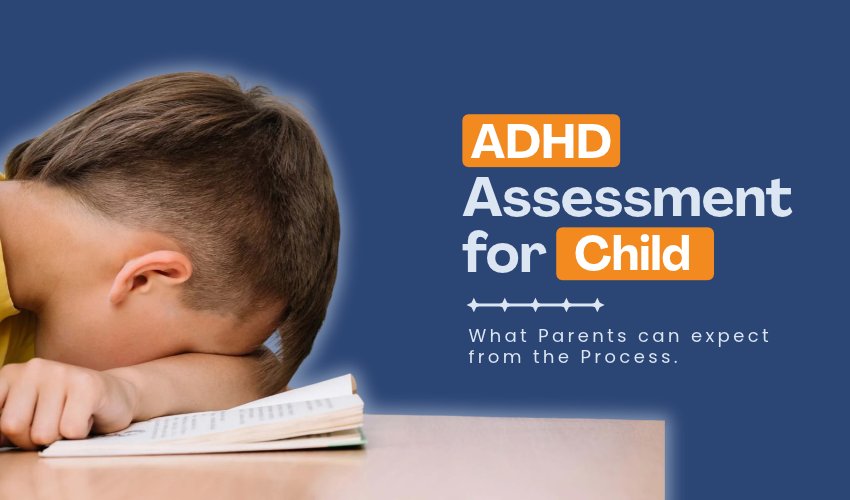
Here’s what most parents don’t realise when they start looking for an ADHD assessment for child:
You’re not signing up for a label. You’re signing up for answers.
Maybe your child loses everything, coats, homework, PE kits, their own train of thought mid-sentence. Maybe mornings are a battle. Maybe school keeps calling. Or maybe it’s the opposite: things look fine at school, but home is chaos.
Here’s the reality: none of that automatically means ADHD. But it does mean something’s worth looking into.
This article walks you through exactly what an ADHD Assessment for Child involves, what happens before it, during it, and after it, so you know what you’re actually getting into.
Why Parents Start Considering an ADHD Assessment in the First Place
Parents don’t wake up one day and decide to book an assessment out of nowhere. It usually builds.
A child consistently struggles with attention, activity levels, impulsivity, organisation, or following instructions. Sometimes it shows up at home. Sometimes at school. Often both.
Here’s what this can look like day to day:
Some kids find schoolwork unusually hard. Others struggle with friendships, routines, emotional regulation, or just getting through everyday tasks without a meltdown. An ADHD Assessment for Child exists to explore whether these difficulties fit the pattern of ADHD, or whether something else is actually going on.
Struggling With Attention Doesn’t Automatically Mean ADHD
Let’s be honest: kids are messy, energetic, forgetful creatures by design.
Being distracted occasionally, losing a jumper, or having a burst of energy at soccer practice? That’s childhood. Not a diagnosis.
Here’s where it gets more complicated. Similar difficulties can show up because of:
- Anxiety
- Poor sleep
- Learning difficulties
- Stressful circumstances at home or school
- Other developmental or emotional factors
This is exactly why a proper assessment doesn’t zoom in on one behaviour in isolation. It looks at the overall pattern.
What Actually Happens During the Assessment Process
Here’s what parents can expect, stripped of the jargon:
Questions. About your child’s current difficulties, their development, education, behaviour, and general wellbeing. Depending on age and circumstances, your child may be brought into the conversation too.
Clinicians will often want input from teachers or school staff who know your child outside the home.
The goal is a balanced picture, not a snap judgment. Everything gets weighed before anyone decides whether the diagnostic criteria for ADHD are actually met.
What Is ADHD in Children, Really?
Inattention, Hyperactivity, and Impulsivity, Broken Down
ADHD is a neurodevelopmental condition. Not a personality quirk, not bad parenting, not “just a phase.” It’s associated with persistent patterns across three areas:
- Inattention , difficulty concentrating, following instructions, completing tasks, keeping track of belongings
- Hyperactivity , excessive movement, talking, difficulty sitting still
- Impulsivity , interrupting, acting without thinking, struggling to wait
It Reaches Further Than School Performance
Here’s what nobody tells you: ADHD isn’t just about grades.
It can hit homework, morning routines, household expectations, social situations, the whole picture. And when a child is genuinely trying hard but keeps struggling with things that look easy for everyone else? That breeds frustration, conflict, and a hit to their confidence.
No Two Kids Look the Same
ADHD doesn’t wear one costume.
Some children are predominantly inattentive. Others show more obvious hyperactivity and impulsivity. And the environment matters too, a highly structured classroom might mask difficulties that become glaringly obvious the second that child gets home to a less structured environment.
Signs That May Point Toward an ADHD Assessment
Attention, organisation, and instruction-following:
Frequently losing belongings. Forgetting instructions. Failing to complete tasks. Getting distracted easily. Needing constant reminders for basic things.
Here’s the key qualifier: these only become relevant when they’re persistent, not just an occasional off day.
Hyperactivity and impulsivity beyond what’s expected for their age:
Young kids are naturally active and impulsive, that’s not up for debate. What clinicians actually look at is whether the behaviour is significantly different from what’s typical for that developmental stage, and whether it’s causing real difficulties at school, home, or in relationships.
When Should You Actually Consider an Assessment?
Look at the Full Picture: Home, School, and Social Life
An ADHD Assessment for Child tends to make sense when difficulties are persistent and affect more than one area of life.
Maybe you’re seeing routine and behaviour problems at home. Maybe the school is flagging concentration or classroom issues. Maybe it’s showing up socially too. All of that matters.
Every Kid Struggles Sometimes, But Persistent Problems Deserve a Closer Look
Every child has off days with concentration or behaviour. That’s normal.
But persistent problems that interfere with learning, family life, friendships, or emotional wellbeing? Those deserve further consideration. Professional advice can help figure out whether ADHD, or something else entirely, is driving it.
Before the Assessment: What Actually Needs to Happen First
Talk to a GP, the School, or Another Relevant Professional
Most parents start here. A GP, the school, or another appropriate professional can offer useful first observations.
Schools in particular can flag classroom behaviour, learning patterns, and relationship dynamics. A Special Educational Needs Coordinator (SENCO) may also weigh in.
Start Gathering the Evidence
Before the assessment, it helps to jot down:
- When concerns began
- Specific examples of behaviour
- Feedback from school
- Situations where things get better or worse
Developmental milestones, health history, sleep patterns, emotional wellbeing, and previous educational support are all relevant too. The more detail you bring, the clearer the picture becomes.
What Actually Happens During the Assessment Itself
Conversations With Parents, Carers, and the Child
A proper ADHD Assessment for Child involves detailed discussion with parents or carers, and, where appropriate, the child themselves.
Clinicians ask about strengths, difficulties, behaviour, emotions, school experience, and relationships. Here’s why the child’s perspective matters: kids experience difficulties adults don’t always see.
Digging Into Development, Medical History, Education, and Family Background
The assessment explores early development, educational history, physical and mental health, and relevant family history. Sleep and emotional difficulties get factored in too, since they can affect attention and behaviour just as much as ADHD itself.
Bringing In Teachers and Other Observers
Information from school helps establish whether the difficulties show up outside the home too.
Teachers can describe attention, activity levels, task completion, classroom behaviour, and social functioning. This gets weighed alongside what parents and the child say, never used on its own.
How Is ADHD Actually Diagnosed?
The Diagnostic Criteria Clinicians Use
Diagnosis comes down to whether the child’s symptoms fit recognised diagnostic criteria for ADHD.
Clinicians look at the nature and persistence of symptoms, when they began, and how significantly they affect functioning. Here’s the bottom line: a diagnosis should follow a full clinical and psychosocial assessment, never a single test.
Why Symptoms Need to Show Up in More Than One Setting
Symptoms generally need to appear across more than one important setting, home and school, for instance.
Why? Because kids behave differently depending on environment, expectations, and structure. Differences between settings aren’t a red flag or a green light on their own, they’re just useful information.
Why Clinical Judgement Beats Any Questionnaire
Rating scales and questionnaires help. They don’t replace professional judgement.
A specialist weighs developmental history, current symptoms, functional impairment, input from different observers, and possible alternative explanations before reaching any conclusion.
Why Information From Home and School Matters So Much
A child’s behaviour can look completely different depending on the setting. That’s not a contradiction, it’s data.
Understanding the Differences Between Environments
A child might seem settled at school but become highly restless at home. Or the reverse.
This doesn’t confirm or rule out ADHD on its own. It helps the clinician understand which situations increase or reduce the difficulties.
Parents, Teachers, and the Child, All Three Perspectives Count
Parents know development and daily routines. Teachers know classroom functioning and learning. And the child? They know their own frustrations and challenges better than anyone.
Put all three together, and you get a far more complete picture than any single viewpoint could offer.
Conditions That Can Look Like ADHD (But Aren’t)
Anxiety, Autism, Learning Difficulties, and Other Overlaps
Here’s where it gets tricky: a lot of conditions can produce ADHD-like difficulties.
Anxiety can wreck concentration. Learning difficulties can make specific academic tasks feel impossible. Autism can involve differences in attention, sensory processing, and social communication. Sleep problems and stress can throw everything off too.
Why Co-Occurring Conditions Can’t Be Ignored
Some children have ADHD alongside another condition. Missing that matters, because support may need to address several areas at once, not just one.
A comprehensive assessment considers whether ADHD, another condition, or a combination of both explains what’s going on.
What Happens After the Assessment Is Done?
Understanding the Outcome
The clinician should explain the findings clearly, no vague hand-waving.
The result may support an ADHD diagnosis, point toward another explanation, or flag that more information or further assessment is needed. You should always get the chance to ask questions about the conclusion.
If ADHD Isn’t Diagnosed, Here’s What That Doesn’t Mean
Not getting an ADHD diagnosis does not mean your child’s difficulties are insignificant.
The assessment might instead identify anxiety, learning difficulties, sleep problems, another neurodevelopmental condition, or another factor needing support. The focus stays on your child’s actual needs, not on chasing a specific label.
Strengths, Needs, and Next Steps
A useful assessment recognises strengths, not just difficulties.
Recommendations might include strategies for home or school, further assessment, psychological support, or other interventions. Next steps should be built around your child, not dictated by a diagnostic label alone.
Treatment and Support Options for Children With ADHD
Parent-Focused, Behavioural, and Psychological Support
Support can include guidance on routines, communication, positive reinforcement, and managing challenging behaviour.
Behavioural and psychological approaches also help kids build practical skills for managing attention, organisation, and emotional responses.
School-Based Strategies and Educational Adjustments
Schools can offer practical strategies tailored to your child, clearer instructions, structured routines, breaking tasks into smaller steps, reducing distractions, or organisational prompts.
When Medication Might Come Into the Picture
Medication may be considered for some children when clinically appropriate.
Here’s what matters: this decision belongs to an appropriately qualified clinician, made after weighing symptoms, age, health, circumstances, potential benefits, and possible side effects. Medication isn’t necessary or suitable for every child, full stop.
Supporting Your Child While You Wait for the Assessment
Assessments take time to arrange. That doesn’t mean you’re powerless in the meantime.
Keep Routines Consistent
Predictable routines make everyday tasks easier. Visual reminders, clear instructions, breaking tasks into smaller steps, and specific positive feedback can all help.
Adapt everything to your child’s age, abilities, and individual circumstances.
Work With the School
Talk to the school about your ongoing concerns and ask what practical strategies might help.
Classroom organisation, written instructions, movement opportunities, and additional prompts can all make a real difference depending on your child’s needs.
Common Myths About ADHD Assessment for Children
Myth: A questionnaire alone can diagnose ADHD. Questionnaires provide useful information. They’re one piece of the puzzle, not the whole thing. A diagnosis requires weighing symptoms, development, impairment, context, and alternative explanations together.
Myth: Every energetic or distracted kid has ADHD. Kids naturally vary in energy and concentration. ADHD involves persistent difficulties that are significant for the child’s developmental stage and meaningfully impact their functioning. Ordinary childhood behaviour isn’t a disorder.
Myth: Parents cause ADHD symptoms. Let’s be clear: ADHD is a neurodevelopmental condition. It is not caused by poor parenting. Parents absolutely play a role in helping children manage difficulties and build supportive routines, but they didn’t cause the condition.
When to Actually Seek Professional Help
Professional advice makes sense when persistent difficulties are affecting school performance, family routines, friendships, or emotional wellbeing.
Repeated problems completing age-appropriate tasks, following instructions, or managing behaviour are worth a conversation too.
You don’t need to wait until things get severe. If there are ongoing questions about your child’s development, learning, behaviour, or wellbeing, speaking with an appropriate professional can help you figure out what support is useful and whether further assessment is needed.
Frequently Asked Questions
What does an ADHD assessment for a child involve?
It involves exploring current symptoms, developmental history, education, functioning, and information from relevant observers. Interviews, questionnaires, and structured tools may all be used, but no single measure decides the diagnosis on its own.
Who can assess and diagnose ADHD in children?
Assessment and diagnosis should be carried out by an appropriately qualified healthcare professional with relevant specialist training and experience in childhood ADHD and developmental assessment.
How long does a child ADHD assessment take?
There’s no single standard duration. It depends on the child’s age, history, complexity of difficulties, and whether information from school or other sources needs gathering. More than one appointment may be needed.
Does the school need to be involved in the assessment?
School information is often valuable, it helps clinicians understand how a child functions outside the home. Exactly what’s required depends on your child’s individual circumstances.
What happens if my child does not receive an ADHD diagnosis?
The clinician should explain the outcome and discuss any alternative explanations or support needs identified. Even without an ADHD diagnosis, your child may still benefit from appropriate educational, psychological, behavioural, or practical support.
Key Takeaways
An ADHD assessment looks at more than individual symptoms. It weighs development, functioning, context, and overall wellbeing together, not one behaviour in isolation.
Home, school, and developmental history all feed into the full picture. Parents, teachers, and children each offer a different but valuable perspective.
Diagnosis requires real evidence and meaningful impact, not a questionnaire score. Symptoms need to form a persistent pattern with a significant effect on functioning.
Other conditions and support needs matter too. A proper assessment considers overlapping possibilities like anxiety, autism, and learning difficulties.The real value of an assessment is clarity. It helps parents and professionals understand what’s actually driving your child’s difficulties, and what to do about it next, whether or not ADHD is the final answer.