Adult ADHD Assessment UK: What Actually Happens During Diagnosis
September 16, 2026
Here’s what nobody tells you about ADHD online assessment:
Half the websites offering them aren’t offering a diagnosis at all. They’re offering a quiz.
And if you’ve spent years wondering why concentration feels impossible, why procrastination has quietly wrecked your career, or why “just focus harder” has never once worked for you, you deserve better than a quiz.
Let’s be honest: ADHD is a neurodevelopmental condition that affects attention regulation, impulse control, organisation, activity levels, and emotional regulation. It doesn’t disappear after childhood. A lot of people carry it silently into adulthood, only recognising it decades later when someone finally names what they’ve been living with.
An ADHD online assessment can be a genuine lifeline, especially if travel is difficult, specialist services are far away, or a remote appointment just fits your life better.
But here’s the reality check this article will give you: “online assessment” means wildly different things depending on where you look. Some sites hand you a symptom checklist. Others deliver a full clinical assessment from a qualified professional. These are not the same thing, and no questionnaire, however well designed, hands you a diagnosis on its own.
This article won’t promise you a instant answer. What it will do is walk you through exactly how remote ADHD assessment works, what it can and can’t tell you, and how to tell a legitimate clinical process from a glorified quiz.
What an ADHD Online Assessment Actually Is
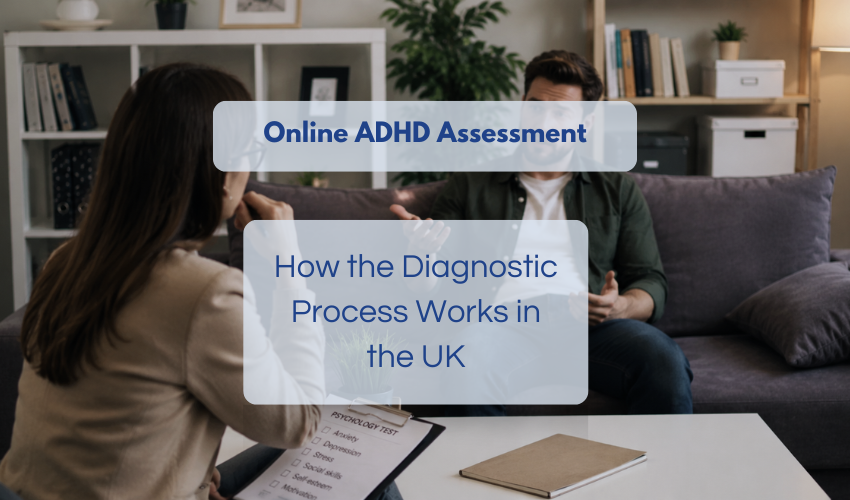
Here’s the core truth: a proper ADHD online assessment is a structured clinical evaluation, conducted remotely, usually over secure video. Its job is to explore whether your symptoms and history meet recognised diagnostic criteria for ADHD.
This is not the same as spotting a few familiar symptoms and calling it done. Concentration and organisational struggles show up in anxiety, depression, stress, poor sleep, and other neurodevelopmental conditions too. A real assessment looks at the whole clinical picture, not just the symptoms you searched for at 2am.
Not All “ADHD Online Assessment” Are Built the Same
Broadly, they fall into three categories:
- Self-screening tools, quick questionnaires flagging whether further assessment might be worth pursuing.
- Online questionnaires or rating scales, useful as part of a professional process, but not diagnostic on their own.
- Remote clinical assessments, conducted by an appropriately qualified professional, involving detailed interviews, developmental history, and a full picture of how symptoms affect daily life.
Here’s why this distinction matters: a positive result on a self-screening tool might point toward possible ADHD symptoms. It cannot confirm you have ADHD. Only a proper clinical assessment can do that.
What the Assessment Is Actually Trying to Achieve
A professional assessment looks at your overall pattern of difficulty, attention, impulsivity, organisation, time management, emotional regulation. The clinician will typically explore when symptoms started, whether they were present in childhood, and how they show up across different areas of your life.
The bottom line: this isn’t about slapping a label on you. It’s about understanding your strengths, your challenges, and what kind of support would actually help.
Who’s Actually Qualified to Do ADHD Online Assessment
A formal assessment needs to be carried out by a clinician with real experience in ADHD assessment and diagnosis, psychiatrists, clinical psychologists, or other specialist ADHD professionals working within their scope of practice.
Before booking anything, it’s worth knowing exactly who will assess you, what their qualifications are, and how their diagnostic process is structured. This isn’t optional due diligence, it’s the whole ballgame.
How the Process of ADHD Online Assessment Works
A genuine ADHD online assessment isn’t a single video call or a five-minute questionnaire. It typically unfolds across several stages.
Initial information gathering. You’ll usually complete registration forms and questionnaires about what’s brought you here and what difficulties are affecting your day-to-day life, plus medical history, prior mental health assessments, and current medication.
Online questionnaires and screening tools. These help structure the assessment, but here’s what matters: a score alone can’t determine whether you have ADHD. Symptoms need to be understood in developmental and personal context, not just tallied up.
Remote clinical consultation. During the video appointment, expect detailed questions about education, employment, relationships, household responsibilities, organisation, and emotional wellbeing. Childhood experiences come into play too, because ADHD is neurodevelopmental, the assessment has to look across your whole development, not just the last six months.
Diagnostic review and feedback. After reviewing everything, the clinician considers whether the diagnostic criteria are met, or whether something else better explains what you’re experiencing. You should get the chance to discuss the outcome, ask questions, and talk through next steps, treatment, practical strategies, further assessment, or exploring other causes.
The Real Benefits of Having ADHD Online Assessment
An ADHD online assessment isn’t just a convenience play. For a lot of people, it solves real problems.
Improved access. If you live far from a specialist clinic, or mobility, work, or caring responsibilities make in-person appointments a genuine barrier, remote assessment removes that wall entirely.
Genuine flexibility. Less time lost to travel. Easier scheduling from home or another private space. But here’s the catch: this doesn’t mean the clinical process itself gets shorter or simpler. A thorough diagnosis still takes the time it takes.
Access to better clinicians. Going remote opens up specialists outside your immediate area, a real win where local services are stretched thin. Just don’t let convenience be the only factor in your decision. The structure and quality of the assessment still matter more than the format.
Are Remote ADHD Assessments Actually Accurate?
Here’s the truth: accuracy has almost nothing to do with whether the appointment happens on a screen or in a room. It comes down to the quality of the clinical process.
What Makes an Assessment Reliable
A trustworthy assessment involves a properly qualified clinician, recognised diagnostic criteria, detailed history-taking, and real consideration of how symptoms affect your daily functioning. The clinician should also be actively checking whether something else, chronic stress, anxiety, depression, poor sleep, might explain what’s going on instead.
Why ADHD Online Assessment Can Absolutely Hold Up Clinically
Clinical interviews. Questionnaires. Developmental history. Discussion of daily functioning. All of it can happen through secure video consultation. Supporting information, school reports, previous assessments, input from people who know you well, can be gathered before or after the appointment too.
Why “Remote” Doesn’t Mean “Automatic”
This is where most people get it wrong: they assume that because it’s online, it must be quick, easy, or rubber-stamped. It isn’t. Even when someone strongly relates to every ADHD symptom on the list, the clinician still has to weigh whether the full diagnostic criteria are genuinely met. A thorough evaluation stays open to every possibility, confirmed diagnosis, further investigation, or an entirely different explanation.
Where Online ADHD Assessment Falls Short
Remote assessment works well for a lot of people. It isn’t automatically the right call for everyone.
Less room for in-person observation. Depending on age, presentation, and individual circumstances, a clinician might decide face-to-face assessment or extra information is genuinely needed. That doesn’t make online assessment unreliable, it just means the right format depends on the person and the complexity of what’s being assessed.
Technology gets in the way sometimes. A stable connection, a decent device, and a private space all matter for video consultations. Technical hiccups can derail the flow of a detailed clinical conversation, and some people simply find video appointments uncomfortable or distracting.
More information is often needed. ADHD assessment frequently requires more than your own account of your symptoms, school reports, developmental history, medical records, or input from family and partners. For children and young people especially, information from parents and schools can be critical to understanding how difficulties show up in different settings.
Online vs Face-to-Face: What Actually Changes
What Stays the Same
Both formats can involve clinical interviews, symptom questionnaires, developmental history, and a real look at functional impact. In both, diagnosis rests on careful evaluation, never a single test result.
What’s Genuinely Different
The obvious one: the setting. Some people feel more at ease discussing personal experiences from their own home. Others prefer the structure of sitting across from someone in person.
So How Do You Actually Choose?
The right format comes down to your practical accessibility, your comfort with video appointments, how complex your difficulties are, and, critically, whether the clinician believes remote assessment is clinically appropriate for you.
Can Online ADHD Assessment Diagnose Adults and Children?
Yes to both, but the process looks quite different depending on age.
For adults, assessment often follows years of noticing patterns that intensified as responsibilities piled up, work, higher education, parenting, running a household. Expect exploration of workplace struggles, organisation, finances, relationships, and long-standing patterns of attention and impulsivity.
For children, things get more layered. Behaviour and development need to be understood in context, parent involvement, developmental history, and school feedback often form a core part of the process. Whether remote assessment suits a particular child depends on that child and the provider.
Age changes everything. ADHD presents differently across life stages, so a process built for adults won’t automatically work for a seven-year-old, and good clinicians adapt accordingly.
Myths That Need Killing
“An online ADHD test is the same as a diagnosis.” It isn’t, and this is the single biggest misunderstanding out there. Screening questionnaires flag symptoms worth investigating further. They don’t replace the depth of a clinical assessment, which weighs developmental history and overall functioning.
“Online assessments are always less reliable.” Location doesn’t determine quality. A well-structured remote assessment from a properly qualified clinician can include every core element of a face-to-face one. What actually matters: clinical standards, process, and whether the format suits the individual.
“A positive screening result confirms ADHD.” It doesn’t. It means further assessment might be worth pursuing, nothing more. Plenty of other conditions produce overlapping symptoms, which is exactly why professional interpretation matters.
How to Actually Prepare
Gather your symptom examples. Write down specific instances of difficulty with attention, organisation, impulsivity, time management, or emotional regulation. Think about how they affect different areas of your life, not just isolated moments.
Revisit your childhood and developmental history. Since assessment looks at developmental patterns, reflecting on school and childhood experiences helps. Old school reports or input from family can add useful context, though not everyone will have access to these.
Set your environment up properly. Find a private, quiet space. Check your internet connection. Have relevant documents ready before the appointment starts. It’s also worth preparing questions about the process, possible outcomes, and what happens next.
What Happens After the Assessment
If the criteria are met, the clinician explains how the diagnosis connects to your specific experiences and discusses where support could help.
If they’re not met, that doesn’t mean your difficulties don’t matter. The clinician might recommend further assessment, explore other explanations, or discuss strategies that could still genuinely help.
Support isn’t one-size-fits-all. Depending on your circumstances, options might include medication where clinically appropriate, psychological support, behavioural strategies, or practical approaches to daily organisation. Not everyone needs the same thing, and treatment decisions should come from proper clinical discussion, not a generic checklist.
Follow-up matters too. Some people need ongoing appointments, particularly where medication is involved. Before choosing a provider, find out what follow-up care is actually included, and what isn’t.
When Should You Actually Pursue This?
Professional assessment is worth considering when difficulties with attention, organisation, impulsivity, or daily functioning have stuck around and are genuinely affecting your quality of life.
Watch for these signs: difficulties that regularly interfere with work, education, relationships, or everyday responsibilities, especially if they’ve been quietly building for years and have become harder to manage, not easier.
Don’t stop at self-diagnosis. Recognising yourself in a description of ADHD is a reasonable starting point. It’s not a substitute for clinical assessment. A qualified professional looks at the bigger picture and considers whether ADHD, or something else entirely, explains what you’re going through.
Rule out the obvious overlaps. Concentration and organisational struggles aren’t unique to ADHD. Anxiety, depression, stress, and sleep difficulties can all produce near-identical symptoms. That’s precisely why a detailed assessment beats an online checklist every time.
Frequently Asked Questions About ADHD Online Assessment
Can ADHD be diagnosed through an online assessment?
In the right circumstances, appropriately qualified clinicians can conduct remote ADHD assessments. An automated quiz, on its own, cannot provide a formal diagnosis.
Are online ADHD assessments accurate?
Accuracy comes down to the quality of the process, the clinician’s expertise, and whether recognised diagnostic criteria are used. Remote delivery alone doesn’t make an assessment unreliable.
Is an online ADHD assessment recognised in the UK?
That depends on whether an appropriately qualified professional carried it out using a proper clinical process. Always check a provider’s qualifications and assessment structure before booking.
How long does an online ADHD assessment take?
It varies, by provider, age, complexity of presentation, and how much supporting information is required. A thorough assessment often spans more than one stage.
Can adults complete an online ADHD assessment?
Yes. Adults often seek remote assessment when long-standing symptoms are affecting work, relationships, organisation, or daily life more broadly.
Key Takeaways About ADHD Online Assessment
Online assessment can genuinely improve access. Remote appointments make professional evaluation more reachable for people facing geographical, mobility, or scheduling barriers.
Quality is about the process, not the format. The real value of an ADHD online assessment comes down to the clinician’s qualifications, the thoroughness of the evaluation, and whether recognised diagnostic standards are being followed, not whether it happens on a screen.
Professional assessment clarifies what’s actually going on. ADHD symptoms overlap with plenty of other conditions. A structured, professional assessment cuts through the guesswork and points toward the support that will actually help.
Whether it happens online or in person, the goal never changes: understand your experiences properly, look at the full clinical picture, and land on the support that actually fits you.