Bipolar and Memory Loss: What’s Actually Happening in Your Brain
July 11, 2026
Is OCD a Disability? Understanding When Obsessive-Compulsive Disorder May Qualify
July 17, 2026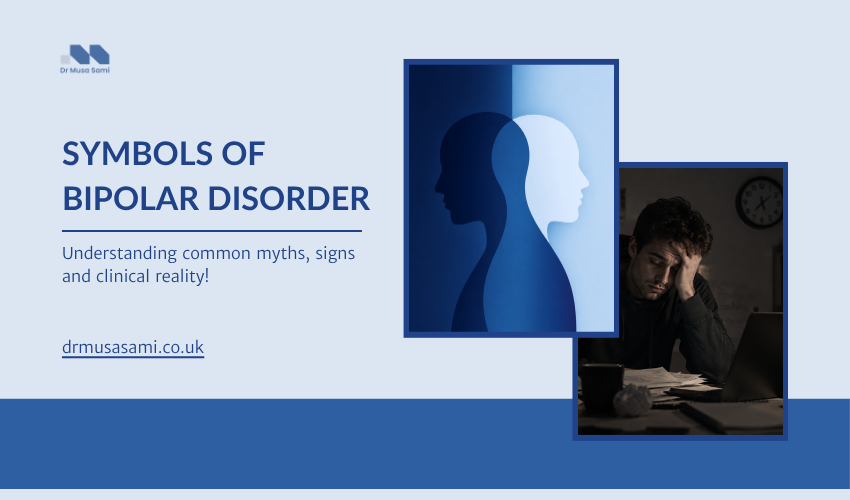
Symbols of Bipolar Disorder explained: discover what common symbols get right, where they create misconceptions, and what truly matters about understanding bipolar disorder.
Most people searching for “symbols of bipolar disorder” aren’t looking for a design lesson.
They’re looking for answers. A way to make sense of something complex, painful, and often invisible. And what they find online, split faces, yin-yang icons, half-sun-half-storm graphics, feels intuitive at first glance.
Here’s the problem: those symbols aren’t wrong, exactly. They’re just dangerously incomplete.
This article won’t tell you that visual metaphors are evil or that awareness campaigns are useless. What it will do is draw a clear line between what these symbols communicate and what bipolar disorder actually is, because confusing the two causes real harm.
By the end, you’ll understand why the symbolism exists, what it gets right, where it falls apart, and what clinical reality actually looks like. No hype. No oversimplification in the other direction. Just an honest assessment.
What Bipolar Disorder Actually Is (Before We Talk About What It Looks Like)
Let’s start with the clinical reality, because everything else follows from here.
Bipolar disorder is a mood disorder characterised by episodes of depression and periods of significantly elevated mood, known as mania or hypomania. It’s not a personality type. It’s not a character flaw. It’s a medical condition with biological, psychological, and social components.
Depressive episodes tend to involve persistent low mood, fatigue, reduced motivation, hopelessness, and social withdrawal. These aren’t just “sad days.” They’re clinical episodes that can last weeks or months and significantly impair daily functioning.
Manic and hypomanic episodes look very different: elevated or irritable mood, reduced need for sleep, racing thoughts, increased confidence, impulsivity, and dramatically elevated energy. Hypomania is less severe than full mania but still clinically significant.
Here’s the distinction that matters most: Bipolar I involves at least one full manic episode. Bipolar II involves major depressive episodes and hypomania, but never full mania.
That’s not a minor footnote. It changes the presentation, the risk profile, and the treatment approach entirely.
And then there’s everything in between, mixed features, rapid cycling, periods of stability, co-occurring anxiety, substance use difficulties, and attention-related challenges. The condition affects concentration, judgement, relationships, sleep, physical health, and work performance.
None of that fits neatly into a graphic with a sun on one side and a storm on the other.
Why Symbols Exist, And Why That’s Not Entirely a Bad Thing
Here’s the reality: mental health experiences are largely invisible.
You can photograph a broken leg. You can’t photograph a manic episode, or the particular exhaustion of a depressive phase, or the disorientation of coming out of one and trying to explain it to someone who’s never been there.
So symbols fill a gap. And when they’re used carefully, they do something genuinely useful: they create an entry point. They start conversations. They signal that a topic is worth discussing.
Common symbols associated with bipolar disorder include:
- Split-face or dual-expression imagery, showing contrasting emotions side by side
- Yin-yang style designs, representing opposing internal states
- Light-and-dark imagery, sunshine and storms, calm and chaos
- Contrasting colour schemes meant to convey mood variation and intensity
None of these are medically defined. There’s no officially recognised clinical symbol used to diagnose or define bipolar disorder. These are cultural and educational tools, not medical terminology.
Used well, they lower the barrier to engagement. Used carelessly, they become the whole story, and that’s where things go wrong.
Where Symbolic Representations Break Down
This is where most people get it wrong.
The most common visual representation of bipolar disorder, a face split between happiness and sadness, implies something specific: that bipolar disorder means switching between two fixed emotional states. Happy and sad. Up and down. On and off.
That’s not what bipolar disorder is.
Mood episodes exist along a spectrum. They vary in intensity, duration, and presentation. Symptoms fluctuate. Many people experience extended periods of stability between episodes, stability that symbolic imagery almost never depicts. Some people experience mixed features, where elements of mania and depression occur simultaneously. That doesn’t fit on either side of a split face.
Let’s be honest about what these images actually communicate: contrast and duality. Those themes capture something real. But they compress an enormously complex lived experience into a binary that doesn’t exist clinically.
And there are consequences to that compression.
The Stigma Problem Nobody Talks About
When simplified imagery is the dominant visual language for a condition, it shapes public understanding in ways that are hard to undo.
Here’s what happens in practice:
People internalise the “two moods” framework and then apply it when they encounter someone with bipolar disorder. They expect obvious extremes. They’re surprised by stability. They confuse mood episodes with personality characteristics, which is both clinically inaccurate and genuinely harmful to the people living with the condition.
Mood episodes are medical phenomena. They are not personality traits.
Some symbols unintentionally portray bipolar disorder as unpredictable, extreme, or frightening, without any of the context that explains the medical reality, the effectiveness of treatment, or the lived experience of the many people managing the condition well.
This reinforces stigma. And stigma delays help-seeking.
There’s a real cost to getting this wrong.
The Misconception That Causes the Most Damage
“Bipolar disorder means having two personalities.”
This comes up constantly, in casual conversation, in media coverage, in the comments sections of mental health posts. It conflates bipolar disorder (a mood disorder characterised by episodic changes in mood, energy, and thinking) with something entirely different: conditions involving identity disturbance or dissociative symptoms.
They are not the same condition. They are not even similar conditions.
Bipolar disorder is about mood episodes. Not personalities. Not identity switching. Mood episodes.
The confusion persists partly because of the imagery, dual faces, split representations, contrasting halves, and partly because of how the condition has been portrayed in films and television, where dramatic storytelling requires extreme versions of everything.
This is where media influence compounds the problem. Sensationalised portrayals emphasise extremes. They overlook the complexity, the periods of stability, the enormous range of presentations, and the reality that most people with bipolar disorder are not defined by their diagnosis.
What Clinical Diagnosis Actually Looks Like
Unlike symbols of bipolar disorder, diagnosis is not based on visual impressions or pattern recognition.
A proper psychiatric assessment examines mood history across months or years, not isolated snapshots. The clinician uses structured frameworks like ICD-11 or DSM-5 to evaluate symptom patterns, duration, severity, and the degree to which they impair functioning in work, relationships, and daily life.
Here’s what that process includes:
- A comprehensive psychiatric interview, exploring mood history, episode patterns, and relevant background
- Consideration of co-occurring conditions, anxiety, substance use, attention-related difficulties are common
- Functional assessment: how symptoms affect real-world performance
- Differential diagnosis: ruling out other conditions that can present similarly
No image, logo, or metaphor can replicate this process. Diagnosis requires clinical expertise, time, and a complete picture of the person, not pattern-matching against an awareness campaign graphic.
This matters because self-diagnosis based on symbolic representations or media portrayals is genuinely risky. It can lead to missed diagnoses, inappropriate self-management, and delayed access to treatments that actually work.
When Visual Metaphors Help, and When to Look Beyond Them
To be fair: symbolic representations aren’t without value.
When used carefully, in the context of accurate educational information, they can engage audiences who might otherwise disengage from mental health content entirely. Patient-led storytelling and lived experience often use imagery to communicate what words alone struggle to convey, and that has real value.
The problem is when symbols replace education rather than support it.
A sun-and-storm graphic that prompts someone to look into bipolar disorder and seek a proper assessment? Useful. The same graphic as a standalone explanation of what bipolar disorder is? A problem.
The bottom line: symbols are starting points. They’re not endpoints.
What to Do If You’re Concerned
Here’s the practical part.
If you’re experiencing persistent mood instability that’s affecting your daily life, whether that’s elevated periods involving reduced sleep, impulsive behaviour, and racing thoughts, or depressive episodes involving withdrawal, hopelessness, and loss of motivation, those symptoms warrant proper assessment.
Functional impairment is a key signal. Difficulties affecting work, relationships, education, or day-to-day coping shouldn’t be dismissed or managed in isolation.
Early psychiatric assessment can support accurate diagnosis and timely, appropriate treatment. In the UK, that process involves evaluation by a consultant psychiatrist using recognised clinical frameworks, not a checklist and not a visual metaphor.
If this resonates, that’s the clearest sign to seek a professional opinion rather than an online explanation.
Frequently Asked Questions
What are the common symbols associated with bipolar disorder?
The most widely recognised include split-face imagery, yin-yang designs, contrasting colour schemes, and light-versus-dark metaphors. These are cultural and educational representations, not medical ones.
Are these symbols medically accurate?
No. They’re artistic and educational tools. Bipolar disorder is diagnosed through comprehensive clinical assessment, not visual symbolism.
Why is bipolar disorder so often represented symbolically?
Because internal emotional experiences are difficult to visualise. Symbols offer a way to communicate emotional contrast and complexity to audiences unfamiliar with the clinical reality.
How is bipolar disorder actually diagnosed?
Through a psychiatric assessment that examines mood history, symptom patterns, duration, severity, and functional impact, using ICD-11 or DSM-5 diagnostic frameworks.
Can symbols help people understand mental illness?
Yes, as entry points. No, as complete explanations. They should always be accompanied by accurate clinical information.
The Key Takeaway
Symbols of bipolar disorder exist because emotional complexity is hard to communicate visually. When used well, they lower barriers and start conversations. That’s worth something.
But they compress a complex, varied, medically serious condition into a binary, and that compression has costs. It shapes public perception. It feeds stigma. It delays appropriate help-seeking.
The most useful thing anyone can do with these symbols is treat them as an opening question, not a final answer. Bipolar disorder is a real medical condition with real diagnostic criteria and real treatment pathways. Understanding it properly, beyond the split face and the storm cloud, is how we actually help the people living with it.