Bipolar Assessment UK: What It Actually Takes to Get the Right Diagnosis
July 2, 2026
How to Deal With Someone With Bipolar Disorder: Communication Strategies and Emotional Support
July 8, 2026Take a closer look at a Bipolar Test and understand what online screening tools can and can’t reveal about your symptoms. Learn how reliable they are and when to seek a professional diagnosis for bipolar disorder.
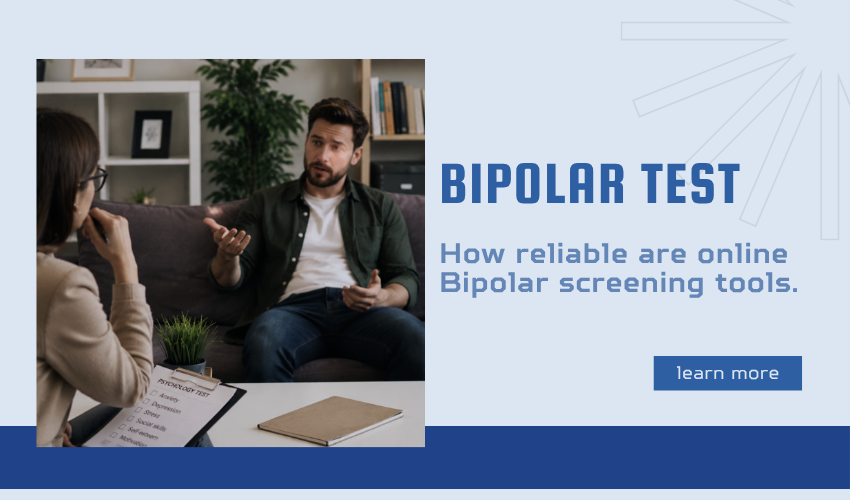
Here’s something most mental health websites won’t say upfront:
That online bipolar test you just took? It cannot diagnose you.
Not even close.
And yet, millions of people complete these questionnaires every year and walk away either panicking about a high score or feeling falsely reassured by a low one. Neither reaction is warranted. Neither is accurate.
Here’s what this article will give you: a clear, honest breakdown of what bipolar screening tools are, how they work, what they’re genuinely useful for, and exactly where they fall short. No miracle promises. No dramatic conclusions. Just the information you need to make a sensible next step.
What a Bipolar Test Actually Is (And What It Isn’t)
Let’s start with the basics.
An online bipolar test is a screening questionnaire, not a diagnostic tool. That distinction matters more than most people realise.
Screening means identifying people who may benefit from further assessment. It casts a wide net. Diagnosis is something else entirely: a comprehensive clinical evaluation conducted by a qualified healthcare professional, informed by your full history, symptom patterns, functioning, and context.
Most online bipolar tests take one of a few forms: symptom checklists, self-report questionnaires, mood assessment scales, or risk screening surveys. They typically ask about mood changes, energy levels, sleep patterns, behaviour, and emotional experiences.
Some are built on solid clinical foundations. Many are not.
This is where most people get it wrong, they assume that because a tool is on a reputable-looking website, it carries clinical weight. It doesn’t. The quality varies enormously, and we’ll come back to that.
How These Tests Work
The questions are designed to identify patterns associated with bipolar disorder, periods of unusually elevated mood, increased energy or activity, reduced need for sleep, impulsive behaviour, and episodes of depression.
Most tools use a scoring system that places you into a category: low, moderate, or high likelihood of bipolar-related symptoms. Higher scores may suggest that further assessment could be worth pursuing. Lower scores may indicate otherwise.
But here’s the crucial thing: a score is not a verdict.
The psychological frameworks behind these tools vary. Some incorporate elements derived from recognised clinical questionnaires used in actual healthcare settings. Others are cobbled together with no scientific validation whatsoever. There’s no universal standard, no regulatory oversight, and no requirement for accuracy.
What a Bipolar Test Can Genuinely Do For You
Despite all the caveats, these tools aren’t worthless. Used correctly, they serve a purpose.
A screening tool may help you notice patterns you hadn’t consciously registered, recurring periods of elevated mood, cycles of high energy followed by low periods, changes in sleep or behaviour that you’d normalised.
For some people, completing a structured questionnaire is the first time they’ve actually stopped and reflected on their emotional experiences in a methodical way. That reflection has value. It can surface concerns worth raising with a GP or psychiatrist.
It can also give you the push to seek help you might otherwise have delayed. If you’ve been sitting on concerns for months and a screening result confirms there’s something worth exploring, that’s useful, as a starting point.
What a Bipolar Test Cannot Do
This is where it matters.
A diagnosis of bipolar disorder requires far more than a questionnaire can capture. Mental health professionals evaluate symptom history, episode duration, severity, functional impact, family history, and numerous other factors before reaching any conclusion. That process cannot be replicated in ten questions online.
There are three major limitations you need to understand:
First, self-reported symptoms are inherently unreliable. You may unintentionally underestimate, overestimate, or misinterpret what you’re experiencing. That’s not a flaw in you, it’s a fundamental limitation of self-assessment.
Second, there’s no clinical context. Bipolar disorder is diagnosed based on patterns that develop over time. A questionnaire captures a snapshot. It doesn’t know what happened last year, or five years ago, or how your symptoms interact with your circumstances.
Third, online tools lack any mechanism for ruling out other conditions. Depression, anxiety disorders, ADHD, personality disorders, and substance-related difficulties can all produce symptoms that overlap significantly with bipolar disorder. A questionnaire can’t unpick that.
The bottom line: a bipolar test cannot diagnose you. Only a qualified clinician can.
Not All Bipolar Tests Are Equal, Here’s Why That Matters
Let’s be honest about the quality problem.
Validated screening tools have been developed and tested through proper clinical research. They’ve been assessed for reliability, validity, and usefulness in healthcare settings. When you use one of these, the results carry some legitimate meaning, not as a diagnosis, but as a structured indicator.
Non-validated tools lack that scientific foundation entirely. They may use different questions, different scoring systems, and different interpretations. That’s why the same person can get wildly different results from different websites.
If results vary across platforms, that’s not a glitch. It’s the point.
It illustrates exactly why these tools can only ever be a starting point. If a standardised clinical instrument can’t tell you whether you have bipolar disorder, a randomly assembled website quiz certainly can’t.
What Bipolar Disorder Actually Requires for Diagnosis
Understanding the clinical standard helps put online tools in their proper context.
Mental health professionals use internationally recognised diagnostic frameworks, the DSM-5 and ICD-11, when assessing bipolar disorder. These provide standardised criteria that require specific patterns of symptoms to be present, at a particular severity, for a defined duration, with measurable impact on daily functioning.
Manic and hypomanic episodes involve elevated or irritable mood, increased activity levels, reduced sleep requirements, racing thoughts, increased confidence, and impulsive behaviour. These aren’t just having a good week or feeling energetic.
Depressive episodes involve persistent low mood, loss of interest, fatigue, impaired concentration, and other symptoms lasting for a clinically significant period.
Critically, diagnosis depends not only on symptom type but on severity, duration, frequency, and the extent to which they impair your ability to function. A one-off period of high energy doesn’t meet the threshold. That’s an important distinction, and it’s one a questionnaire simply cannot assess.
Common Misunderstandings That Cause Real Problems
Here’s what nobody talks about openly enough.
Confusing a high score with a diagnosis is probably the most common mistake. A high-risk result means the tool has identified patterns that may warrant further exploration. That’s it. It does not confirm bipolar disorder.
Assuming a low score means you’re in the clear is equally problematic. False reassurance is a genuine risk here. Low scores do not rule out bipolar disorder or any other mental health condition. If you have real concerns, a low score shouldn’t stop you seeking assessment.
And then there’s the issue of normal mood variation. Everyone experiences fluctuations. Life events cause emotional responses. Not every period of elevated mood or low mood indicates a clinical condition. The question isn’t whether your mood changes, it’s whether those changes reach a particular threshold of severity, duration, and functional impairment.
Sound familiar? If you’ve been second-guessing a screening result in either direction, this is exactly why professional assessment exists.
Signs That May Indicate Professional Assessment Is Worth Considering
Online tools aside, there are concrete patterns worth paying attention to.
Recurring mood changes that meaningfully interfere with your work, relationships, or daily functioning deserve proper evaluation. Not mood changes in general, specific, recurring episodes that disrupt your ability to operate normally.
Periods of unusually high energy combined with behavioural changes, impulsivity, reduced sleep, grandiosity, poor decision-making, are worth taking seriously. So are persistent episodes of low mood, fatigue, loss of motivation, and social withdrawal.
If people close to you have raised concerns about your behaviour during certain periods, that’s clinically relevant. The people around you sometimes notice patterns you can’t see from the inside.
If symptoms feel overwhelming or difficult to manage, seeking help early improves outcomes. That’s not hype, it’s consistent evidence from clinical practice.
How Bipolar Disorder Is Actually Diagnosed
The clinical process looks substantially different from filling out an online form.
Diagnosis begins with a comprehensive psychiatric interview. A consultant psychiatrist takes a detailed history, symptoms, mood patterns, episode timelines, functional impact, personal circumstances, and relevant background. This isn’t a 15-minute conversation.
Family history matters too. Bipolar disorder has a recognised genetic component, and information from relatives or carers can help clarify patterns that are difficult to assess from self-report alone.
Clinicians also consider what else might explain the symptoms. Depression, anxiety, ADHD, personality disorders, physical health conditions, medications, and substance use can all produce presentations that overlap with bipolar disorder. Ruling these out, or understanding how they interact, is part of the diagnostic process.
Mood tracking over time provides additional valuable information. Patterns of mood, sleep, energy, and behaviour tracked across weeks and months tell a more complete story than any single assessment can.
In the UK, many people begin by discussing concerns with their GP, who may refer to specialist mental health services. Private psychiatric assessment is also available for those seeking faster access to a consultant psychiatrist.
The Real Value of Bipolar Tests, Used Correctly
Here’s the fair conclusion.
Online bipolar screening tools aren’t useless. They can prompt awareness, encourage reflection, and motivate people to seek help earlier than they otherwise would. That’s worth something.
But they need to be used for what they actually are: a starting point, not an answer.
If you’ve completed a bipolar test and found the results concerning, or if you’ve recognised patterns in yourself that feel persistent and significant, the right move is to discuss those concerns with a professional. A GP is a reasonable first step. A private psychiatric assessment offers more immediate, specialist-level evaluation.
What you shouldn’t do is use a screening result to either diagnose yourself or rule yourself out.
That’s not what these tools are for. And treating them as though they are will either cause unnecessary distress or delay you getting the right help.
Treatment and Support: What Comes After Assessment
For those who are assessed and diagnosed with bipolar disorder, the pathways are well-established.
NHS mental health services, community mental health teams, and specialist psychiatric clinics can all provide ongoing support. Medication, mood stabilisers, antipsychotics, or other evidence-based interventions, is often part of the treatment picture, depending on individual circumstances and the specific diagnosis.
Psychological therapies, including CBT, psychoeducation, and relapse prevention work, help people understand their condition, recognise early warning signs, and develop strategies for managing episodes. Long-term follow-up matters too: maintaining stability and reducing relapse risk requires ongoing monitoring, not just an initial intervention.
None of this starts without an accurate diagnosis. Which is precisely why skipping straight from a screening tool to self-managed treatment isn’t a viable path.
Frequently Asked Questions
Can an online bipolar test diagnose me?
No. An online bipolar test is a screening tool, not a diagnostic instrument. It can identify patterns that may warrant further exploration, but it cannot confirm or rule out a diagnosis of bipolar disorder. Only a qualified healthcare professional, such as a consultant psychiatrist, can do that through a comprehensive clinical assessment.
How accurate are online bipolar screening tools?
It depends entirely on the tool. Validated screening instruments, developed and tested through clinical research, carry some legitimate weight as indicators. Non-validated tools, and there are many, may have no scientific basis at all. Even the best-validated online tools have meaningful rates of false positives and false negatives, which is precisely why a professional assessment is always required.
I scored high on a bipolar test. Does that mean I have bipolar disorder?
Not necessarily. A high score means the tool has flagged patterns that may be worth discussing with a professional. It is not a diagnosis. Many conditions, including depression, anxiety, ADHD, and borderline personality disorder, can produce similar screening results. A psychiatrist will assess the full picture before drawing any conclusions.
I scored low on a bipolar test. Does that mean I definitely don’t have bipolar disorder?
No. A low score does not rule out bipolar disorder or any other mental health condition. If you have genuine concerns about your mental health, a low screening result should not stop you from seeking a professional assessment. False reassurance from an online tool is a real risk.
What’s the difference between bipolar disorder and normal mood swings?
Everyone experiences fluctuations in mood. The distinction lies in severity, duration, frequency, and functional impact. Bipolar disorder involves mood episodes, manic, hypomanic, or depressive, that meet specific clinical thresholds and meaningfully impair daily functioning. Normal emotional responses to life events don’t typically meet those criteria. A psychiatrist is best placed to make that distinction.
The Bottom Line
An online bipolar test may help you spot patterns worth exploring.
It cannot tell you whether you have bipolar disorder.
Only a qualified healthcare professional, working from a comprehensive assessment, your full history, and recognised diagnostic frameworks, can do that.
If you’re concerned about your mental health, use a screening tool as a prompt, not a conclusion. Then take that prompt to a professional who can actually help you understand what you’re dealing with. That’s the only path to an accurate answer.