
Understanding the Link Between Trauma And Workplace PTSD
April 6, 2026
Can PTSD Cause Memory Loss: What’s Actually Happening Inside Your Brain
April 9, 2026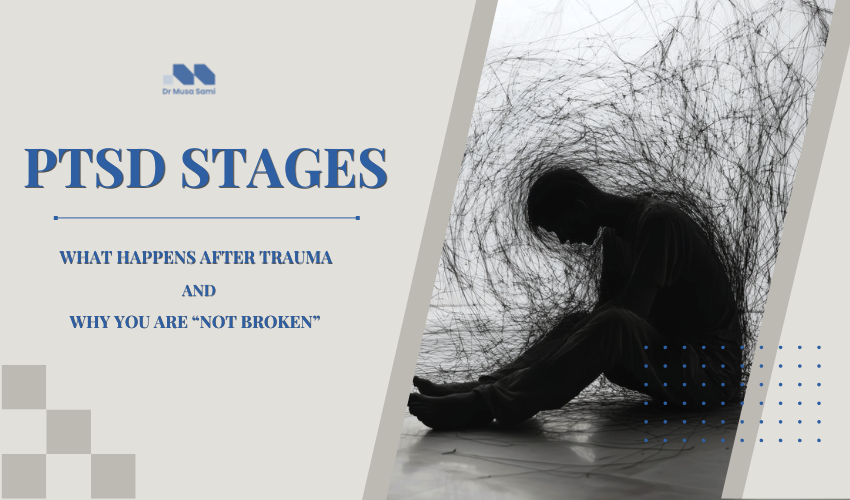
Discover the key PTSD Stages and what actually happens after trauma. Learn how symptoms develop, progress over time, and when to seek professional help. Here’s what nobody tells you about PTSD:
It doesn’t arrive fully formed the moment something terrible happens. It builds. It shifts. It sometimes disappears for months, then comes back without warning.
And if you don’t understand that, you’ll spend years wondering why you can’t just “move on.” This article won’t promise you a neat recovery timeline. What it will do is explain, clearly and honestly, how PTSD typically develops, so that whether you’re experiencing it yourself or trying to understand someone who is, the symptoms start to make sense instead of feeling like chaos.
What PTSD Actually Is (Not the Hollywood Version)
PTSD is a mental health condition that can develop after exposure to a traumatic event. Under both ICD-11 and DSM-5, the two main diagnostic frameworks clinicians use, it’s characterised by three core symptom clusters: re-experiencing the trauma, actively avoiding reminders of it, and a persistent sense of threat that keeps your nervous system on high alert.
That’s it. No dramatic flashbacks every scene. No inability to function in every area of life.
The reality is more nuanced.
PTSD can follow a wide range of experiences, physical or sexual assault, serious accidents, military combat, natural disasters, childhood abuse or neglect. But here’s the crucial thing: not every traumatic event leads to PTSD. Risk increases with repeated or prolonged trauma, limited social support, and pre-existing mental health conditions. It’s not about how “tough” you are. Genetics, brain chemistry, and prior life experience all play a role.
PTSD is also more common than most people assume. Yet many who have it spend years not knowing that’s what they’re dealing with.
Why “Stages” of PTSD? And Why They’re Not a Checklist
Clinicians often describe PTSD in stages or phases to help make sense of symptom development. Here’s the truth about those stages:
They’re a framework, not a fixed sequence.
Official diagnostic manuals don’t define rigid PTSD stages. The stage model exists because it’s genuinely useful, it gives people language to describe what they’re going through, and it helps clinicians understand where someone might be in their experience.
But real PTSD doesn’t follow a script. Stages overlap. They skip. They come back. Someone might jump straight from the initial shock into chronic hyperarousal without ever showing much avoidance. Someone else might live in Stage 2 for a decade before a life change brings everything flooding back.
Here’s why this matters: many people dealing with PTSD blame themselves for not “recovering correctly.” Understanding the fluid nature of PTSD stages can strip a lot of that self-blame away. Your symptoms aren’t a sign of weakness, they’re a sign that your brain is responding to overwhelming experience in the only way it knows how.
Stage One, Impact and Acute Stress Response
In the hours and days immediately after trauma, the brain is overwhelmed.
It hasn’t yet been able to process what happened. So it does what it’s designed to do: it floods the system with stress hormones and keeps you on high alert. The result is confusion, emotional numbness, difficulty sleeping, intrusive thoughts, anxiety, and what can feel like emotional instability.
This is not PTSD yet. This is your nervous system doing its job.
These acute stress reactions are normal and often resolve naturally within a few weeks. When they don’t, when symptoms persist beyond that window and begin to interfere with daily life, clinicians may diagnose acute stress disorder. This can be an early warning sign that PTSD may be developing.
Most people never progress beyond this stage. But for some, the symptoms don’t fade. They shift.
Stage Two, Denial, Avoidance, and Emotional Numbing
This is where the mind gets protective.
If facing the trauma is too overwhelming, the brain creates distance from it. Suddenly, you’re avoiding places, people, thoughts, or situations that remind you of what happened. You might not even fully realise you’re doing it.
This stage often looks like disconnection from the outside. People in it frequently describe:
Feeling emotionally “flat,” a loss of interest in things they used to care about, and a creeping sense of detachment from other people, even those they love.
It makes sense as a short-term survival strategy. The problem is what happens when it becomes the default mode.
Avoidance doesn’t process trauma, it postpones it. And it actively prevents people from recognising that they need help, because if you’re not letting yourself think about the event, you’re also not connecting the dots between that event and how you’re currently feeling.
This is where most people get it wrong, mistaking numbness for healing.
Stage Three, Intrusion and Re-Experiencing
At some point, the avoidance stops working.
This is often the most distressing of all the PTSD stages, because it’s the one that feels most out of control. Flashbacks. Nightmares. Unwanted memories that surface at random moments, in the supermarket, in a meeting, lying in bed.
Here’s the neurological reality: the brain’s threat-detection system has become hypersensitive. Neutral cues, a smell, a sound, a time of year, get tagged as dangerous because they’ve been associated with the original trauma. When those cues appear, the brain reacts as though the danger is present right now.
The result is a sense of losing control over your own mind.
That feeling, the sense that intrusive symptoms are happening to you rather than by you, is a defining feature of this stage. And it’s one of the most potent sources of secondary anxiety: you start to fear the symptoms themselves.
Stage Four, Hyperarousal and Heightened Threat Response
The body remains permanently braced for danger.
Clinically, this is called hyperarousal: a sustained state of heightened physiological alertness. For the person experiencing it, it feels like being unable to switch off.
Constant scanning for threats. Difficulty relaxing, even in objectively safe situations. Poor sleep, lying awake, waking suddenly, never reaching deep rest. Irritability that flares into anger with little warning. Difficulty managing even ordinary stress.
This is exhausting in a way that’s hard to communicate to people who haven’t experienced it. Because it doesn’t look like anything from the outside. You might appear fine. Functional. Maybe even calm.
Over time, chronic hyperarousal takes a physical toll. Fatigue, cardiovascular strain, a weakened immune system, the body isn’t built to run its emergency systems indefinitely.
Stage Five, Secondary Consequences and Cumulative Impact
When PTSD goes untreated, the effects ripple outward.
Relationships strain under the weight of emotional dysregulation, avoidance, and withdrawal. Work performance drops. Social withdrawal deepens. And the longer symptoms persist, the more likely it is that secondary conditions develop alongside PTSD, depression, generalised anxiety, panic disorder.
Some people turn to alcohol or drugs to get through. That’s not a moral failure. It’s a coping mechanism, one that creates its own serious complications and tends to delay recovery significantly.
This is the stage where the cumulative cost of untreated trauma becomes impossible to ignore.
Complex PTSD, When the Stages Look Different
Standard PTSD stages describe what typically happens after a single traumatic event or a discrete period of trauma.
Complex PTSD (C-PTSD) develops from something different: prolonged, repeated trauma, often in contexts where escape wasn’t possible, like childhood abuse, domestic violence, or prolonged captivity.
C-PTSD doesn’t follow the typical pattern. It tends to show up as deep, chronic difficulties with emotional regulation, persistent feelings of shame or worthlessness, profound disruptions to self-identity, and serious difficulties forming or maintaining relationships.
Let’s be honest: C-PTSD is often harder to recognise and harder to diagnose. Its symptoms overlap with personality disorders, depression, and other conditions. Many people carrying it have been misdiagnosed multiple times. This matters because the treatment approach is different, more complex, often longer, and requiring specific trauma expertise.
What Shapes How PTSD Develops
Not everyone exposed to the same trauma develops PTSD. And among those who do, the progression varies significantly.
Social support is one of the most powerful moderating factors, a strong network of relationships can meaningfully reduce both the severity and duration of PTSD symptoms.
Prior trauma history cuts both ways: it can increase vulnerability, but it can also, depending on how previous experiences were processed, build a degree of resilience.
Biological factors matter too. Genetics, the structure and function of the amygdala and prefrontal cortex, and baseline neurochemistry all influence how the brain responds to traumatic stress.
None of this is about blame. It’s about understanding that PTSD isn’t arbitrary.
The Misunderstandings That Keep People Stuck
Misconception one: PTSD stages follow a fixed order.
They don’t. Symptoms overlap, skip stages, and reappear. Someone can be in a period of apparent calm and then be thrown back into intrusion or hyperarousal by a new life stressor.
Misconception two: If symptoms disappear, they won’t come back.
Delayed-onset PTSD is real. Some individuals show no significant symptoms until months or even years after the original trauma, then something shifts and the symptoms emerge. This isn’t unusual. It doesn’t mean something new has gone wrong.
Misconception three: Symptom fluctuation means you’re not getting better.
Recovery from PTSD is rarely linear. A bad week doesn’t erase progress. Understanding that fluctuation is part of the process, not evidence of failure, is one of the most important shifts a person can make.
Sound familiar?
When It’s Time to Get a Professional Assessment
If any of these apply, it may be worth speaking to a GP or mental health professional:
Symptoms have persisted for several weeks or months. They’re interfering with your daily life, work, relationships, or your ability to function. They’re causing significant distress, regardless of how they look from the outside.
Early intervention changes outcomes. Significantly. This isn’t a cliché, it’s one of the most consistent findings in the trauma literature. The sooner appropriate support is in place, the less likely PTSD is to become chronic.
Seeking help doesn’t require certainty. You don’t need to be sure you have PTSD before you talk to someone.
What Treatment Actually Looks Like at Different Stages
Treatment approaches for PTSD aren’t one-size-fits-all, they shift depending on where someone is.
In early or acute stages, the focus is on stabilisation: emotional regulation, building a sense of safety, developing practical coping strategies. This isn’t about diving into the trauma, it’s about building the foundation that makes deeper work possible.
For processing traumatic memory, two therapies have the strongest evidence base: Trauma-Focused Cognitive Behavioural Therapy (TF-CBT) and Eye Movement Desensitisation and Reprocessing (EMDR). Both are specifically designed to help the brain reprocess traumatic memories so they stop generating automatic threat responses.
For complex or chronic presentations, particularly C-PTSD, longer-term therapeutic support is often necessary. This addresses not just the trauma itself but the deeper patterns that have formed around it over time.
Frequently Asked Questions
What are the main PTSD stages?
The commonly described stages run from initial impact and acute stress response, through avoidance and emotional numbing, into intrusion and re-experiencing, hyperarousal, and finally the broader secondary effects on daily life. These stages are not strictly linear and often overlap.
How long do PTSD stages last?
It varies significantly. Some people move through early stages within weeks. Others experience symptoms for months or years. Social support, early intervention, and the nature of the original trauma all affect the timeline.
Can PTSD appear months or years after the trauma?
Yes. Delayed-onset PTSD is a documented clinical reality. In some cases, noticeable symptoms don’t emerge until well after the traumatic event. This is still considered part of the broader PTSD pattern.
Does everyone experience every stage?
No. Some people primarily struggle with avoidance. Others experience hyperarousal without much intrusion. Each person’s experience is unique, which is part of why early professional assessment matters.
Can PTSD improve without treatment?
Some individuals see a natural reduction in symptoms over time, particularly in early stages. But without appropriate support, symptoms can persist or worsen. Evidence-based therapies are highly effective; not seeking help is rarely the better gamble.
The Bottom Line
PTSD is not a character flaw. It’s not a sign that you’re broken or weak or failing to recover properly.
It’s a condition with recognisable patterns, patterns that, once understood, make a lot of frightening and confusing experiences start to make sense.
The stages described here aren’t a checklist. They’re a map. And like any map, they’re useful not because they tell you exactly where you’ll go, but because they help you figure out where you are, and what the next step might be. If you’re recognising yourself in any of this: early intervention works. Getting support is not giving up. It’s the most practical thing you can do.