
Private ADHD Diagnosis UK Cost: What You’re Actually Paying For (And What Nobody Tells You)
September 7, 2026
ADHD vs ADD: Why You’ve Been Confused About the Difference (And What’s Actually True)
September 13, 2026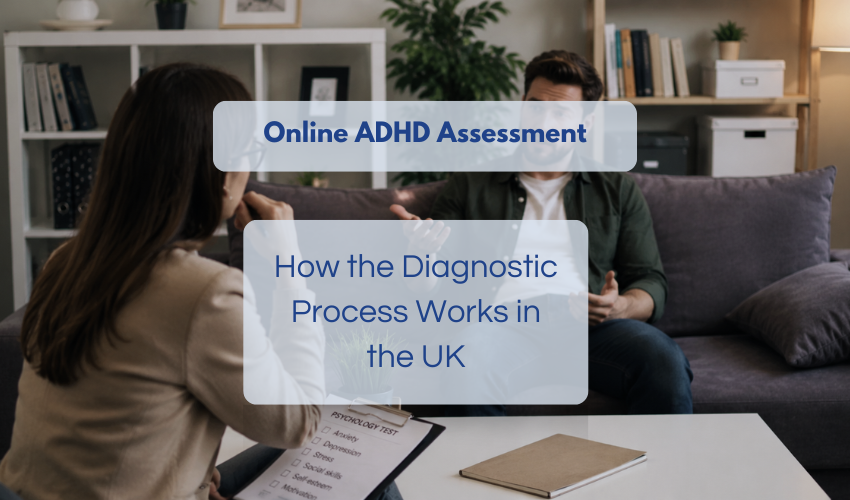
Here’s what nobody tells you about online ADHD assessment:
Most people assume “online” means “less legitimate.” Or they assume it means “just a quiz.” Neither is true, and neither is the full picture either.
Let’s be honest about what’s actually going on. ADHD affects attention, impulsivity, organisation, emotional regulation, and your ability to function day to day. Some people notice it in childhood. Others don’t connect the dots until years later, often after a lifetime of wondering why everything feels harder than it should.
So people search for an Online ADHD Assessment hoping for clarity. Fair enough.
But here’s the distinction that matters most, and the one most people miss entirely:
A professional Online assessment and a five-minute internet quiz are not the same thing. Not even close.
A real clinical assessment involves an appropriately qualified healthcare professional, clinical interviews, developmental history, questionnaires, and a genuine look at how your symptoms affect your actual life. An automated online test can’t diagnose anything. It can only flag a pattern.
For some people, Online assessment is a genuinely practical option. But here’s the catch: the quality of an assessment comes down to the clinician and the process, not whether you’re sitting in a waiting room or on your sofa. This article breaks down exactly how the process works, so you can decide whether it’s right for you.
What Is an Online ADHD Assessment, Really?
The Actual Purpose
An ADHD assessment isn’t there to confirm that you occasionally lose your keys or zone out in meetings. Everyone does that sometimes.
Here’s what it’s actually checking: whether there’s a persistent pattern of symptoms consistent with ADHD, and how significantly that pattern affects your everyday functioning.
Because here’s the truth, attention difficulties can come from a dozen different places. Stress. Anxiety. Poor sleep. Depression. Life just being a lot right now.
A proper assessment considers all of it. That’s the point.
An Online ADHD Assessment can help you understand how these difficulties are showing up, at work, in education, in relationships, in the basic business of running your life. And critically: not everyone who books an assessment walks away with an ADHD diagnosis. A comprehensive process looks at alternative explanations too. That’s not a failure of the process, that’s the process working.
Online ADHD Assessments vs. Online ADHD Tests, Let’s Separate the Two
These get used interchangeably. They shouldn’t be.
An online screening questionnaire asks about common ADHD-related experiences, distractibility, forgetfulness, impulsivity, difficulty finishing tasks. Useful for spotting a pattern. Not useful for a diagnosis.
A remote clinical assessment is a different animal entirely. It typically involves a detailed interview with a qualified clinician, structured diagnostic tools, your developmental history, and a real look at how symptoms show up across different areas of your life.
The clinician weighs all of this in context. A questionnaire just spits out a score.
Who’s Actually Allowed to Do This?
A professional online ADHD assessment should be conducted by appropriately qualified healthcare professionals with relevant training. Depending on your age and situation, that might include:
- Psychiatrists
- Clinical psychologists
- Specialist ADHD clinicians working within their scope of practice
Here’s what this means for you: before you book anything, find out who’s actually running the assessment, what experience they have, and how the process is structured. This isn’t a box-ticking exercise, it’s the single biggest factor in whether the assessment means anything.
Why Do People Choose Online Over In-Person?
It’s Accessible, But That’s Not the Whole Story
Remote appointments cut out a lot of the practical friction of attending a clinic in person.
If you live far from specialist services, deal with mobility difficulties, or find travelling genuinely difficult, an Online ADHD Assessment can remove a real barrier. Some people also find it easier to open up from a familiar environment rather than an unfamiliar clinical one.
Less travel time also means it’s easier to fit around work, education, or family life.
But here’s the honest caveat: online ADHD assessment isn’t automatically the right fit for every person or every clinical situation. What matters is what fits your circumstances.
More Scheduling Flexibility
Depending on the provider, online services can offer more flexibility around appointment times, and remove geographical limits on which specialists you can actually see.
That doesn’t mean every online service delivers the same quality or availability. The bottom line: understand how the provider runs its assessments and what support exists afterward, before you commit.
You’ve Been Living With This for Years and Want Answers
A lot of people seeking assessment have been dealing with this for a long time without ever understanding why.
Sound familiar? Common experiences include:
- Difficulty sustaining attention
- Chronic procrastination
- Struggles with organisation
- Forgetfulness
- Impulsive decisions
- Difficulty managing responsibilities
- Emotional regulation difficulties
Some adults only start exploring ADHD after noticing a pattern that’s quietly shaped their education, career, or relationships for years. Others start looking into it after a child or family member gets diagnosed, and suddenly a lot of their own experiences click into place.
How Does an Online ADHD Assessment Actually Work?
Step 1, Initial Consultation and Information Gathering
The process usually starts with a conversation about why you’re seeking assessment in the first place.
The clinician will ask about your current symptoms and how they play out in daily life, along with relevant personal, medical, and mental health history. The goal here isn’t to tick off symptoms, it’s to understand your experience in context.
Depending on the provider, some of this information might be gathered through forms before the main appointment even happens.
Step 2, ADHD Screening Questionnaires
Questionnaires and rating scales usually form part of the process. These help structure the information, and depending on the situation, may be completed by you, or by parents, partners, teachers, or others who know you well.
They typically explore:
- Attention
- Impulsivity
- Hyperactivity
- Organisation
- Emotional regulation
- Functional difficulties
Here’s the truth: the results are supporting information. A questionnaire alone can’t tell you whether you have ADHD.
Step 3, The Clinical Interview
This is the core of the assessment.
During a video consultation, expect the clinician to explore:
- Current ADHD-related symptoms
- Childhood experiences
- Developmental history
- School or education history
- Employment history
- Relationships
- Daily routines
- Functional difficulties
Here’s why childhood comes up so much, even in an adult assessment: ADHD is a neurodevelopmental condition. Clinicians need to know whether relevant symptoms were present growing up, even if you’re being assessed decades later.
The clinician will also explore whether anxiety, depression, sleep problems, trauma, autism spectrum differences, or other factors could be part of the picture. This is clinical judgement at work, not a checklist being worked through mechanically.
Step 4, Diagnostic Review and Feedback
After the assessment, the clinician reviews everything and considers whether the diagnostic criteria for ADHD are actually met.
You’ll usually get this outcome in a feedback appointment, or however the provider structures it. Expect the clinician to explain:
- Whether ADHD diagnostic criteria are met
- Which symptoms were identified
- How those symptoms affect daily functioning
- Whether other factors need considering
- Recommendations for support going forward
Depending on the provider, a written diagnostic report may follow.
What Information Do You Actually Need to Bring?
Childhood History and Developmental Information
Understanding your childhood matters here. Expect questions about early behaviour, school experiences, concentration, activity levels, and how you handled instructions and organisation as a kid.
Useful sources might include:
- School reports
- Childhood memories
- Observations from parents or family
- Previous assessments
Here’s some reassurance: you don’t need perfect recall of your childhood. Clinicians know historical information is often incomplete, and they work with whatever’s available.
Current Symptoms and Daily Functioning
The assessment also looks at how symptoms are affecting your life right now, work, education, appointments, household responsibilities, relationships, routines, planning, and emotional regulation.
Symptoms alone aren’t the whole story. How much they actually affect your functioning matters just as much.
Additional Information From Family or Professionals
Sometimes another person’s perspective adds real value, parents, partners, teachers, other family members, or relevant professionals.
For children and young people especially, parent and school input carries real weight, since symptoms need to be considered across different environments. That said, this isn’t always necessary or available for every assessment. The clinician will decide what’s appropriate for your situation.
Is an Online ADHD Assessment Actually Accurate?
Clinical Standards Are What Matter, Not the Location
Here’s the truth most people get backwards: accuracy comes down to the quality of the clinical process, not whether the appointment happens on Zoom or in an office.
What actually matters:
- Appropriate clinician qualifications
- Relevant ADHD assessment experience
- Use of recognised diagnostic criteria
- A comprehensive clinical interview
- Consideration of developmental history
- Assessment of functional impact
- Exploration of alternative explanations
A well-conducted Online ADHD assessment can follow the exact same clinical principles as an in-person one, when remote assessment is the right fit for the individual.
The Real Strengths of Online ADHD Assessment
- Easier access to specialists
- Less travel required
- More geographical flexibility
- Comfort of a familiar environment
- Less disruption to work or family life
For a lot of people, these practical benefits are the difference between seeking help and putting it off indefinitely.
The Real Limitations, Too
Let’s not pretend it’s perfect.
Tech problems can derail an appointment. Some people find it harder to open up over a video call than in person. In more complex cases, a clinician might need more information, or decide an in-person appointment is genuinely the better call. Some observations simply can’t be made remotely.
This is why suitability gets assessed individually. One format isn’t automatically right for everyone.
Online vs. Face-to-Face: What’s Actually Different?
What Stays the Same
Whether it’s remote or in-person, a proper ADHD assessment should involve:
- Clinical interviews
- Symptom questionnaires
- Developmental history
- Input from other people where relevant
- Consideration of daily functioning
- Diagnostic review
Both formats need real clinical judgement behind them, not just a score from a questionnaire.
What’s Actually Different
The obvious one: location. Online happens over secure video. Face-to-face happens in a clinical setting.
Online can mean less travel and more convenience. In-person might suit you better if you’re more comfortable speaking directly with someone, or if your situation genuinely calls for physical attendance.
Personal preference plays a real role here too.
How to Choose
Worth weighing:
- Personal preference
- Access to reliable tech
- Privacy at home
- Travel difficulties
- Clinical complexity
- Provider availability
Here’s the bottom line: there’s no universally “best” format. What matters is that the assessment itself is thorough, appropriate, and run by someone properly qualified to do it.
Assessments for Adults vs. Children
Adults
Most adults come to this after recognising a pattern that’s shaped years of their life, missed deadlines, struggles staying organised, trouble concentrating in meetings, unfinished tasks, strained relationships.
Adults have often also built coping strategies along the way. A good assessment explores both sides: the difficulties and the workarounds you’ve developed to manage them.
Children
Online ADHD assessment for children brings extra considerations. Parents or carers usually provide developmental information, while schools contribute observations on behaviour and learning.
The assessment typically looks at how symptoms show up differently across home, school, and social settings. Whether remote assessment is even appropriate for a child depends on their age, individual needs, and the provider’s approach.
Age-Appropriate Assessment Matters
Children, teenagers, and adults experience ADHD differently, so the assessment approach should flex accordingly.
For younger children, parents, carers, and schools carry a lot of the weight. Adults tend to provide more detail on their own lived experience, though childhood evidence still matters. An Online ADHD Assessment should be built around the individual, not a one-size-fits-all template.
What Happens After Diagnosis?
Understanding the Outcome
A diagnosis can help some people finally make sense of patterns that have shaped huge parts of their life. For others, the assessment points to a different explanation entirely.
Either way, the clinician should walk you through the findings and what comes next.
Here’s the truth: a diagnosis isn’t just a label. It’s a framework, one that helps you understand your difficulties and identify the right kind of support.
Treatment and Support Options
Support after diagnosis varies person to person. Possible approaches include:
- Medication, where clinically appropriate
- Psychological support
- Behavioural strategies
- Organisational support
- Workplace adjustments
- Educational support
There’s no single right answer here. Treatment decisions should reflect your symptoms, health, circumstances, and personal preferences.
Ongoing Care
Some people need follow-up appointments after diagnosis, reviewing treatment, monitoring medication, or working through practical strategies.
Before you even start, it’s worth asking what follow-up support is included and whether additional appointments come with the service.
Let’s Kill the Common Myths
“It’s Just a Questionnaire”
No. A real assessment goes far beyond filling in a form.
Rating scales contribute useful information, but diagnosis requires clinical interpretation, your history, symptoms, daily functioning, and other possible explanations, all considered together.
“Online Can’t Possibly Be Reliable”
Reliability comes down to clinical standards, not the physical location of the appointment.
A remote assessment run by an appropriately qualified professional, using a structured and comprehensive process, can be a perfectly suitable diagnostic route, when remote assessment is clinically appropriate. That said, some individuals will need more information gathered, or an in-person assessment.
“A Positive Screening Result Means I Have ADHD”
It doesn’t. A positive screening result flags that certain symptoms may be present and that further assessment could help.
Similar symptoms can show up in other conditions, or during periods of stress and emotional difficulty. This is exactly why professional assessment matters, it interprets symptoms within your wider clinical and developmental history, rather than taking them at face value.
How to Actually Prepare
Gather This Before Your Appointment
- Examples of current difficulties
- Relevant medical history
- Previous mental health assessments
- Childhood information
- Old school reports, if you have them
- Details of difficulties at work or in education
It also helps to think through when symptoms first became noticeable and how they’ve shaped different parts of your life.
Set Up the Right Environment
A remote appointment works best with:
- A reliable internet connection
- A device suited to video calls
- A private, quiet space
- Minimal interruptions
Give yourself time before and after so you’re not rushing in or straight back out.
Prepare Your Questions
Worth asking upfront:
- What does the assessment process actually involve?
- What information is required?
- How are diagnostic decisions made?
- What happens afterward?
- What treatment or support options are available?
- Is a written report provided?
- What follow-up arrangements exist?
Knowing the answers upfront means you walk in prepared, and walk out able to make an informed decision about your own care.
Frequently Asked Questions
Can you get an ADHD diagnosis through an online assessment in the UK?
Yes, an appropriately qualified clinician can conduct an ADHD assessment remotely, when it’s suitable for the individual and clinical circumstances. A diagnosis should come from a comprehensive professional assessment, not an automated test or questionnaire alone.
Is an online ADHD assessment the same as an online ADHD test?
No. An online ADHD test is a screening questionnaire designed to flag possible symptoms. A professional remote assessment involves clinical evaluation, developmental history, discussion of functional difficulties, and diagnostic interpretation by a qualified clinician.
Are online ADHD assessments recognised in the UK?
What matters is whether the assessment was carried out appropriately, by a suitably qualified professional, using recognised clinical standards. Before booking, find out the clinician’s qualifications, the assessment process, and what documentation you’ll receive.
How long does an online ADHD assessment take?
It varies by age, individual circumstances, and the provider’s structure. Some involve information gathering before the main appointment; others involve more than one consultation. Complex cases may need extra time or supporting information.
Can children have an online ADHD assessment?
Yes, through some specialist providers, depending on the child’s age and circumstances. Parent involvement, developmental history, and school feedback typically play an important role.
Key Takeaways
An Online ADHD Assessment Is a Structured Clinical Process, Not a Quiz Done properly, it involves professional clinical evaluation, structured information gathering, and real consideration of your developmental history and current functioning.
Convenience Doesn’t Replace Clinical Quality Being able to attend from home is a bonus, not a substitute for a thorough assessment. The clinician’s qualifications, experience, and methods matter far more than whether you’re on a screen or in a room.
Understanding Your Options Lets You Decide With Confidence Remote assessment can be a genuinely practical route for exploring possible ADHD symptoms. But the right pathway depends on your circumstances, your clinical needs, and your own preferences.
Whichever route you choose, online or face-to-face, what matters is getting assessed by someone properly qualified to give you real answers.