Is Bipolar Disorder a Disability UK? Here’s What the Law Actually Says
June 17, 2026
Bipolar Disorder in the UK: What It Actually Is, How It Gets Diagnosed, and What Managing It Really Looks Like
June 23, 2026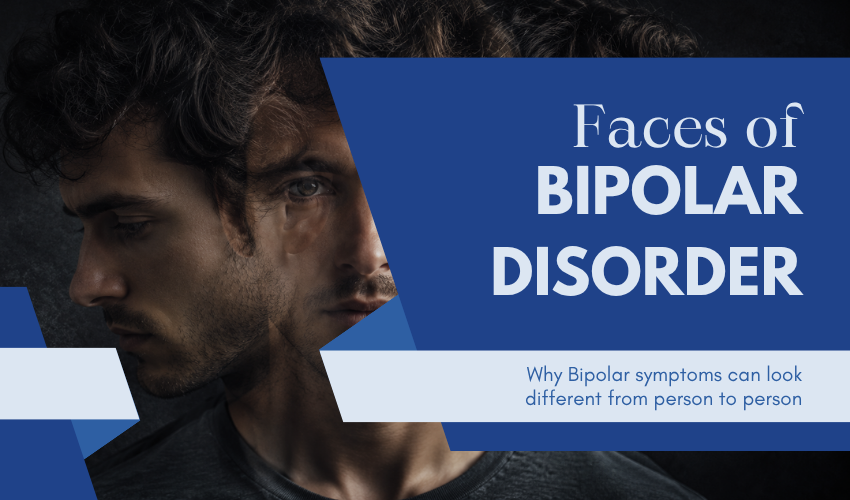
Faces of Bipolar Disorder can vary widely from person to person. Learn how symptoms, mood episodes, and experiences differ, and why understanding these variations is important for accurate diagnosis and support.
Here’s what most people get wrong about bipolar disorder:
They think they’d recognise it. Dramatic mood swings. One day on top of the world, the next day unable to get out of bed. Obvious. Unmistakable.
The reality? A lot of people with bipolar disorder go years, sometimes decades, without a correct diagnosis. Not because the condition is rare. Because it rarely looks the way people expect it to.
This article won’t tell you what bipolar disorder “looks like.” It’ll show you why that question misses the point entirely.
Bipolar Disorder Isn’t What You Think It Is
Let’s start with the basics, and then immediately complicate them.
Bipolar disorder is a long-term mental health condition characterised by distinct episodes of depression and elevated mood (mania or hypomania). It’s classified as a mood disorder, but that label doesn’t begin to capture what it actually does to a person’s life.
Here’s what most people miss: these aren’t just “bad days” and “good days.” They’re clinically recognised states that alter how a person thinks, functions, and experiences the world, sometimes for weeks or months at a time.
During a depressive episode, someone might feel so exhausted and hopeless they can’t hold a conversation. During a manic episode, that same person might go three days without sleep, make three impulsive financial decisions, and feel completely fine about all of it.
That gap between episodes, and the wildly different forms each episode can take, is what makes this condition so difficult to pin down.
It’s also why it affects each person so differently.
The Different Types of Bipolar Disorder, and Why They Matter
Bipolar disorder isn’t one thing. Bipolar Disorder is a spectrum, and the different presentations have different names for good reason.
Bipolar I is defined by at least one full manic episode. These can be severe, elevated or irritable mood, reduced need for sleep, racing thoughts, impulsive behaviour, sometimes grandiosity or psychosis. Depressive episodes often occur too, but mania is the diagnostic marker. In serious cases, hospitalisation may be needed.
Bipolar II is frequently misunderstood as the “milder” version. It’s not. The distinction is that Bipolar II involves hypomania, a less severe elevated state, rather than full mania. But the depressive episodes in Bipolar II can be long, deep, and seriously disabling. People often don’t get help because the hypomanic phases feel normal, even productive. They don’t realise it’s part of a condition.
Cyclothymic disorder involves chronic mood instability over at least two years, fluctuations that don’t meet full criteria for major depression or mania, but still create real disruption to daily functioning and relationships.
And then there are presentations that don’t fit neatly into any of these boxes.
Here’s the truth: the clinical categories are a framework, not a complete picture. Real people often sit between the lines.
Why Bipolar Disorder Looks Different in Every Person
This is where it gets genuinely important.
Same condition. Completely different presentations. Here’s why.
Personality shapes how symptoms show up. An introverted person might become almost invisible during a depressive episode, withdrawing entirely from social contact. An extroverted person might become explosive or erratic during hypomania. Same underlying process. Completely different external appearance.
Age changes everything. In adolescents, bipolar disorder often looks like irritability, behavioural disruption, and emotional volatility, things that are easy to dismiss as “just being a teenager.” In older adults, symptoms can be mistaken for cognitive decline or early dementia. In working adults, episodes often get labelled as “burnout” or “work stress” before anyone thinks to look deeper.
Gender influences how symptoms are recognised and reported. Some research suggests women are more frequently diagnosed with Bipolar II, while men may present earlier with more severe manic episodes. These are patterns, not rules, individual experience will always vary.
Culture affects how symptoms are expressed and whether they get disclosed. In some cultural contexts, mental health struggles are communicated through physical symptoms rather than emotional language. Stigma stops people from describing what’s actually happening. Both factors delay accurate diagnosis.
Life circumstances determine what’s visible. Someone with significant responsibilities, a demanding job, young children, financial pressure, may mask symptoms through sheer necessity. Someone with more flexibility may have an easier time identifying and naming what they’re experiencing.
Sound familiar? This is exactly why there’s no single “face” of bipolar disorder.
The Symptoms, What’s Actually Happening
During a depressive episode, someone may experience persistent low mood, loss of interest in things they normally enjoy, fatigue, feelings of hopelessness or guilt, changes in appetite or sleep, and difficulty concentrating. These symptoms range from mild to severe and can make even basic tasks feel impossible.
During a manic episode, the picture shifts: elevated or irritable mood, significantly reduced need for sleep, increased activity, overconfidence, impulsive decision-making, rapid speech or thoughts. In severe cases, mania can include psychotic symptoms like delusions or hallucinations.
Hypomanic episodes look like a less intense version of mania. The person feels energised and productive. Others might notice they’re talking more, sleeping less, taking on more projects. Because it can feel good, it often doesn’t register as a problem, until it escalates or crashes into depression.
Mixed features are among the most misunderstood. This is where symptoms of depression and mania occur at the same time, high energy combined with low mood, or agitation alongside hopelessness. It’s disorienting, it’s distressing, and it makes diagnosis significantly more complex.
The Presentations Nobody Talks About
This is where most people get it wrong.
The bipolar disorder most people picture involves obvious euphoria, someone flying high, spending wildly, sleeping four hours and feeling great. But that’s only one version.
Irritability instead of euphoria. For many people, mania or hypomania doesn’t feel like happiness. It feels like anger. Agitation. A short fuse. Everything feels urgent and frustrating. This gets misread as a personality flaw or relationship problem, not a mood episode.
High-functioning presentations. Some people maintain successful careers, stable relationships, and a polished exterior while experiencing significant internal upheaval. Their mood cycles may be invisible to colleagues, friends, even family. The cost of that maintenance, the exhaustion, the constant management, is real, but it happens behind closed doors.
Anxiety as the dominant feature. Anxiety disorders and bipolar disorder frequently co-occur. In some cases, anxiety dominates the clinical picture so completely that the underlying mood disorder goes unrecognised for years.
Emotional intensity mistaken for personality. Rapid shifts in emotional state, intense reactions, difficulty regulating feelings, these can look like emotional dysregulation or personality traits rather than symptoms of a mood disorder. The distinction matters, because the treatment approach is different.
Why Diagnosis Takes Time (And Why That’s Not a Failure)
Let’s be honest: bipolar disorder is one of the hardest conditions to diagnose accurately.
It shares features with depression, anxiety disorders, ADHD, and personality disorders. Someone presenting primarily with depressive episodes may be treated for unipolar depression for years before a manic or hypomanic episode changes the picture. Someone with high-functioning hypomania may never present to services during those phases.
Diagnosis relies on careful clinical interview, building a picture of mood patterns over time, not just what’s happening right now. Family history of mood disorders can be a meaningful clue. Life events and stressors provide context.
This isn’t a process that should be rushed, and it isn’t one you should try to navigate alone. Self-assessment tools exist, but they’re not a substitute for proper clinical evaluation.
The stakes matter here: getting the diagnosis right directly affects treatment. Medications that work for depression can trigger mania if bipolar disorder isn’t identified.
What Treatment Actually Looks Like
There’s no single treatment protocol for bipolar disorder. Here’s what’s typically involved.
Medication usually includes mood stabilisers, and sometimes antipsychotic medications. These don’t cure bipolar disorder, they reduce the frequency and severity of mood episodes and support longer-term stability. Finding the right combination can take time.
Psychological therapies, particularly CBT, psychoeducation, and relapse prevention approaches, help people understand their own patterns, identify early warning signs, and develop practical coping strategies.
Lifestyle management is genuinely important, not just a nice-to-have. Consistent sleep, stress management, and early recognition of warning signs are central to long-term stability.
Social support changes outcomes. Having people who understand what you’re experiencing, family, friends, peer groups, has a measurable impact on recovery and long-term management.
Here’s what treatment cannot do: eliminate the condition entirely, guarantee episodes won’t recur, or remove the need for ongoing management. Bipolar disorder is typically a lifelong condition. But manageable is not the same as limiting. Many people with bipolar disorder lead stable, fulfilling, fully functioning lives.
When to Actually Do Something About Bipolar Disorder
If you’re reading this because you’re trying to work out whether you or someone you care about might have bipolar disorder, here’s honest guidance.
Seek professional assessment if there are persistent mood changes that last days or weeks, significant disruption to work, relationships, or daily functioning, or behaviour that feels out of character and hard to control.
If there are thoughts of self-harm, suicidal ideation, psychotic symptoms, or severe impairment, that’s urgent. Contact a GP, go to A&E, or call a crisis line.
Support is available through NHS pathways including GP referral and community mental health teams, and through private psychiatric services for faster access. Early intervention consistently leads to better long-term outcomes.
Questions People Actually Ask About Faces of Bipolar Disorder
Can bipolar disorder go away on its own?
Short answer: no. Bipolar disorder is a long-term condition that doesn’t resolve without support. Some people experience long periods of stability, sometimes years, but that’s not the same as the condition disappearing. Those stable periods are usually the result of effective treatment and self-management, not the disorder running its course. Stopping medication or therapy during a good patch is one of the most common reasons people relapse.
Is bipolar disorder genetic? Will I pass it on to my children?
Genetics play a role, but they’re not destiny. Having a parent or sibling with bipolar disorder increases your risk, but the majority of people with a family history never develop the condition. Environment, stress, and life events all factor in. If you have a family history and are concerned, that’s worth raising with a clinician, but it’s not a guarantee of anything.
Can someone with bipolar disorder have a normal life?
Yes. Full stop. “Normal” is doing a lot of work in that question, but the honest answer is that many people with bipolar disorder maintain careers, relationships, and daily functioning at a high level. It requires understanding your own patterns, staying consistent with treatment, and building the right support around you. It’s not effortless. But it’s absolutely possible.
How do I know if it’s bipolar disorder or just bad anxiety and depression?
This is exactly why professional assessment matters. The symptom overlap between bipolar disorder, depression, anxiety disorders, and ADHD is significant. The key differentiator is usually a history of elevated mood episodes, mania or hypomania, not just how severe the depression feels. The problem is that those elevated episodes are often the ones people don’t report, because they didn’t feel like a problem at the time. A thorough clinical interview looks at the full pattern, not just the current presentation.
My mood changes a lot. Does that mean I have bipolar disorder?
Not necessarily. Mood variability is part of being human. Bipolar disorder involves distinct episodes, sustained periods of depression or elevated mood that last days to weeks and meaningfully impair functioning. It’s not the same as having good days and bad days, being emotionally sensitive, or reacting strongly to stressors. If your mood changes are affecting your ability to function consistently, that’s worth exploring with a professional. But fluctuating emotions alone don’t equal a diagnosis.
The Bottom Line
Bipolar disorder doesn’t have one face. It has hundreds.
It can look like irritability or euphoria, productivity or paralysis, high-functioning success or quiet internal struggle. It shows up differently in teenagers, adults, and older people. It’s shaped by personality, culture, gender, and life circumstance.
Understanding this matters, because when we rely on stereotypes, we miss the people who don’t fit them.
Reducing stigma starts here: with a more accurate, more human picture of what this condition actually is. Not the dramatic version. The real one. If any of this resonates, for yourself or someone you know, professional assessment is the right next step. Not because a label solves anything, but because clarity is the foundation of everything that comes after it.