PTSD Stages: What Actually Happens After Trauma And Why You’re Not “Broken”
April 7, 2026
Drug Addiction and Dependence: What Nobody Actually Tells You
April 11, 2026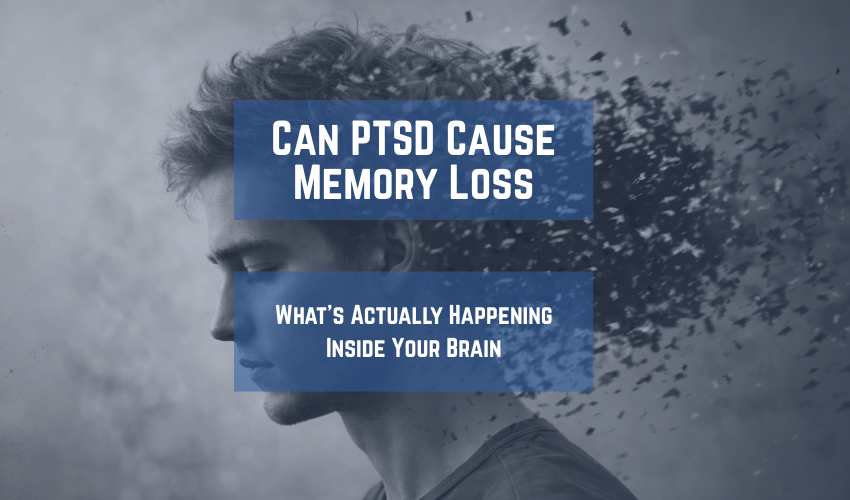
Can PTSD cause memory loss? Discover the key causes, symptoms, and powerful insights into how trauma affects memory, brain function, and long-term mental health.
Most people think trauma damages memory like a hard drive getting corrupted.
That’s not what happens.
The truth is stranger, more complex, and, once you understand it, a lot less terrifying. Your brain isn’t broken. It did exactly what it was designed to do under extreme stress. The problem is that design wasn’t built for life after the threat.
This article won’t cure your PTSD. It won’t recover lost memories or promise you a quick fix. What it will do is explain the neuroscience behind why trauma scrambles memory the way it does, so you can stop blaming yourself for something that’s rooted in biology, not weakness. Let’s get into it.
What PTSD Actually Is and Can PTSD cause memory loss?
Post-Traumatic Stress Disorder is a recognised mental health condition triggered by exposure to traumatic events. Both ICD-11 and DSM-5 outline the same core symptoms: re-experiencing, avoidance, and a persistent sense of threat.
But flashbacks are just the headline.
PTSD also affects mood, cognition, and behaviour in ways that get far less attention, emotional numbing, difficulty concentrating, and significant memory disturbances. Around 4% of the UK population will experience PTSD at some point in their lives. That’s not a rare edge case. That’s millions of people quietly struggling with symptoms they often can’t explain.
And memory loss is one of the most confusing, and least talked about, of those symptoms.
How Memory Actually Works (Before We Talk About What Trauma Does to It)
Here’s the quick version of how your brain files memories under normal conditions.
Three structures do most of the heavy lifting. The hippocampus organises memories into coherent, time-sequenced events, it’s what lets you recall what happened, when, and where. The amygdala assigns emotional weight to experiences, flagging intense moments so they’re remembered more vividly. The prefrontal cortex regulates attention and recall, helping you distinguish between a past event and a present threat.
When these three work in sync, memory formation is relatively orderly.
Trauma breaks that sync entirely.
Here’s What Trauma Does to Your Brain
The moment a traumatic event begins, your brain shifts into one priority: survival.
Everything else, including orderly memory formation, gets deprioritised. Stress hormones flood your system. Cortisol and adrenaline spike to levels that directly interfere with hippocampal functioning. The very structure responsible for organising memories into a coherent narrative gets chemically disrupted at the exact moment you most need it.
This is why trauma memories don’t feel like normal memories.
Instead of a clear, sequential story, they’re stored in fragments, an image here, a sound there, a physical sensation with no context attached. The brain preserved the survival-relevant sensory data. It didn’t preserve the story.
That’s not a flaw. That’s your brain doing its job under extreme conditions. The problem is those fragments don’t stay neatly filed away. They resurface. Repeatedly. Without warning.
The Memory Paradox Nobody Prepares You For
Here’s what most people find deeply unsettling about PTSD and memory.
You can forget significant parts of a traumatic event, sometimes entire chunks of it—while simultaneously being bombarded by intrusive flashbacks of other moments. Forgetting and re-experiencing at the same time.
That seems contradictory. It’s not.
It reflects how different brain systems were activated during the trauma. The amygdala was working overtime, burning certain sensory details into memory with intensity. The hippocampus was impaired, failing to organise those details into a complete, coherent narrative.
The result: vivid fragments coexisting with significant gaps.
This is not inconsistency. This is not dishonesty. This is neuroscience.
The Types of Memory Problems PTSD Actually Causes
Let’s separate these out clearly, because they’re not all the same thing.
Gaps in traumatic memory. Missing pieces of the event itself, sometimes minutes, sometimes longer, where memory simply doesn’t exist. This is one of the most documented effects of trauma.
Fragmented or disorganised recall. Memories feel jumbled, out of sequence, impossible to piece into a coherent narrative. You know something happened, but you can’t organise it into a story with a beginning, middle, and end.
Intrusive memories and flashbacks. The opposite problem, memories that force themselves into consciousness, often triggered by sensory cues, sometimes feeling more like reliving than remembering.
Everyday working memory difficulties. PTSD doesn’t just affect memory of the trauma. Chronic stress and hypervigilance consume significant cognitive resources, leaving less bandwidth for focus, planning, and short-term memory. Tasks that used to be automatic become genuinely difficult.
And there’s one more factor that amplifies all of this.
What Sleep Has to Do With It
Memory consolidation, the process of moving experiences from short-term to long-term storage, happens primarily during sleep.
PTSD devastates sleep. Nightmares, hypervigilance, difficulty settling. Night after night of disrupted rest doesn’t just leave you tired. It actively impairs your brain’s ability to process and store information properly.
This is why memory difficulties in PTSD often extend well beyond the traumatic event itself.
It’s not just about what your brain couldn’t encode in the moment. It’s about what your brain can’t consolidate now, night after night, while it’s stuck in survival mode.
Dissociation: When Memory Gaps Go Deeper
In some cases, particularly with Complex PTSD, memory difficulties become more severe through a process called dissociative amnesia.
This isn’t ordinary forgetting. It’s not walking into a room and blanking on why you went there. Dissociative amnesia involves significant gaps in autobiographical memory, often directly linked to trauma, rooted in psychological defence mechanisms the brain uses to protect itself from overwhelming experience.
Complex PTSD, which develops after prolonged or repeated trauma, tends to produce more pronounced and persistent dissociative symptoms. The memory disturbances are often more extensive, more disorienting, and harder to navigate without professional support.
PTSD vs. Dementia: Why the Distinction Matters
This is where things get clinically important.
PTSD-related memory difficulties and early dementia can look similar on the surface, both involve cognitive impairment, memory gaps, and difficulty concentrating. But they behave very differently.
PTSD-related memory problems are typically inconsistent and emotionally triggered. They’re linked to specific contexts, stimuli, or states of distress. They fluctuate. Dementia, by contrast, involves progressive, global cognitive decline that doesn’t fluctuate based on emotional state.
Because symptoms can overlap, PTSD is sometimes misattributed to neurological causes, and vice versa. If memory problems are worsening over time, affecting broader areas of function, or accompanied by confusion, language difficulties, or disorientation, seek a full medical assessment. Ruling out neurological causes isn’t overcautious. It’s necessary.
Let’s Be Honest About the Memory Myths
Myth: Memory gaps mean someone is making their experience up.
Reality: Gaps are a well-documented, clinically expected consequence of trauma. The brain didn’t encode a complete record under life-threatening stress. That’s not fabrication. That’s neurobiology.
Myth: Recovered memories are either completely accurate or completely false.
Reality: Memory is reconstructive, not archival. Recovered memories may contain truth, distortion, or a mixture of both. This complexity doesn’t invalidate someone’s experienc, it reflects how memory actually works.
Myth: Remembering some details vividly while forgetting others means you’re being selective.
Reality: It means different brain systems were activated at different intensities during the trauma. Selective recall is a symptom, not a character flaw.
How These Symptoms Are Assessed Clinically
When a clinician assesses PTSD-related memory difficulties, they’re not just asking “what do you remember?”
They take a detailed history covering both trauma exposure and cognitive symptoms, how memory problems manifest, what triggers them, how they’ve changed over time. In some cases, formal neuropsychological testing helps differentiate PTSD-related memory issues from other conditions. That distinction matters enormously for what treatment looks like.
Treatments That Actually Address Trauma and Memory
Here’s the honest picture on treatment.
Trauma-Focused CBT helps individuals process and organise fragmented traumatic memories within a structured, safe framework. It’s one of the most evidence-based treatments available for PTSD.
EMDR (Eye Movement Desensitisation and Reprocessing) works differently, it uses bilateral stimulation to help the brain reprocess disorganised traumatic memories. The evidence base is strong, particularly for memory fragmentation and intrusive recall.
Stabilisation comes first. Before any direct memory work begins, effective clinicians focus on emotional regulation and psychological safety. Diving into traumatic memory without that foundation can do more harm than good. This isn’t a delay tactic. It’s clinical best practice.
Practical Strategies for Managing Day-to-Day Memory Difficulties
While working through trauma with professional support, there are practical steps that genuinely help with everyday cognitive load. Use written reminders and digital tools rather than relying on mental bandwidth that PTSD is consuming. Break tasks into smaller steps. Maintain a consistent daily routine where possible. Prioritise sleep, imperfect sleep is still better than none, and consistent sleep hygiene makes a real difference over time.
One important warning: don’t try to force traumatic memory recall on your own.
Attempting to recover memories without professional guidance can be overwhelming and potentially destabilising. The goal of treatment isn’t to recover every lost fragment, it’s to reduce the power those fragments hold over your daily life.
When to Seek Help
These are the signs that memory difficulties may be rooted in trauma and warrant professional assessment: persistent gaps in memory you can’t account for, intrusive flashbacks, difficulty concentrating that’s affecting work or relationships, and emotional distress that seems linked to specific memories or their absence.
When you approach your GP or a mental health professional, be open about both your memory concerns and any history of trauma. Clinicians can’t join dots they don’t know exist. The more complete the picture you give them, the more accurate the assessment they can provide.
FAQs
Can PTSD cause permanent memory loss?
In most cases, no. With appropriate treatment—Trauma-Focused CBT, EMDR, or both, significant improvement is achievable. Recovery timelines vary depending on the individual and the complexity of the trauma, but permanence is not the expected outcome.
Why do I remember some parts of the trauma but not others?
Because your brain stores traumatic events differently from ordinary experiences. Emotional and sensory fragments get preserved while the narrative structure doesn’t. That asymmetry is the brain’s survival system doing its job, badly suited to life afterwards, but doing its job in the moment.
Can PTSD affect short-term memory and concentration?
Yes, significantly. Chronic hypervigilance and disrupted sleep consume cognitive resources that would otherwise go to focus, attention, and short-term memory. Tasks that used to be automatic become genuinely effortful.
Is PTSD-related memory loss the same as dissociative amnesia?
Not exactly, though they can overlap. Dissociative amnesia is more specific, with significant gaps in autobiographical memory linked directly to trauma. PTSD-related memory difficulties are broader, also including fragmentation and intrusive recall.
When should memory loss prompt a medical assessment?
If problems are progressively worsening, affecting broad areas of daily functioning, or accompanied by confusion, language difficulties, or disorientation, seek medical evaluation. Those features warrant ruling out neurological causes.
The Bottom Line
Your brain’s memory system wasn’t designed for trauma. It was designed for survival. And in the moment, it chose survival, at the cost of coherent, orderly memory formation.
That’s not weakness. That’s not fabrication. That’s neurobiology.
Understanding the science behind PTSD and memory doesn’t just satisfy intellectual curiosity. It removes the shame that stops people from seeking help.
Memory gaps, intrusive flashbacks, difficulty concentrating, dissociation, these are documented, well-understood consequences of how the human brain responds to overwhelming threat. They’re symptoms. They’re treatable. And they do not define what happened to you or how your story ends. If any of this resonates, the next step is a conversation with someone qualified to assess it properly.