Depression Treatment in London: What Nobody Tells You Before You Start Looking
February 19, 2026
Who Can Actually Diagnose PTSD in the UK? (And Why Getting This Wrong Costs You Months)
March 28, 2026
Most people searching for information on PTSD treatments therapy are already exhausted.
They’ve Googled the same questions at 2am. They’ve read articles full of clinical language that explains everything and helps nothing. They’ve heard “therapy works” but have no idea what that actually means in practice.
Here’s what this article will do: give you a clear, honest breakdown of what PTSD is, how it progresses, what treatments actually exist, and when to seek help.
Here’s what it won’t do: promise you a cure, oversimplify a complex condition, or pretend recovery follows a neat timeline. If you want straight answers, not medical padding, keep reading.
PTSD Isn’t Just “Being Stressed After Something Bad Happened”
Let’s start with what PTSD actually is, because there’s a lot of misunderstanding here.
Post-Traumatic Stress Disorder develops after experiencing or witnessing a traumatic event, serious accidents, physical or sexual assault, combat, natural disasters, or any situation perceived as life-threatening or deeply distressing.
Here’s the crucial distinction most people miss:
Having a strong reaction after trauma is normal. PTSD is when those reactions don’t stop.
When the fear, avoidance, and distress persist, intensify, and start interfering with daily life, that’s the line between a natural stress response and a clinical condition. And crossing that line matters, because it changes what kind of support is needed.
PTSD affects people in three broad ways:
Thoughts become dominated by intrusive memories, flashbacks, or negative beliefs about yourself and the world. Concentration suffers. The mind keeps returning to what happened, whether you want it to or not.
Emotions shift toward persistent fear, anger, guilt, shame, or the opposite: a strange numbness, like someone turned the volume down on everything you used to feel.
Behaviour changes too. Avoidance becomes a survival strategy. You start steering around people, places, conversations, or even feelings that remind you of the trauma. Relationships suffer. Risk-taking or irritability can increase.
The result is a life that gets smaller and smaller. And that’s exactly why early recognition matters.
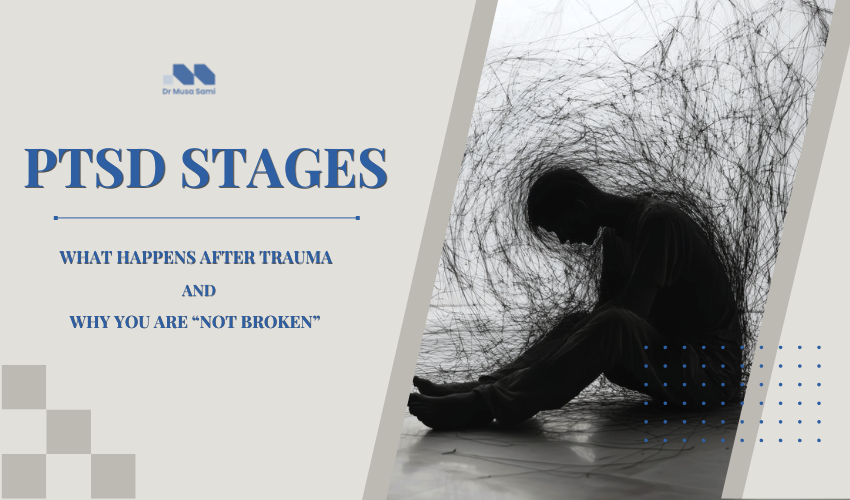
The Stages of PTSD, And Why They’re Not a Straight Line
Here’s something the clinical literature often buries in footnotes:
PTSD stages are a framework, not a fixed schedule.
People don’t move neatly from Phase 1 to Phase 4 and then ring a bell at the end. They move forward, loop back, plateau, and sometimes revisit phases they thought were behind them. Understanding this upfront saves a lot of frustration.
That said, the broadly described phases are useful to understand:
1. Acute stress phase, the immediate aftermath of trauma. The body and mind are in crisis mode.
2. Emerging symptoms phase, distressing responses begin to crystallise into recognisable patterns.
3. Chronic or persistent PTSD phase, symptoms have lasted more than a month and are significantly impacting daily life.
4. Recovery and integration phase, with the right support, the person begins processing the trauma and rebuilding.
Each phase calls for a different approach. What’s appropriate at week one is not the same as what’s needed at month six.
What Happens Right After Trauma (And When to Pay Closer Attention)
Immediately after a traumatic event, the body does what it’s designed to do.
Shock. Disbelief. Heightened alertness. Sleep disruption. Physical symptoms like a racing heart or bone-deep fatigue. These are not signs of weakness, they’re the nervous system doing its job.
Most people experience these reactions and gradually stabilise. That’s normal.
But here’s where it gets important:
If symptoms are getting worse rather than better after a few weeks, or if someone can’t function, is at risk of self-harm, or is turning to substances to cope, that’s not the normal post-trauma adjustment curve. That’s a signal that professional monitoring, at minimum, is warranted.
Early support doesn’t always mean formal therapy immediately. It can mean psychoeducation (understanding what’s happening in your mind and body), emotional reassurance, and practical help. Social connection and stability go further than most people expect in those early days.
The mistake is ignoring early warning signs until things become much harder to treat.
How PTSD Symptoms Develop, The Three Clusters You Need to Know
As PTSD takes hold, symptoms typically fall into three recognisable patterns.
Intrusion. The trauma keeps breaking through. Distressing memories arrive uninvited. Vivid flashbacks make it feel like it’s happening again. Nightmares disrupt sleep. Triggers, which can be sounds, smells, places, or words, set off cascading reactions.
Avoidance. The mind tries to protect itself by steering clear. People avoid anything that could trigger the trauma: people, places, conversations, even their own thoughts and feelings. This avoidance can lead to emotional detachment, a kind of greying out of experience that makes life feel flat and distant.
Hyperarousal and cognitive changes. The nervous system stays on high alert. Irritability. Sleep problems. Hypervigilance, the constant sense that something dangerous is about to happen. Alongside this, people often develop deeply negative beliefs: I’m broken. The world isn’t safe. I can’t trust anyone. These beliefs feed low mood, hopelessness, and withdrawal.
These aren’t character flaws. They’re symptoms of an injury, one that responds to the right treatment.
Why PTSD Affects Some People More Than Others
This is worth addressing honestly, because it’s something people often blame themselves for.
The type and severity of trauma matters. Prolonged or repeated trauma, abuse, extended combat exposure, ongoing neglect, carries a higher risk of developing PTSD than a single acute event. That’s not a rule with no exceptions, but it’s the general pattern.
Individual factors play a role too. Previous mental health history, coping skills, personality, and genetic predisposition all influence vulnerability. Some people have more natural resilience, not because they’re stronger or better, but because of a combination of biology and experience.
Social context is arguably the biggest variable. Strong support networks are among the most protective factors against PTSD taking hold long-term. Isolation, ongoing stress, and unsafe environments have the opposite effect. This is one of the most clinically consistent findings in the trauma literature.
None of this means outcomes are fixed. It means understanding someone’s full picture matters when designing treatment.
PTSD Treatments Therapy: What Actually Works
Here’s the truth about PTSD treatment:
Evidence-based psychological PTSD treatments therapy is the gold standard. Not willpower. Not time alone. Therapy.
There is no single approach that works for everyone, and anyone who tells you otherwise is oversimplifying. But there are well-researched, highly effective treatments that work for the majority of people when delivered correctly.
Here’s what the evidence actually supports:
Trauma-Focused Cognitive Behavioural Therapy (TF-CBT)
TF-CBT is one of the most widely recommended and extensively researched treatments for PTSD.
It works by helping you understand the relationship between your thoughts, emotions, and behaviours, and then systematically challenging the distorted thinking patterns that trauma creates. It also involves gradually processing traumatic memories rather than avoiding them.
This is where most people have the wrong expectation. Processing trauma in therapy isn’t about dwelling in pain. It’s about breaking the loop, taking the memory from something that hijacks you to something you can hold without being overwhelmed.
TF-CBT helps develop healthier coping strategies and rebuilds a more accurate narrative about what happened and what it means.
Eye Movement Desensitisation and Reprocessing (EMDR)
EMDR sounds strange when you first hear about it. Recalling traumatic memories while following guided eye movements? It can seem like something invented to fill therapy appointment slots.
But the evidence for EMDR is robust. It is recommended by NICE (the National Institute for Health and Care Excellence) alongside TF-CBT as a first-line treatment for PTSD.
The theory is that bilateral stimulation, the eye movements, or tapping, or auditory tones, helps the brain process stuck memories in a way that reduces their emotional intensity. The exact mechanism is still debated. What’s consistent is that it works for a significant proportion of people.
Narrative Exposure Therapy and Other Structured Approaches
For people with complex trauma histories, multiple traumatic events, often experienced across a lifetime, Narrative Exposure Therapy offers a structured way to place individual traumatic experiences within a broader life narrative.
Rather than isolating one event, it acknowledges that trauma doesn’t always arrive as a single incident. The goal is coherence and context, building a story of your life that includes the trauma without being defined by it.
Other structured approaches may be recommended depending on individual presentation, co-existing conditions, and preferences.
How PTSD Treatments Therapy Changes Depending on Where You Are in Recovery
This is where the concept of PTSD stages becomes practically useful.
Early stage: Safety and stabilisation first.
Before trauma processing begins, the priority is building a stable foundation. That means ensuring the person is safe, developing basic emotional regulation skills, and establishing trust with a clinician. Jumping straight into trauma processing before someone is ready can be counterproductive.
Therapy in this phase might focus on grounding techniques, psychoeducation, and building a support structure. This isn’t stalling, it’s laying the groundwork for the harder work ahead.
Middle stage: Processing the trauma.
Once stabilised, therapy shifts toward the core work. Processing traumatic memories, challenging maladaptive beliefs, reducing avoidance. This is where TF-CBT and EMDR are typically applied most intensively.
This stage is hard. It often involves confronting things the mind has been trying to protect you from. Done well, with the right clinician, this is also where the most significant shifts happen.
Later stage: Consolidation and resilience.
Recovery isn’t finished when acute symptoms reduce. The later stage involves maintaining progress, preventing relapse, and translating the skills learned in therapy into sustainable long-term habits.
This is also where the definition of “recovery” gets clarified. More on that shortly.
Medication: When It Helps, When It Doesn’t
Let’s be direct about this.
Medication is not a cure for PTSD. It does not process trauma. It does not resolve the underlying patterns that keep people stuck. Anyone suggesting otherwise is misrepresenting the evidence.
What medication can do is reduce symptom severity, particularly anxiety, depression, and intrusive symptoms, to a level that makes engaging with therapy more manageable.
Certain antidepressants (SSRIs and SNRIs are the most common classes) have the best evidence base for PTSD and are considered appropriate when symptoms are moderate to severe, when therapy alone isn’t sufficient, or when co-existing conditions like depression are present.
If medication is considered, regular monitoring is essential. Effectiveness varies between individuals, side effects are real, and the goal is always to support, not replace, psychological treatment.
Self-Management: What You Can Actually Do Between Sessions
Therapy and medication are the clinical tools. But recovery happens across the whole week, not just in the appointment room.
Routine is stabilising. Consistent daily structure helps regulate mood, sleep, and the nervous system’s baseline threat level. It doesn’t need to be rigid, just predictable enough to reduce chaos.
Sleep matters more than most people realise. Poor sleep amplifies every PTSD symptom. Regular sleep and wake times, reduced screen exposure before bed, and a calm sleep environment are basic but genuinely effective.
Grounding techniques manage acute distress. When symptoms spike, grounding brings you back into the present moment. Deep breathing, sensory awareness exercises, and mindfulness practices have solid evidence behind them, not as cures, but as tools for managing difficult moments.
Social connection is not optional. Isolation is one of the most consistent predictors of worse outcomes in PTSD. Maintaining relationships, even when it’s uncomfortable, even when it feels like an effort, reduces the reinforcement loop that trauma and avoidance create together.
The Myths That Keep People Stuck
“I should be over this by now.”
No timeline exists for trauma recovery. Someone can develop symptoms months or even years after an event. Someone else might improve rapidly. Comparing your progress to an imaginary schedule serves no one.
“Therapy will make it worse.”
This is the fear that stops a lot of people seeking help. Here’s the reality: evidence-based PTSD therapies are designed with this concern in mind. Good clinicians work at a pace that is manageable. Processing trauma is uncomfortable, but doing it in a controlled therapeutic environment is fundamentally different from being ambushed by it alone.
“If it’s bad enough, I’ll know.”
Some people function highly in visible areas of life while experiencing significant distress privately. PTSD doesn’t always look like crisis. If symptoms are persistent and interfering, with sleep, relationships, concentration, enjoyment of life, that’s enough reason to seek assessment.
When to Actually Seek Professional Help
Here’s a straightforward set of indicators:
Symptoms have persisted beyond a month. Daily functioning, work, relationships, self-care, is being meaningfully impaired. You’re relying on avoidance, substances, or other unhealthy strategies to cope. There’s any risk of self-harm.
If any of these apply, professional assessment is the appropriate next step.
In the UK, access routes include:
Your GP, who can refer to NHS mental health services. NHS IAPT (Improving Access to Psychological Therapies) services, some of which have PTSD-specific pathways. Specialist trauma services. Private psychiatric or psychological care for faster access.
If you are considering private care for faster access and a more structured assessment process, you may wish to explore a private PTSD assessment UK. At Dr Musa Sami’s clinic, assessments are conducted by a consultant psychiatrist and focus on developing a clear understanding of your symptoms, diagnosis, and next steps.
Assessment typically involves a clinical interview, symptom evaluation, and a review of your personal history. The goal isn’t labelling — it’s building an accurate picture so that the right treatment can be matched to your specific presentation.
What Recovery Actually Looks Like
Here’s something worth being honest about:
Recovery from PTSD does not always mean the complete absence of symptoms.
For many people, recovery looks like this: reduced distress, improved functioning, greater resilience in the face of triggers, and the ability to live a full life that isn’t dictated by what happened.
Some symptoms may remain at a lower level. Certain triggers may still register. But the relationship to those experiences changes. The trauma becomes part of your history not the constant lens through which you experience the present.
Setbacks are part of this. Periods of increased stress, life transitions, or reminders of the trauma can temporarily amplify symptoms. That’s not failure. It’s the nature of complex psychological conditions. The difference is that people in recovery have tools to manage those periods rather than being overwhelmed by them.
Regular follow-up with a clinician supports this, catching emerging challenges early and ensuring the gains made in treatment hold over time.
Common Questions about PTSD Treatments Therapy
What are the main PTSD treatment options?
Trauma-focused therapies, primarily TF-CBT and EMDR, are the evidence-based first-line treatments. Medication may be added when needed. Supportive interventions and self-management strategies complement formal treatment.
Do symptoms always follow the same stages?
No. PTSD stages are a framework for understanding patterns, not a fixed sequence. Individual experiences vary considerably.
How long does treatment take?
It depends on severity, complexity, and individual factors. Some people see significant improvement in months. Others need longer-term support. There’s no honest universal answer here.
Can PTSD improve without professional treatment?
Some people recover naturally following mild or single-incident trauma with strong social support. For moderate to severe presentations, professional intervention significantly improves outcomes. Self-managing serious PTSD alone is difficult and often prolongs suffering unnecessarily.
Is medication always required?
No. Many people recover effectively through therapy alone. Medication is a tool for specific circumstances, not a requirement.
The Bottom Line about PTSD Treatments Therapy
PTSD is a real, serious condition with real, effective treatments.
The evidence is clear that trauma-focused therapies, delivered by qualified clinicians, at the right pace for the individual, produce meaningful recovery for the majority of people who access them.
What’s also true: recovery takes time, isn’t linear, and looks different for everyone.
If you’re experiencing persistent symptoms that are affecting your ability to live your life, seek assessment. Not because you’re weak. Not because something is permanently wrong with you. Because you’re dealing with a complex psychological injury, and the right support can change your trajectory significantly.
The first step is always the clearest: speak to a professional who can properly evaluate your situation and help you understand your options. That’s where it starts.