False Memory OCD: Why Intrusive Doubts Can Feel So Real
July 31, 2026
Autism and OCD: What’s Actually Different (And Why Getting It Wrong Costs You)
August 27, 2026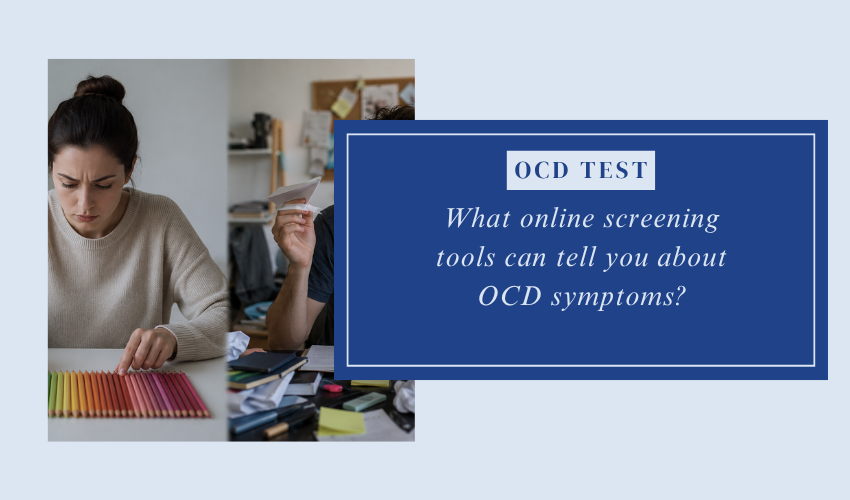
You typed “OCD test free” into Google.
Maybe it’s the intrusive thoughts. Maybe it’s the checking, the counting, the reassurance-seeking that never quite settles the doubt. Whatever brought you here, you want answers, and you want them now.
Here’s the truth: an online screening tool can help. But it can’t do what you’re really hoping it will do.
It can’t diagnose you. It can’t tell you, with certainty, whether what you’re experiencing is OCD. What it can do is give you language for something you’ve probably been struggling to explain, and help you decide whether it’s time to talk to someone who can.
This article will walk you through exactly what these tools do, what they don’t, and what to do with the result either way.
What an “OCD Test Free” Tool Actually Is
It’s a questionnaire. Nothing more, nothing less.
A short set of questions about unwanted thoughts, repetitive behaviours, anxiety, avoidance, checking, contamination fears, and how much time you spend dealing with them.
The point isn’t to slap a label on you. It’s to raise awareness. To help you decide whether digging deeper is worth it.
And if your only exposure to OCD has been jokes about neat freaks and colour-coded bookshelves, a screening tool can also be the first thing to show you how much broader the condition actually is.
Screening vs. Assessment: Not the Same Thing
A self-screening questionnaire gives you a structured set of questions and a score. That’s it.
An OCD clinical assessment goes further. Much further.
A qualified clinician will ask when your symptoms started. How often they happen. What triggers them. How you respond. How much time they eat out of your day. They’ll look at your broader mental health history and consider whether something else might explain what you’re going through.
Diagnosis depends on context, not a number on a screen. Even the International OCD Foundation says as much: screening tools aren’t official diagnoses, and results should be discussed with a qualified professional.
How Do Free OCD Screening Tests Actually Work?
Here’s what you’ll typically get asked about:
- Intrusive or unwanted thoughts, images or urges
- Fears about harm, contamination or making mistakes
- Repeated checking or cleaning
- Seeking reassurance from other people
- Mental rituals or repeated thoughts
- Anxiety or distress tied to intrusive experiences
- Time spent on compulsions or trying to neutralise thoughts
Not everyone with OCD looks the same. Some people have compulsions you can see. Others run entirely on mental rituals, invisible to everyone around them, exhausting all the same.
The Scoring Problem
Most of these tools spit out a score. A higher score can suggest further assessment is worth it.
But here’s where people get it wrong: a score isn’t a verdict.
A high score doesn’t mean you have OCD. A low score doesn’t mean you don’t. The International OCD Foundation’s own screener, built on shortened versions of the Obsessive-Compulsive Inventory, is explicit that it’s designed for screening, not diagnosis.
Not All Screening Tools Are Built the Same
The Obsessive-Compulsive Inventory (OCI) and its shorter versions are common screening questionnaires.
The Yale-Brown Obsessive Compulsive Scale (Y-BOCS) is different, it’s the one clinicians actually use to assess severity, weighing time consumed, distress, interference, and how much control you have over your symptoms.
A quick online quiz and a clinician-led assessment are not interchangeable. Treat them as different tools for different jobs.
What Can an OCD Test Free Tool Actually Tell You?
It Can Name What You’ve Been Struggling to Explain
A screening tool might highlight patterns you’ve never had the words for. Intrusive thoughts. Repeated checking. Contamination fears. Reassurance-seeking. Fears of causing harm. A relentless need for certainty. Repetitive mental rituals.
Sometimes those intrusive thoughts centre on things that feel deeply upsetting to even acknowledge.
Here’s what matters: having an intrusive thought doesn’t mean you want it to happen, or that you’d ever act on it. What matters clinically is the pattern around the thought, the distress it causes, and what you do in response to it.
It Can Give You Language
This might be the single most useful thing a screening tool does.
Maybe you’ve been calling it “overthinking.” Or “being overly careful.” Or “not being able to let something go.” Learning about obsessions and compulsions can hand you a framework that actually fits what’s happening.
That’s not a diagnosis. It’s a starting point, something concrete to bring to a GP, psychiatrist, psychologist, or other qualified professional.
It Can Tell You When It’s Time to Go Further
Professional assessment tends to matter most when your symptoms:
- Take up a significant chunk of your day
- Cause real anxiety, shame or distress
- Interfere with work, study or relationships
- Push you to avoid everyday situations
- Make ordinary decisions feel impossible
- Involve repeated reassurance-seeking or rituals
- Get in the way of things that actually matter to you
OCD can seriously disrupt your life. But it’s treatable. That part doesn’t get said enough.
What Can’t an OCD Test Free Tool Tell You?
It Can’t Diagnose You. Full Stop.
A questionnaire on its own can’t establish a diagnosis.
Diagnosis requires weighing symptoms, duration, severity, functional impairment, and the full clinical picture. A professional can also work out whether something else, another condition entirely, or something running alongside it, might explain what’s going on.
This matters more than you’d think, because intrusive thoughts and anxiety show up in plenty of conditions beyond OCD.
It’s Not Built for Self-Diagnosis
It’s tempting to see a high score and think: I have OCD.
It’s just as easy to see a low score and think: Guess it’s nothing.
Neither conclusion holds up. A score is an indicator, something to prompt a conversation, not something to build a self-diagnosis on.
And if you already struggle with doubt or reassurance-seeking, repeatedly retaking the quiz to chase certainty can become its own unhelpful loop.
Other Conditions Look Similar From the Outside
OCD shares features with anxiety disorders, depression, PTSD and health anxiety. Difficulties with attention, impulsivity or repetitive behaviour can also overlap with ADHD or other conditions.
A professional assessment is what untangles the overlap, and shows you how different pieces might be interacting.
The Symptoms an OCD Screening Tool Is Actually Looking For
Obsessions: The Thoughts You Didn’t Ask For
Obsessions are persistent, unwanted, distressing thoughts, images or urges. Fears of contamination. Of accidentally harming someone. Of making a serious mistake. Of losing control. Of offending someone. Of never reaching certainty.
You might get doubts like “What if I did something terrible and don’t remember?” or “What if I’ve missed something important?”
Having an intrusive thought doesn’t mean you have OCD. Almost everyone gets them occasionally. OCD is what happens when those thoughts become persistent, distressing, and disruptive.
Compulsions: What You Do to Make the Anxiety Stop
Compulsions are the repetitive behaviours or mental acts you perform in response to those thoughts. Common ones:
- Checking locks, appliances or messages
- Excessive washing or cleaning
- Counting or repeating
- Arranging objects a particular way
- Asking others for reassurance
- Mentally reviewing past events
- Repeating phrases or prayers
- Mentally “neutralising” an unwanted thought
- Avoiding situations that trigger fears
Compulsions work, for a moment. That’s the trap. The temporary relief reinforces the behaviour, and the cycle gets harder to break.
The Cycle That Keeps It Going
It looks like this:
Obsession → anxiety → compulsion → temporary relief → obsession returns.
Say you get a doubt that you left the door unlocked. Anxiety spikes. You check it. Relief, for now. Then the doubt creeps back later, and you check again.
Treatment isn’t about eliminating every unwanted thought. It’s about changing your relationship to the thought, the anxiety, and the compulsive response.
Are Free Online OCD Tests Actually Accurate?
It Depends Entirely on What’s Behind the Quiz
Not every “OCD test” you find online is built the same way.
A validated screening tool has been researched to check it actually measures what it claims to measure. An informal internet quiz making dramatic promises and spitting out an unexplained score is a different animal entirely.
Even the good ones are still just screening. One piece of a bigger process, not a verdict.
What Can Throw Off Your Results
Your answers can shift based on:
- Current stress levels
- Mood and anxiety
- How you personally interpret a question
- Whether symptoms have recently changed
- How comfortable you feel admitting certain experiences
- Whether you’re actively avoiding or reassurance-seeking right now
One questionnaire, taken on one day, was never going to capture the full picture.
Why a Professional Sees More Than a Screener Ever Could
A clinician can ask follow-up questions. Clarify anything vague. Look at the pattern across everything you’ve told them, not just a tally of yes/no answers.
They can also weigh the functional impact and check for other conditions running alongside it. That’s the depth a score alone can’t give you.
So You Took the Test. Now What?
When It’s Worth Talking to Someone
If your result points toward possible OCD, or your symptoms are bothering you regardless of what the score said, it’s worth talking to a professional.
You don’t need to wait until things get unbearable. Catching it early tends to make everything that follows easier.
What an Actual OCD Assessment Looks Like
Expect:
- A clinical interview
- Discussion of your obsessive thoughts and compulsive behaviours
- Questions about when it started
- A look at how often it happens, how distressing it is, and how much time it eats
- Discussion of how it affects your everyday life
- A review of any past mental health difficulties or treatment
- Consideration of other possible diagnoses
The goal is a full picture. Not a score.
Your Options in the UK: NHS and Private Routes
You can speak to your GP about OCD symptoms, who can refer you to appropriate services. In many parts of England, you can self-refer to NHS Talking Therapies directly.
Private assessment is the other route, booking directly with a qualified mental health professional. Which one is right for you comes down to your circumstances, your preferences, and what’s accessible to you.
What Treatment Actually Looks Like
CBT and Exposure Response Prevention (ERP)
CBT, specifically Exposure and Response Prevention, is the established psychological treatment for OCD.
ERP means gradually facing the thoughts, situations or triggers you fear, while learning not to respond with the usual compulsion. It’s done in a structured, supported way, tailored to your specific symptoms.
The goal isn’t proving every feared outcome is impossible. It’s building your tolerance for uncertainty, and loosening your reliance on compulsions to manage it.
Medication
Medication can also be part of treatment. Selective serotonin reuptake inhibitors (SSRIs) are commonly used, and should always be prescribed and monitored by a qualified clinician.
The specific medication, dose, and whether it’s combined with therapy, all of that depends on you. Never start, change, or stop medication without proper medical guidance.
What You Can Do Yourself
Self-management won’t replace evidence-based treatment. But it can support it.
Learning about OCD. Noticing your triggers and compulsive patterns. Keeping regular routines. Managing stress. Protecting your sleep. Staying connected to people who support you.
One shift that helps a lot of people: recognising reassurance-seeking itself as a compulsion, rather than something separate from the cycle you’re trying to break.
Myths That Keep People From Getting Help
“A High Score Means I Definitely Have OCD”
A high score can mean further assessment is worth pursuing. It doesn’t mean you have a diagnosis. The score only means something alongside your symptoms, your history, and the impact on your life.
“OCD Is Just About Cleaning and Organising”
Cleaning and organising can be part of it. They’re a small slice of a much bigger picture.
OCD can involve harm-related fears, sexual or religious intrusive thoughts, relationship doubts, health concerns, checking, responsibility fears, and plenty more.
“If I Can Resist a Compulsion, I Can’t Have OCD“
OCD sits on a spectrum. People vary in how strongly they respond to compulsions.
You can delay, reduce, or even occasionally resist a compulsion and still be dealing with real obsessions and real distress. The overall pattern matters more than whether you can white-knuckle your way through every single urge.
When It’s Time to Actually Seek Help
Consider it if OCD-like symptoms are causing real emotional distress. If they’re pushing you to avoid things. Straining relationships. Cutting into your ability to work, study, or handle everyday responsibilities.
Or if your rituals are eating more and more of your time, if your day is quietly built around avoiding feared outcomes.
Seeking help isn’t about proving your symptoms are “bad enough.” It’s about taking persistent distress seriously.
OCD is treatable. Evidence-based psychological and medication options exist, and they work.
Frequently Asked Questions About OCD Test Free Screening Tools
Is an OCD test free online tool accurate?
A reputable tool built on a validated questionnaire can be genuinely useful for spotting possible symptoms. But it can’t confirm a diagnosis. Treat the result as a signal that further assessment might help, not a final answer.
Can an OCD test free questionnaire diagnose OCD?
No. A questionnaire can’t replace a qualified professional’s assessment. Diagnosis requires weighing symptoms, history, duration, distress, and functional impact together, a questionnaire simply isn’t built to do that.
What is the best free OCD test online?
There’s no single tool that fits everyone. Your best bet is a recognised, research-based screening measure, not an informal quiz that never explains how its questions or scoring were built.
What should I do if my screening result suggests possible OCD?
Take it to a GP, psychiatrist, psychologist, or other qualified mental health professional. If your symptoms are significantly affecting daily life, a professional assessment can clarify what’s actually going on and what treatment might help.
Can OCD symptoms exist without obvious compulsions?
Yes. Compulsions aren’t always visible. Mental rituals, reviewing memories, repeating phrases internally, analysing thoughts, chasing internal certainty, mentally “undoing” a thought, are just as real, even if no one else can see them.
The Bottom Line
An online screening tool is useful for awareness. It was never built for diagnosis.
It can highlight symptoms worth paying attention to. It can nudge you toward getting support. What it can’t do is replace a qualified clinician who looks at your history, your triggers, your compulsions, your distress, and how all of it fits together, especially when your symptoms overlap with anxiety, depression, PTSD, or health anxiety.
If you see yourself in any of this, you don’t have to figure it out alone. CBT with ERP, and medication where appropriate, can help you manage OCD symptoms and take back real control over your life.
A screening test is a first step. Just not the last one. If intrusive thoughts or compulsive behaviours are interfering with your life, the next step is a conversation with a qualified mental health professional.