
How to Deal With Someone With Bipolar Disorder: Communication Strategies and Emotional Support
July 8, 2026
Symbols of Bipolar Disorder: What They Get Right, What They Get Wrong, and What Actually Matters
July 14, 2026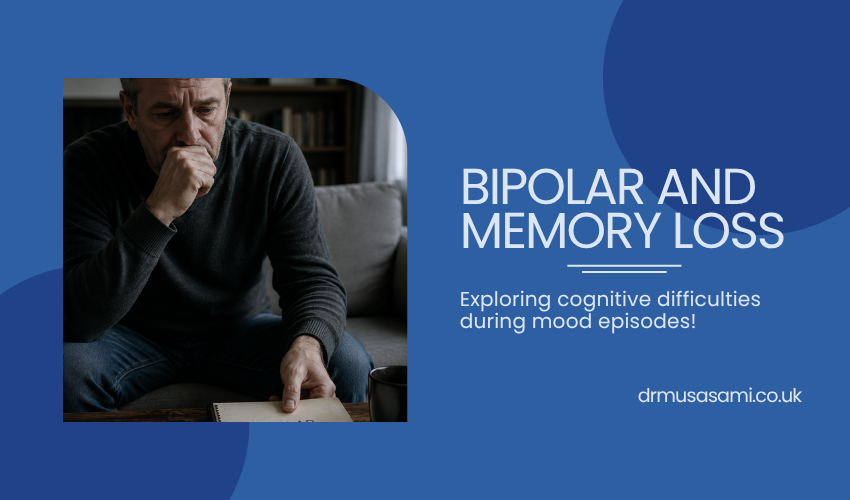
Bipolar and Memory Loss can affect concentration, recall, and daily functioning. Learn what causes these cognitive changes, treatment options, and when to seek professional help.
Most people assume bipolar disorder is just about mood.
High. Low. Repeat.
But if you’re living with it, or supporting someone who is, you already know there’s a whole other layer that nobody talks about enough. The fog. The forgetting. The feeling that your brain just isn’t working the way it should.
Here’s what this article is and isn’t: it’s not going to promise you a fix, and it’s not going to pretend cognitive symptoms are simple. What it will do is give you a clear, honest picture of why bipolar and memory loss are so often connected, and what you can actually do about it.
The Brain You’re Working With During a Mood Episode
Let’s start with something that surprises a lot of people.
Most memory complaints in bipolar disorder aren’t strictly about memory. They’re about attention. And that distinction matters more than you’d think.
Here’s why: memory formation requires your brain to actually process and encode information in the first place. If your attention is fractured, which is almost guaranteed during a mood episode, that encoding never happens properly. It’s not that the memory was stored and then lost. It’s that it was never properly formed.
This is where most people get it wrong. They assume they have a memory problem, when what they actually have is an attention problem that creates a memory problem.
The difference matters clinically. And it matters for how you manage it day-to-day.
What Bipolar Disorder Actually Does to Your Brain
Quick overview for context, because understanding the mechanism helps.
Bipolar disorder is characterised by significant shifts in mood, energy, and activity levels. There are two primary presentations: Bipolar I, which includes at least one full manic episode, and Bipolar II, which involves recurrent depression alongside hypomania.
During depressive episodes, you’re likely to experience persistent low mood, fatigue, reduced motivation, social withdrawal, and that heavy, slowed feeling that makes everything feel like wading through concrete.
During manic or hypomanic episodes, it flips: elevated or irritable mood, reduced need for sleep, racing thoughts, increased energy, and impulsive behaviour.
Both states affect cognition. Just in very different ways.
What Happens to Your Memory When You’re Manic
Here’s something that doesn’t get said enough about mania: it feels sharp. It feels like your brain is finally firing on all cylinders.
But here’s the reality.
Racing thoughts aren’t focused thoughts. When your mind is jumping between ideas, conversations, and tasks every few seconds, nothing gets processed deeply enough to stick. You’re covering a lot of ground. You’re not actually absorbing any of it.
Add distractibility to that, and you’ve got a perfect storm for poor memory encoding. Every time your attention shifts before a thought is fully processed, that potential memory evaporates.
There’s also the sleep piece. Manic and hypomanic episodes commonly involve reduced sleep, sometimes dramatically so. And sleep is when your brain consolidates memories from the day. Cut that process short consistently, and the downstream cognitive effects are significant.
It’s not that your brain is broken during mania. It’s that it’s operating in a mode that isn’t built for careful, deep processing.
What Happens to Your Memory When You’re Depressed
This is where most people recognise themselves most clearly.
Depression doesn’t just affect mood. It slows your cognitive processing speed. Tasks that were once automatic require effort. Retrieving information, even information you definitely know, can feel like trying to pull something out of thick mud.
This is sometimes called psychomotor slowing, and it’s a genuine neurological effect, not laziness, not weakness.
Here’s what it means in practice: you don’t necessarily lose memories during depression. You lose access to them. The information is likely still there. The processing speed required to retrieve it just isn’t available in the same way.
Fatigue makes this worse. Low motivation makes this worse. The combination means cognitive performance during depressive episodes often looks far worse than the underlying capability actually is.
The Longer-Term Picture
Let’s be honest about what the research does and doesn’t show here.
Some individuals with bipolar disorder experience cognitive difficulties even during periods of mood stability, not just during episodes. These difficulties tend to be subtle rather than dramatic, but they can affect daily functioning in real ways: planning, organising, prioritising, making decisions. These are what clinicians call executive functions, and they’re among the most commonly affected.
It’s also worth noting that frequent or severe mood episodes may increase the likelihood of ongoing cognitive difficulties over time. The research is still exploring the exact mechanisms, but this is a reason why consistent, effective mood management matters beyond just symptom relief.
The crucial thing to hold onto: most cognitive symptoms fluctuate alongside mood. They’re not static. They’re not permanent for the majority of people. And they’re not evidence of brain damage.
Medication For Bipolar and Memory Loss: An Honest Conversation
Here’s a question that comes up constantly: is it the medication causing the memory problems, or the condition itself?
The answer is usually: it’s complicated.
Some mood stabilisers can cause side effects including slowed thinking or mild concentration difficulties in certain individuals. Some antipsychotic medications carry sedation that affects alertness and cognitive performance. This is real, and it’s worth discussing openly with your psychiatrist.
But here’s the thing most people miss: unmanaged mood episodes typically cause far more cognitive disruption than the medications used to treat them. The goal isn’t zero side effects. It’s the best possible overall functioning, which usually means effective symptom control.
If you’re concerned that your medication is affecting your cognition, that’s a conversation worth having with your psychiatrist. What it’s not is a reason to stop medication unilaterally. That’s where things tend to get worse, not better.
The Sleep, Stress, and Lifestyle Reality
This isn’t the exciting part, but it’s the part that actually moves the needle day-to-day.
Sleep disruption during mood episodes is both a symptom and a driver of cognitive difficulties. Poor sleep impairs learning, concentration, and memory performance, and in bipolar disorder, sleep problems often persist between episodes as well. Protecting sleep isn’t optional if cognitive functioning matters to you.
Chronic stress compounds everything. It taxes attention, working memory, and processing speed. Substance use, alcohol especially, directly worsens cognitive symptoms and interferes with recovery.
None of this is radical information. But the gap between knowing it and actually building routines around it is where most people struggle.
When the Cognitive Symptoms Look Like Something Else
This matters.
ADHD and bipolar disorder can coexist, and both cause significant attention and concentration difficulties. Depression, even without bipolar disorder, is strongly associated with slowed thinking and impaired memory retrieval. Anxiety can consume working memory resources that would otherwise support concentration and recall.
And in rare cases, persistent or progressive memory problems may indicate a neurological condition that needs separate investigation.
The bottom line: don’t self-diagnose your cognitive symptoms in isolation. They need to be understood in the context of your full picture, mood state, medication, sleep, stress, other conditions. That requires a proper clinical assessment.
How These Symptoms Are Assessed
A thorough assessment of cognitive symptoms typically begins with a detailed psychiatric history, mood patterns over time, cognitive concerns, context, and how symptoms vary across different mood states.
Formal cognitive testing may be used when symptoms are significantly affecting daily functioning. Family members or carers are often valuable in providing observations about changes in behaviour and cognition that the individual themselves may not have fully registered.
One assessment at one point in time tells you very little. Evaluating symptoms across different mood states, stable, depressed, hypomanic, gives you a far more accurate and useful picture.
Can Memory Actually Improve?
For most people, yes, particularly with mood stabilisation.
When mood symptoms are effectively managed, cognitive performance typically improves alongside them. This isn’t guaranteed, and it isn’t always complete, but it’s the pattern seen consistently.
Psychological therapies can help build practical organisational strategies. Regular exercise, consistent sleep, and structured routines genuinely support attention and memory function, not just as pleasant lifestyle advice, but as evidence-informed interventions. Some individuals benefit from more targeted cognitive rehabilitation where appropriate.
The point is: cognitive symptoms in bipolar disorder are not a fixed endpoint. They’re modifiable. The trajectory isn’t inevitable.
Practical Strategies That Actually Help
Let’s be direct: these are tools, not cures. But used consistently, they make a real difference.
External memory aids, calendars, reminders, smartphone apps, written notes, reduce reliance on a system that isn’t always reliable. There’s no nobility in refusing to use them.
Structured daily routines decrease cognitive load. Predictability means you’re not burning processing resources on figuring out what comes next.
Single-tasking over multitasking. When attention is already compromised, splitting it further makes encoding significantly worse.
Mindfulness practices, done consistently over time, can strengthen attentional control. This isn’t a quick fix. It’s a long-game intervention.
The Real Impact on Daily Life
Cognitive symptoms in bipolar disorder affect work, relationships, and self-esteem in ways that can be just as significant as mood symptoms themselves.
Forgetting conversations. Missing commitments. Struggling to maintain concentration in meetings or follow complex tasks through to completion. These things create real-world consequences.
And here’s what often gets overlooked: the emotional weight of cognitive difficulties can be disproportionate to the actual impairment. Feeling like your brain isn’t working, especially if you’ve been academically or professionally capable, hits identity hard.
That emotional weight is worth acknowledging in its own right, not just as a secondary effect of mood symptoms.
Clearing Up the Misconceptions
“Memory loss in bipolar disorder means permanent brain damage.” In most cases, this simply isn’t accurate. The majority of cognitive difficulties fluctuate with mood state and other contributing factors. They are not evidence of irreversible neurological damage.
“My memory problems are constant.” They’re probably not. Most people find cognitive symptoms vary significantly across mood states and over time, which is actually useful information, because it means change is possible.
“What I’m experiencing is definitely memory loss.” It might be. It might also be attentional difficulties presenting as memory problems, or the cognitive effects of poor sleep, stress, or medication. Getting clarity on the mechanism matters for how you address it.
When to Get a Professional Assessment
Seek professional evaluation when cognitive difficulties are persistent or progressively worsening, when they’re affecting your ability to work, drive safely, manage medication, or live independently, or when people close to you are raising concerns about changes they’re observing.
A comprehensive psychiatric or neurological assessment can identify contributing factors, rule out other causes, and determine appropriate treatment and support options. These aren’t symptoms to manage alone.
Frequently Asked Questions
Does bipolar disorder cause permanent memory loss?
Not usually. While some individuals experience ongoing cognitive difficulties, many memory problems improve with effective mood management and treatment.
Why do I forget things during mood episodes?
Changes in attention, concentration, sleep, and cognitive processing speed affect how well information is encoded and retrieved during episodes.
Can medication affect memory in bipolar disorder?
Some medications may contribute to cognitive side effects. The benefits typically outweigh these effects, but if you’re concerned, speak with your psychiatrist, not around them.
Is cognitive impairment common in bipolar disorder?
Yes. Difficulties with attention, concentration, processing speed, and memory are relatively common and are a recognised part of the condition.
Can memory improve when mood stabilises?
For many people, yes. Cognitive functioning often improves significantly when mood symptoms are well managed.
The Bottom Line
Bipolar and memory loss are connected, but the relationship is more nuanced than most people realise.
Most cognitive difficulties in bipolar disorder aren’t about memories disappearing. They’re about attention problems that prevent proper encoding, processing slowdowns that make retrieval difficult, and sleep disruption that undermines consolidation. They fluctuate with mood. They’re influenced by medication, stress, and lifestyle. And for most people, they’re significantly modifiable.
That’s not minimising the impact. Cognitive symptoms can be genuinely disabling. But it does mean there’s more agency here than the word “memory loss” implies.
Understand what’s actually happening. Work with your psychiatrist. Build the habits that protect cognitive function. That’s the path forward, not a miracle solution, but a meaningful one.
This article is written for informational purposes and does not constitute medical advice. If you have concerns about your cognitive symptoms or mental health, please consult a qualified healthcare professional.