Could Stress Kill You? Here’s What the Science Actually Says
May 17, 2026
The Enemy Inside Your Head: What Internal Stress Actually Is and Why It’s Wrecking You
May 24, 2026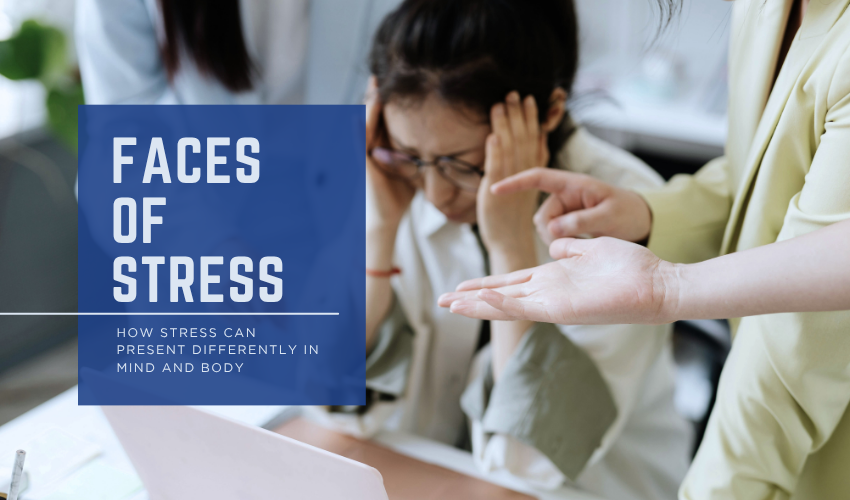
Discover the different faces of stress and how stress can affect the mind and body through emotional, physical, cognitive, and behavioural symptoms. Learn the signs, causes, and ways to manage stress effectively.
Here’s something most people get completely wrong about stress:
They think they’d know it if they had it.
They picture the panicked person, the overwhelmed parent, the executive having a breakdown in a parking lot. And because they’re not that person, because they’re still showing up, still functioning, still keeping it together, they assume stress isn’t the problem.
This is where most people miss it entirely.
Stress doesn’t always look like anxiety. It doesn’t always feel like worry. For a lot of people, it looks like a persistent headache that won’t quit. A short fuse with the people they love. An inability to concentrate on anything for more than three minutes. A gut that’s always churning without a clear medical reason.
This article isn’t going to tell you stress is secretly killing you or that you need to overhaul your entire life by Tuesday. What it will do is show you the many forms stress actually takes, so you can recognise it in yourself, understand why it looks different for different people, and know when it’s time to do something about it.
What Stress Actually Is (Not the Definition You Already Know)
Let’s be honest, most people have heard the “fight-or-flight” explanation so many times it’s stopped meaning anything.
So here’s what it actually means in practice.
Stress is your mind and body’s response to demands that feel like they exceed your ability to cope. That’s it. It’s not a character flaw. It’s not weakness. It’s a biological system doing exactly what it was designed to do, except in modern life, it often doesn’t get to switch off.
When your brain detects stress, it triggers a cascade. Adrenaline. Cortisol. Heart rate up. Muscles tighten. Breathing sharpens. You’re primed to either run or fight.
That system is extraordinary in a genuine emergency.
The problem is that your nervous system can’t easily distinguish between a lion chasing you and a string of unanswered emails. It responds to both with the same urgency.
Acute stress is short-lived, a difficult meeting, a near-miss on the motorway, a confrontation that passes. The body recovers, and life continues.
Chronic stress is different. That’s when pressures don’t let up over weeks, months, sometimes years. When the recovery window never opens. The longer that system stays activated, the more it starts to affect everything else, sleep, digestion, mood, concentration, relationships.
Why Your Stress Doesn’t Look Like Theirs
Here’s what nobody tells you when they talk about stress: there’s no universal version of it.
Two people can go through the same job loss, the same relationship breakdown, the same gruelling workload, and emerge with completely different symptoms. One develops anxiety and racing thoughts. The other gets migraines and can’t eat. A third seems completely fine on the outside while quietly unravelling.
This isn’t random. There are real reasons why stress presents so differently.
Biology and temperament matter. Your nervous system’s baseline sensitivity, partially genetic, partially developed through early life experience, shapes how intensely you respond to stressors and which systems in your body feel it first.
Past experiences matter too. How you learned to handle difficulty, what coping strategies you picked up (or didn’t), and how your body learned to process threat all influence the picture. Someone who learned early that emotions weren’t safe to express might find stress shows up almost entirely in physical symptoms.
And then there’s culture. Gender expectations, family norms, social environments, these shape what kinds of stress responses feel acceptable to show. In some contexts, admitting emotional distress isn’t an option, so it goes underground. And comes out somewhere else.
The result? The many faces of stress you’re about to see.
The Emotional Faces: When Your Mood Is Sending You a Message
Emotional changes are often the first signal that stress is becoming unmanageable, and also the ones most easily dismissed as “just having a bad week.”
Watch for irritability that feels disproportionate. A short fuse. Snapping at people over things that wouldn’t normally register. Feeling on edge without a clear reason. These aren’t personality flaws, they’re your nervous system running hot.
Feeling overwhelmed is another one. That sense that everything, even routine, manageable tasks, suddenly feels like too much. Where a normal to-do list starts to feel like a mountain.
And then there’s emotional exhaustion. The numbness. The flatness. The low motivation that isn’t quite depression but isn’t quite fine either. Prolonged stress depletes emotional resources in the same way physical exertion depletes the body. You can only sustain it for so long before the tank runs empty.
Sound familiar? Keep reading.
The Physical Faces: When Your Body Starts Keeping Score
This is where stress gets sneaky.
Physical symptoms are frequently dismissed, or attributed to entirely separate medical issues, when stress is actually the primary driver. And because the body and mind are not as separate as we like to think, stress has a wide reach physically.
The most common include tension headaches, neck and shoulder pain, and jaw tightness (often noticed at night, or only when someone points it out). Persistent fatigue that doesn’t improve with rest. A body that feels heavy and achy without obvious cause.
Your gut is particularly reactive to stress. Nausea, stomach discomfort, irritable bowel-type symptoms, appetite shifts, either losing interest in food or eating for reasons that have nothing to do with hunger, these are classic stress signatures, though they’re often investigated medically without stress ever entering the conversation.
Sleep is almost always affected. Difficulty falling asleep, waking at 3am with a busy mind, sleeping enough hours but waking up exhausted, these are reliable indicators that your nervous system isn’t getting the recovery it needs.
Here’s what this means for you: if you’re managing a rotating roster of physical symptoms without clear medical explanation, stress deserves serious consideration. This isn’t about dismissing real physical problems. It’s about not missing the ones that have a psychological root.
The Cognitive Faces: When Your Brain Stops Cooperating
Stress doesn’t just affect how you feel. It changes how you think.
Concentration problems are one of the most common and underreported effects. Forgetting things. Losing your place mid-task. Reading the same paragraph four times. Being physically present in a conversation while your brain is somewhere else entirely.
Racing thoughts are another. That relentless mental chatter that doesn’t let up even when you want to rest. The mind that stays “on” regardless of what you do to switch it off.
Chronic stress also impairs decision-making. Even small decisions start to feel disproportionately difficult. There’s a reason stressed people often describe being unable to make choices they’d normally handle without a second thought, the cognitive load of sustained stress exhausts the mental resources required for clear thinking.
The Behavioural Faces: What Stress Looks Like in Action
Here’s where stress becomes visible to the people around you, even when you haven’t noticed it yourself.
Productivity shifts. Some people become scattered, unable to complete tasks or maintain any kind of structure. Others go the opposite direction, using overwork as a pressure valve, keeping busy as a way to outrun how they’re actually feeling.
Social withdrawal. Cancelling plans. Going quiet. Reducing contact with people who would normally be energising. Stress narrows the world.
Increased conflict in relationships. Saying things you don’t mean. Reacting rather than responding. Stress lowers the threshold for interpersonal friction.
And then there are coping behaviours, the ones that provide temporary relief while quietly making things worse. Avoidance. Procrastination. Increased alcohol use. Emotional eating. These aren’t moral failures. They’re the strategies people reach for when they don’t have better ones to hand.
The bottom line: behaviour is often the last domino to fall. By the time it changes visibly, stress has usually been building for a while.
The Hidden Faces Of Stress: The Ones Easiest to Miss
This is the one worth paying the most attention to.
Some people carry significant stress while appearing completely functional. They hit their targets. They show up. They hold conversations without giving anything away. From the outside, everything looks fine. On the inside, there’s a constant low-grade sense of exhaustion, tension, or dread.
This is sometimes called high-functioning stress, and it’s particularly easy to miss because the external signals just aren’t there. The person experiencing it often dismisses their own symptoms: “I’m still getting things done, so it can’t be that bad.”
It can be. And it often gets worse before it gets recognised.
Then there are the subtle physical symptoms that rarely get linked to stress: skin flare-ups, dizziness, teeth grinding, digestive sensitivity, chronic low-level fatigue. These are easy to attribute to other causes, and sometimes they do have other causes. But stress should always be in the differential.
Here’s something else that catches people off guard: symptoms sometimes emerge after a stressful period ends. Once the pressure lifts, after the project is finished, after the crisis resolves, that’s when exhaustion or illness surfaces. The body was holding it together under demand, and it releases once demand eases.
Stress Looks Different at Every Stage of Life
Children and adolescents rarely say “I’m stressed.” Instead, they become irritable, clingy, or withdrawn. School performance dips. Sleep changes. Unexplained physical complaints appear. Behaviour often communicates what words don’t.
Working-age adults absorb stress from multiple directions simultaneously, careers, finances, relationships, caregiving responsibilities, parenting, often with very little recovery space built into daily life.
Older adults face a particular set of pressures: health concerns, grief and bereavement, social isolation, the gradual loss of independence. These are real and significant stressors that are sometimes minimised or assumed to be “just part of getting older.”
They’re not. Stress at any age deserves attention.
When Stress Crosses Into Something That Needs Professional Assessment
Let’s be clear about where normal stress ends and clinical concern begins.
Stress and anxiety disorders overlap significantly. When worry becomes excessive, persistent, and difficult to control, when it’s no longer proportionate to actual circumstances, that’s a signal worth taking seriously.
Chronic stress and depression also have a well-documented relationship. Prolonged stress depletes the same neurological resources that underpin mood regulation. Long enough exposure, and the line between “I’m burned out” and “I’m depressed” becomes harder to draw.
Professional assessment is worth seeking if: symptoms have persisted for weeks or months without improvement, stress is significantly affecting your work, relationships, or daily functioning, you’re relying heavily on coping behaviours that are making things worse, or something just feels wrong and you can’t identify why.
This isn’t about pathologising normal human experience. It’s about not suffering longer than necessary because you weren’t sure things were “bad enough” to warrant help.
How Stress Is Assessed and What Comes Next
A proper clinical assessment for stress isn’t just “tell me about your week.”
It involves exploring symptom patterns, what’s happening, how often, how long. Understanding your stressors and triggers. Reviewing sleep, lifestyle, and physical health. Assessing emotional wellbeing alongside physical symptoms. And screening for related conditions where appropriate, including anxiety, depression, and trauma responses.
The goal is to identify which faces of stress are most prominent for you, because the management approach should be tailored accordingly.
Physical tension responds well to relaxation techniques, exercise, and body-based approaches. Cognitive symptoms, the racing thoughts, the concentration problems, often improve with mindfulness-based practices or cognitive behavioural techniques. Emotional overwhelm tends to need relational support: therapy, trusted relationships, sometimes a structured stress management programme.
Lifestyle factors underpin everything: sleep quality, movement, nutrition, and structured routine aren’t optional extras in stress recovery. They’re the foundation.
What You Can Actually Do About Stress
Managing stress well isn’t about eliminating all pressure. It’s about improving your capacity to respond to it, and recovering from it.
Practically, this means: building genuine recovery time into your life, not just the idea of it. Developing adaptive coping skills, which often means replacing the default ones (avoidance, overwork, alcohol) with something more effective. Strengthening social connections, which research consistently shows to be one of the most powerful buffers against stress. And setting realistic limits on what you take on and what you expose yourself to.
Preventing chronic stress also means catching it early. The most effective intervention point is before it becomes entrenched. That means paying attention to the early signals, mood shifts, sleep changes, and physical tension, and treating them as information rather than an inconvenience.
The Signs You Should Not Ignore
Seek support when stress has been present for more than a few weeks without improvement.
Seek support when it’s affecting your ability to work, maintain relationships, or function in daily life.
Seek support when your coping mechanisms are causing their own problems.
And seek support if you’re unsure, because uncertainty isn’t a reason to wait.
Support options include counselling and psychotherapy, stress management programmes, lifestyle-focused interventions, and where symptoms are complex or persistent, psychiatric assessment to rule out or address underlying conditions.
Frequently Asked Questions About Faces Of Stress
People ask a lot of questions about stress. Here are the ones that come up most, answered directly, without the fluff.
Does stress always feel like anxiety or worry?
No. And this is the misconception that causes the most problems.
Stress can feel like constant fatigue, physical tension, digestive issues, irritability, or a foggy brain. Many people experiencing significant stress don’t feel particularly anxious, they just feel exhausted, snappy, or physically unwell. If you’re waiting to feel “worried enough” before taking stress seriously, you might be waiting for a signal that never arrives in that form.
Why does stress affect people so differently?
Biology, personality, past experiences, and environment all play a role. Your nervous system’s baseline sensitivity is partly genetic. Your coping strategies were shaped by what you learned growing up. Your culture influences which symptoms feel acceptable to acknowledge and which get suppressed.
Two people in identical situations can have completely different stress responses, and both responses are valid. There’s no “standard” version to compare yourself against.
Can stress actually cause physical illness?
Here’s the reality: chronic stress doesn’t just feel bad. It has measurable effects on the body over time.
Sustained cortisol elevation affects immune function, cardiovascular health, digestion, sleep quality, and inflammatory responses. This doesn’t mean stress causes every physical problem, but dismissing it as “just psychological” misses how deeply interconnected the mind and body actually are. Physical symptoms with no clear medical cause deserve stress to be in the conversation.
What’s the difference between normal stress and something more serious?
Duration and impact. That’s where most clinicians draw the line.
Short-term stress in response to real pressure is normal. It passes when the pressure eases. What warrants closer attention is stress that persists for weeks or months, that doesn’t improve even when circumstances change, or that’s significantly affecting sleep, work, relationships, or functioning. That’s when it stops being situational and starts being something that needs proper assessment.
What is high-functioning stress, and how do I know if I have it?
High-functioning stress is exactly what it sounds like: carrying a significant internal stress burden while continuing to perform externally. You’re meeting deadlines. You’re showing up. You’re holding things together. But underneath, there’s persistent tension, exhaustion, or emotional flatness that never quite lifts.
The giveaway is often the gap between how things look and how they actually feel. If the answer to “how are you?” is always “fine, just busy”, and has been for months, it’s worth looking more honestly at what’s running in the background.
What You Need to Take Away From This
Stress doesn’t wear one face. It wears dozens.
It can look like anxiety. It can look like a bad back. It can look like someone who’s quietly fine while privately struggling. It can look like short tempers, forgotten tasks, gut problems, and 3am wakefulness. It can look like high performance and hidden exhaustion existing simultaneously.
Recognising your particular version of stress matters, because the right response depends on knowing what you’re actually dealing with.
No two people will experience or manage stress identically. But the fundamentals are consistent: early recognition is better than late, honest assessment is more useful than minimisation, and getting appropriate support isn’t a last resort. It’s just the sensible move. If something in this article felt uncomfortably familiar, that’s not a coincidence. And it’s worth paying attention to.