Drug Addiction Before and After: What Actually Happens to You, And Why Recovery Is Harder (and More Possible) Than You Think
April 13, 2026
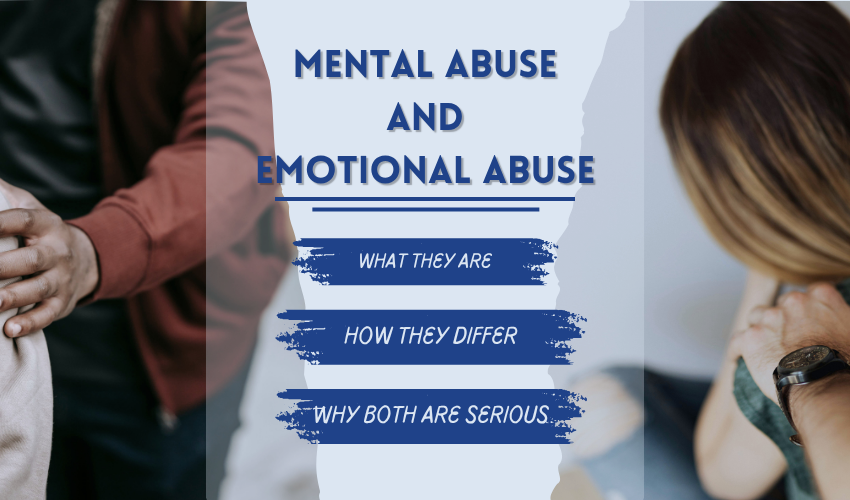
Mental Abuse and Emotional Abuse: What They Are, How They Differ, and Why Both Destroy You From the Inside Out
April 18, 2026
Learn what mental and psychological abuse is, how it manifests in relationships, and how to recognise the warning signs early. This guide to mental and psychological abuse helps you understand its impact and when to seek support.
Nobody tells you this about psychological abuse:
It’s often invisible. Even to the person living it.
No bruises. No scars. Nothing you can point to and say, “there, that’s the proof.” And that invisibility is exactly what makes it so dangerous.
If you’ve found yourself questioning your own memory, walking on eggshells around someone you love, or wondering whether what you’re experiencing even “counts” as abuse, this article is for you.
Here’s what we’re going to cover: what psychological abuse actually is, how it works, how to spot it, and what you can do about it. We’re not going to promise you a quick fix. But we will give you clarity, and clarity is usually where recovery begins.
What Psychological Abuse Actually Is (And What It Isn’t)
Let’s start with a definition that actually means something.
Mental and psychological abuse is a pattern of behaviours used to control, manipulate, intimidate, or undermine another person. The word “pattern” matters here. One bad argument doesn’t make abuse. One unkind comment doesn’t either.
Here’s the reality: abuse is about consistent, repeated dynamics that create a power imbalance. It’s not about individual incidents, it’s about what those incidents add up to over time.
Clinically, psychological abuse is recognised as a form of emotional harm with measurable effects on mental health. Legally, in the UK, it falls under coercive and controlling behaviour frameworks, a serious acknowledgement that harm doesn’t require a raised fist.
There’s a meaningful difference between conflict and abuse. Healthy conflict involves both people being heard, some degree of mutual respect, and some path to resolution. Abuse involves none of that. It involves one person consistently working to diminish, control, or destabilise the other.
And psychological abuse frequently overlaps with emotional abuse and coercive control, these aren’t separate boxes, they’re points on the same spectrum.
Who Does This Happen To?
Here’s what most people get wrong: psychological abuse isn’t just a relationship problem.
Yes, it happens in romantic partnerships. But it also happens between parents and children, siblings, colleagues, managers, and social groups. Anywhere a power imbalance exists, or can be created, the conditions are there.
And it doesn’t discriminate. Any age. Any gender. Any background. Any income level. The idea that psychological abuse only happens to a certain “type” of person is one of the most harmful myths in this space, because it stops people from recognising their own experience.
The Tactics. Here’s What They Actually Look Like.
Gaslighting is probably the most discussed tactic, and for good reason. It involves systematically denying facts, twisting information, or dismissing your experiences until you start doubting your own memory. “That never happened.” “You’re too sensitive.” “You’re imagining things.” Over time, your grip on reality loosens, which is exactly the point.
Isolation is simpler and more insidious. The abuser works to cut you off from friends, family, and support networks. Not always dramatically, often through subtle discouragement, manufactured conflict, or guilt. The goal is dependency. The fewer people you have around you, the easier you are to control.
Persistent criticism and humiliation erodes confidence. This isn’t feedback. This is a steady drip of put-downs, insults, and belittling comments designed to make you feel small, and keep you there.
Threats and intimidation don’t always look like shouting. They can be implied. A look. A silence. An atmosphere of fear that you’ve learned to navigate without anyone saying a word.
The silent treatment isn’t just moodiness, it’s weaponised withdrawal. Withholding communication or affection as punishment keeps you anxious, compliant, and focused on managing the other person’s emotions rather than your own.
Surveillance and control shows up as excessive monitoring, checking your phone, tracking your location, controlling who you see or where you go. This is not protectiveness. It is a mechanism of control.
How It Starts: The Pattern Nobody Expects
This is where most people get it wrong.
They imagine abuse beginning with obvious cruelty. It rarely does.
It often starts with the opposite. Psychological abuse frequently begins with what’s called love bombing, overwhelming affection, attention, and idealisation in the early stages of a relationship. You feel chosen, Special, and Seen.
Then, gradually, things shift. The standards change. The goalposts move. The affection becomes conditional. But by then, you’ve already built a relationship around this person, and the changes are slow enough that each one, on its own, seems explainable.
This is the grooming process. Not in the dramatic sense, but in the very ordinary sense of becoming accustomed to behaviours that you would never have accepted on day one. The escalation is gradual. The normalisation is quiet. And by the time the pattern is clear, you may have been living inside it for years.
Recognising It: Signs in Yourself and Others
If you’re experiencing it yourself, you might notice:
Persistent self-doubt. Constantly second-guessing your own memory or judgement. Walking on eggshells. Feeling anxious around a specific person. Making yourself smaller to avoid a reaction. Feeling confused after conversations that seemed to say one thing but meant another.
If you’re watching someone else, look for:
Withdrawal from people they used to be close to. A noticeable change in confidence or personality. Increased anxiety. Deferring to another person constantly, checking before they speak, looking for approval before they act.
Here’s the truth: because psychological abuse develops gradually, many people don’t recognise it until significant harm has already occurred. This isn’t weakness. It’s what happens when you’re inside a slowly shifting system, you adjust to each change before the next one arrives.
The Myths Worth Addressing Directly
“It’s not really abuse if there’s no physical violence.”
This is wrong. Psychological abuse can cause damage that is just as serious, sometimes more lasting, than physical harm. The absence of physical violence does not define the presence or absence of abuse.
“It only happens in romantic relationships.”
Also wrong. Families, workplaces, friend groups. Anywhere people interact, the potential exists.
“You’d know if it was happening to you.”
Not necessarily. The gradual nature of psychological abuse means that by the time the pattern is clear, you may have already adapted to it as normal.
What It Does to You Over Time
Short-term: confusion, self-doubt, reduced confidence, anxiety, difficulty trusting your own perceptions.
Long-term: the picture can be more serious. Anxiety disorders. Depression. Post-traumatic stress disorder. These are not uncommon outcomes of prolonged psychological abuse, and they’re not signs of weakness. They are the predictable result of sustained harm.
Daily functioning is often affected too: decision-making, the ability to form healthy relationships, and basic sense of self can all be significantly disrupted.
The Legal Position in the UK
Psychological abuse has legal weight in the UK, and that matters.
Coercive and controlling behaviour is a criminal offence. The Domestic Abuse explicitly includes psychological and emotional abuse within its definition of domestic abuse. This isn’t just symbolic. It reflects a serious legal acknowledgement that non-physical harm is real harm.
If you’re considering reporting abuse to authorities, speaking first with a specialist support service can help you understand your options and what to expect.
If Someone You Know Might Be Experiencing This
Approach carefully.
Listen without judgement. Don’t push them to act before they’re ready. Don’t express disbelief, or minimise what they’re describing, or tell them what you would do in their position. These responses, however well-intentioned, can increase isolation and distress.
The most useful thing you can do is stay present. Offer information. Remain available. Respect their autonomy. And gently encourage access to professional support without making it a condition of your relationship with them.
Getting Help Regarding Mental and Psychological Abuse
If you’re experiencing the effects of psychological abuse, a GP or mental health professional is a good starting point; they can assess what’s happening and connect you to appropriate support.
In the UK, specialist domestic abuse services and helplines are available and confidential. Talking therapies, particularly trauma-informed approaches and CBT, have a strong evidence base for supporting people through this kind of experience.
Recovery is not a single event. It’s a process, often involving rebuilding confidence, identity, and the ability to trust your own judgement. That takes time. And it’s entirely possible.
The Answers to Questions People Are Afraid to Ask
Can it happen without any physical violence?
Yes. Often it does.
What’s the difference between gaslighting and general manipulation?
Gaslighting is a specific, sustained pattern aimed at making you doubt your own reality. Manipulation is broader; gaslighting is a particularly targeted form of it.
How long does it take to recognise?
Months to years. The gradual nature is part of what makes it so hard to identify.
Can men experience this?
Yes. People of all genders can experience psychological abuse. Support services are available for everyone.
What mental health conditions can result?
Anxiety, depression, complex PTSD, and significant impacts on self-esteem are all commonly associated. Professional assessment is important for accurate diagnosis.
The Bottom Line
Mental and psychological abuse is real, serious, and often hidden, including from the person experiencing it.
It doesn’t require physical violence to cause lasting harm. It can happen in any relationship. And it typically develops gradually enough that by the time the pattern is obvious, significant damage may already have been done.
If something feels wrong, that’s worth paying attention to.
Not every difficult relationship is abusive, but your experience deserves to be taken seriously, including by you. If you or someone you know needs support, the NHS, national helplines, and local specialist services are all available. You don’t need to have everything figured out before you reach out.