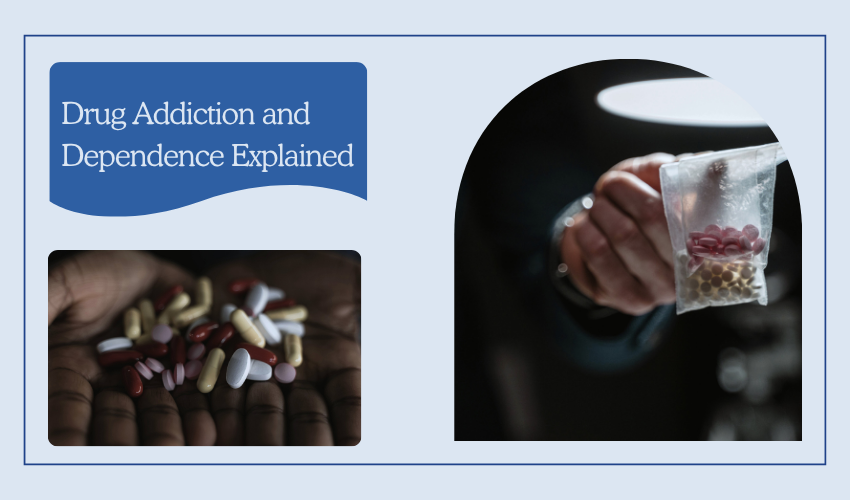
Drug Addiction and Dependence: What Nobody Actually Tells You
April 11, 2026
What Is Mental and Psychological Abuse? A Guide to Recognising the Signs in Relationships
April 17, 2026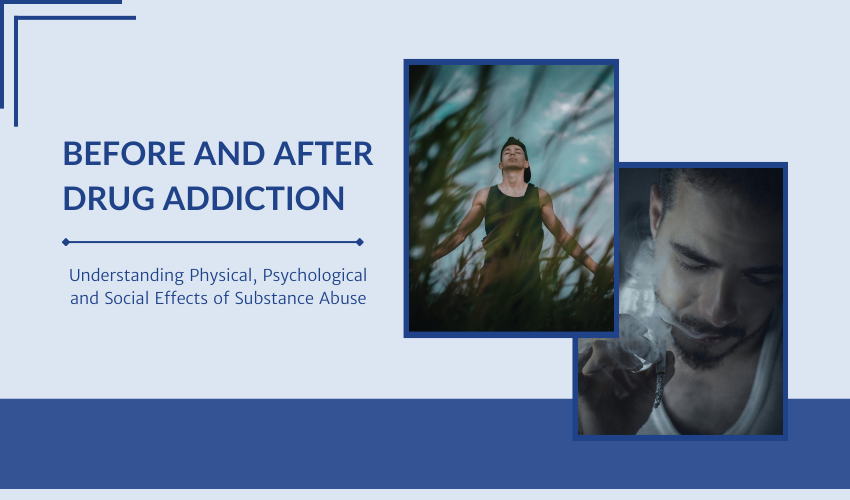
Explore the effects of drug addiction before and after, including the physical, psychological, and social effects of substance use. Learn key signs, causes, and recovery pathways.
Here’s the uncomfortable truth most articles won’t say upfront:
Reading about drug addiction won’t fix it. Not yours, not someone you love.
What it will give you is clarity.
Because right now, you’re probably dealing with one of two problems. Either you’re watching addiction dismantle someone’s life from the outside, helpless, frustrated, scared. Or you’re inside it, wondering how you got here and whether there’s a way out.
Both are legitimate. Both deserve a straight answer. So here’s what this guide actually covers: the clinical reality of what addiction does to a brain, a body, a family, and a life, and what “after” genuinely looks like. No miracle framing. No recovery porn. Just what you need to know.
It Didn’t Start With a Choice. But It Rarely Starts With a Crisis Either.
Most people imagine addiction begins with a dramatic moment. It doesn’t.
It usually starts quietly. A few drinks to unwind. A prescription to manage pain. Something that works, until it works too well, and then you need more of it to get the same effect.
This is where most people get it wrong: they assume addiction is about weakness or poor character. It’s not. It’s about brain chemistry doing exactly what it’s designed to do, seek reward, avoid pain, repeat what works.
The problem is that substances hijack that system.
Almost every addictive substance floods the brain with dopamine, the neurochemical your brain uses to mark “do that again.” Over time, the brain stops producing as much dopamine naturally. It starts expecting the substance to do that job. Normal life, food, connection, achievement, starts feeling flat. The substance feels like the only thing that still works.
That’s not a weakness. That’s neurological adaptation.
Here’s the reality: genetics load the gun, environment pulls the trigger. People with a family history of addiction are measurably more vulnerable. So are people who experienced trauma, abuse, or adverse childhood experiences. So are people who first used during adolescence, before their brain’s decision-making architecture was fully formed.
None of this excuses the behaviour. But it explains why willpower alone rarely solves it.
What Prolonged Drug Use Actually Does to the Brain
Let’s separate myth from mechanism.
You’ve probably heard that addiction “changes the brain.” That’s true, but most people don’t understand what that actually means.
The brain adapts to repeated drug use by rewiring its reward pathways. The prefrontal cortex, the part responsible for planning, impulse control, and rational decision-making, becomes less effective. The limbic system, your emotional, instinct-driven core, gets louder. The result is a brain that increasingly prioritises short-term relief over long-term consequence.
This is why people with addiction make decisions that look irrational from the outside. It’s not that they can’t see the consequences. It’s that the part of the brain meant to pump the brakes has been progressively compromised.
Here’s what this means for recovery: stopping isn’t just about deciding to stop. It requires rebuilding neural pathways, which takes time, structured support, and often clinical intervention.
The good news? The brain retains significant capacity for change. With sustained abstinence and the right treatment, many of these changes reverse. Not all of them, not immediately, and not for everyone, but the trajectory is real.
The Physical Toll! And What Healing Actually Looks Like
Drug addiction doesn’t just affect the mind. The body takes the hit too.
In the short term, depending on the substance, you’re looking at disrupted sleep, appetite changes, elevated heart rate, and impaired coordination. Unpleasant. Manageable. Reversible.
The long-term picture is more serious.
Liver disease, cardiovascular damage, respiratory problems, immune suppression, these aren’t hypothetical risks. They’re documented, common outcomes of sustained heavy substance use. Some are reversible with treatment. Some leave permanent marks.
But here’s what’s also true and often overlooked:
The body has a remarkable capacity to recover when given the chance.
Blood pressure normalises. Liver function often improves significantly with abstinence. Sleep patterns stabilise. Energy returns. The timeline varies, weeks for some changes, months or years for others, but the direction, with proper care, is consistently toward recovery.
The body wants to heal. It just needs the conditions to do it.
The Psychological Reality About Drug Addiction Before and After Nobody Warns You About
Here’s what nobody tells you about the psychological side of addiction:
It rarely exists in isolation.
The majority of people struggling with addiction are also managing something else, anxiety, depression, PTSD, unprocessed trauma. For many, the substance was never really the problem. It was the solution they found for a problem nobody helped them address differently.
This matters enormously for treatment. Because if you only treat the addiction without addressing what’s underneath, you’re building on an unstable foundation.
During active addiction, the psychological profile is often marked by mood instability, difficulty concentrating, increased impulsivity, and distorted thinking. These aren’t personality flaws. They’re symptoms of a brain under chemical siege.
During recovery, the shift is gradual but real. Emotional regulation improves. Cognitive clarity returns. People describe rediscovering things they thought were gone, motivation, creativity, the ability to feel genuine pleasure.
That doesn’t happen overnight. But it happens.
What It Does to Relationships, Work, and Everything Else
Addiction doesn’t stay in a box. It spreads.
Family relationships fracture under the weight of broken promises, erratic behaviour, and the particular anguish of watching someone you love disappear into something you can’t fight. Trust erodes slowly, then suddenly.
Parenting suffers. Employment suffers. Financial stability suffers. And in trying to protect themselves, people around the individual often pull back, which only deepens the isolation that feeds the cycle.
Social isolation is both a consequence and a cause of addiction. Pull the thread and it loops back on itself.
Fewer meaningful connections → more reliance on the substance → more behaviour that drives people away → fewer connections.
This is why recovery isn’t just a medical event. It’s a social rebuild.
Recognising It! In Yourself or Someone Else
Let’s be honest: most people already know something is wrong before they name it.
The signs accumulate. Secretive behaviour that didn’t used to be there. Disappearing money. Missed commitments. A decline in physical appearance or hygiene. Withdrawal from activities and people that used to matter.
Physiologically, dependence announces itself through tolerance, needing more to get the same effect, and withdrawal, feeling unwell when the substance isn’t present. Cravings that feel less like a want and more like a need.
Sound familiar?
If you’re asking whether you or someone you know has a problem, that question itself is usually the answer.
The Addiction Myth That Keeps People Stuck
Here’s the one that does the most damage:
The belief that addiction is a moral failing.
It’s not. Clinically, it’s classified as Substance Use Disorder, a chronic medical condition involving identifiable neurological changes and a recognisable symptom pattern. You wouldn’t tell someone with diabetes they just need more willpower. The same logic applies here.
Stigma, from others or from within, is one of the most significant barriers to people seeking help. It delays treatment. It increases shame. It costs lives.
If you’re carrying that stigma, it’s worth putting it down. Not because the behaviour hasn’t caused harm, it often has, but because shame is not a treatment. It doesn’t help anyone get better.
Assessment and Diagnosis, What Actually Happens?
If you or someone you know seeks professional support, here’s what the initial assessment typically involves:
A clinical interview exploring the history, pattern, and impact of substance use. Screening questionnaires to assess severity. A review of relevant medical history. An honest conversation, no judgment, just information.
Diagnosis is based on recognised criteria (the DSM-5 or ICD-11 frameworks), looking at the pattern of use, the loss of control, and the consequences. The goal isn’t to label you. It’s to understand what’s happening so the right support can be offered.
If you’re not sure whether what you’re experiencing qualifies, here are three questions worth sitting with: Has substance use affected your life in ways you didn’t choose? Have you tried to stop and found you couldn’t? Do cravings or withdrawal drive your decisions?
If you answered yes to any of those, that’s enough to seek a conversation.
Treatment: What’s Available and What Actually Works
There’s no single right answer here. What works depends on the substance, the severity, the individual, and what they have access to.
Medically supervised detox is typically the first step for physical dependence. Withdrawal from alcohol, opioids, and benzodiazepines can be medically dangerous, never attempt cold-turkey detox from these without clinical support.
Talking therapies, particularly Cognitive Behavioural Therapy (CBT) and Motivational Interviewing, address the psychological architecture of addiction. They don’t fix everything, but the evidence base is solid.
Medication-Assisted Treatment (MAT), using medications like methadone or buprenorphine, is one of the most evidence-backed approaches for opioid dependence. It reduces cravings, stabilises people, and saves lives. It’s also one of the most misunderstood and stigmatised treatments available.
Residential rehabilitation provides intensive, structured support for people whose addiction is severe or whose home environment makes recovery difficult. It’s not necessary for everyone, but for some it’s the right starting point.
And many people recover through outpatient treatment, community support, and GP-led care, without ever setting foot in a residential facility.
The bottom line: there are multiple valid pathways. The best one is the one the person will actually use.
In the UK: NHS vs Private! What You Need to Know
In the UK, support is available through both NHS and private routes.
NHS: Free at the point of use. Access your GP, or refer directly to your local drug treatment service. The level of care is often good, but waiting times exist, and you may not always get to choose your treatment approach.
Private treatment: Faster access, typically more personalised, and with greater choice of clinician and setting. Costs vary considerably, so it’s worth understanding what’s included.
Neither route is objectively better. The right choice depends on urgency, personal circumstances, and what’s available in your area.
If Someone You Love Is Struggling
You can’t force recovery. But you can create conditions that make it more possible.
Listening without judgment is underrated. So is expressing concern without ultimatums, at least as a first step. Encouraging professional help, and being patient when progress is slow or non-linear, matters more than most people realise.
At the same time: you are not required to absorb unlimited harm to prove you care. Healthy boundaries, what you will and won’t accept, protect both you and the person you’re trying to support. They are not abandonment. They are sustainability.
If a formal conversation about treatment feels necessary, a structured intervention, ideally facilitated by a professional, can help. But it requires careful preparation, not confrontation.
When to Get Help Immediately
Some situations can’t wait for a scheduled appointment.
Severe withdrawal symptoms, particularly from alcohol, benzodiazepines, or opioids, can be life-threatening. Seizures, confusion, chest pain: these are medical emergencies.
Overdose is always a medical emergency. Call 999 immediately. If naloxone is available and you’ve been trained to use it, use it while waiting for help.
If there’s a mental health crisis alongside the addiction, suicidal ideation, psychosis, severe self-harm, treat it as the emergency it is.
When in doubt, err toward acting.
The Questions People Ask Most
Can the brain fully recover after long-term drug use?
To a significant extent, yes, particularly with sustained abstinence and structured treatment. Some changes may persist, but the trajectory with proper support is toward meaningful improvement.
How long does recovery take?
It varies enormously. For most people, it’s a long-term process rather than a defined endpoint. Think years, not weeks.
Can someone become addicted after using it only a few times?
Yes. Some substances, particularly opioids, can establish dependence rapidly, especially in individuals with genetic or psychological vulnerability.
What’s the difference between relapse and returning to full addiction?
A relapse is a temporary return to use. It doesn’t erase progress or mean recovery has failed. Full addiction involves a sustained return to compulsive, uncontrolled use. The distinction matters, both clinically and psychologically.
Can someone recover without residential rehab?
Absolutely. Many people do. The level of support needed depends on severity, not a fixed rule.
What “After” Actually Looks Like
Recovery isn’t a destination. It’s a direction.
In clinical terms, recovery means improved functioning, not necessarily perfect abstinence in perpetuity, but a life that’s no longer controlled by substance use. Better relationships. Regained employment. A returning sense of purpose.
Relapse can and does happen. For many people, it happens more than once. That is not failure. It is part of the non-linear nature of a chronic condition, similar in that respect to other chronic health conditions where management, not cure, is the realistic frame.
Peer support groups, community services, and long-term therapeutic relationships all play a role in sustaining recovery. The research on this is consistent: connection is protective.
The Bottom Line
Drug addiction before and after isn’t a simple story of fall and redemption. It’s a complex, often painful process that affects brain chemistry, physical health, relationships, identity, and that reverses slowly, unevenly, and with effort.
Here’s what’s also true:
Recovery is not a fantasy. People rebuild lives, repair relationships, and regain function every day. Not because of magic, but because the right support makes a real difference.
If you’re at the point where you’re reading articles like this, something in you is already reaching for something better. That matters. The next step is a conversation with a professional, your GP, a local drug service, or a private specialist. Start there. Be honest. The rest follows.