Can PTSD Cause Memory Loss: What’s Actually Happening Inside Your Brain
April 9, 2026
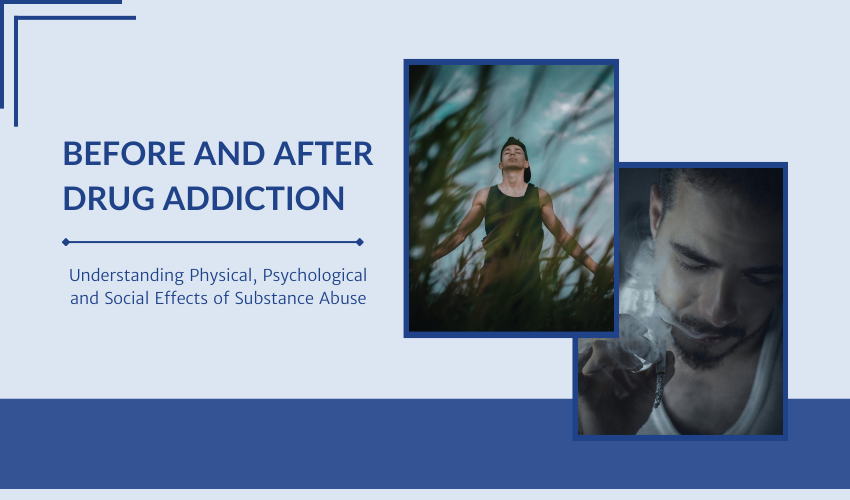
Drug Addiction Before and After: What Actually Happens to You, And Why Recovery Is Harder (and More Possible) Than You Think
April 13, 2026
Understand drug addiction and dependence, including causes, symptoms, and key warning signs. Learn when to seek help and explore effective treatment options for recovery.
Most people searching for this topic are doing so in pain.
Either they’re watching someone they love disappear into substance use, or they’re the one disappearing, and they need answers that aren’t wrapped in clinical cotton wool.
Here’s what this article will give you: a clear, honest breakdown of what drug addiction and dependence actually are, how they differ, what causes them, and when it’s time to stop reading and start acting.
Here’s what it won’t give you: false hope, miracle promises, or the suggestion that understanding this is the same as fixing it.
Let’s get into it.
Addiction and Dependence Aren’t the Same Thing, And Confusing Them Causes Real Damage
Everyone uses these words interchangeably. Even people who should know better.
But in clinical practice, the distinction matters enormously, because confusing them leads to misdiagnosis, unnecessary shame, and people not getting the right kind of help.
Here’s the core difference:
Dependence is primarily a physiological process. Your body adapts to a substance, needs more of it to achieve the same effect (tolerance), and protests when you take it away (withdrawal). It’s biological. It can happen to anyone on certain medications, including people who take them exactly as prescribed.
Addiction is different. It’s a behavioural and neurological condition, characterised by compulsive use despite knowing the consequences. It hijacks the brain’s reward system. It distorts decision-making. And critically, it involves a loss of control that goes far beyond physical dependence.
Can you have dependence without addiction? Yes. Absolutely.
A patient taking opioids for chronic pain under medical supervision can become physically dependent, their body adapts to the drug, without ever displaying the compulsive, loss-of-control behaviour that defines addiction.
This distinction is crucial. Not just clinically, but for how we talk about people who are struggling.
How Drug Dependence Actually Develops
The process starts with tolerance. Your body is remarkably adaptive, when exposed to a substance regularly, it compensates, and the same dose produces a diminishing effect. So you need more. And more. That’s how dependence builds.
There are two dimensions to this:
Physical dependence means your body now requires the substance to function normally. Remove it suddenly, and the system rebels, withdrawal kicks in.
Psychological dependence is the emotional and mental layer. The substance has become your coping mechanism. Your comfort. Your reset button. You haven’t just adapted physically, you’ve reorganised your internal world around it.
The substances most likely to drive physical dependence are opioids (including heroin and morphine), benzodiazepines, alcohol, and nicotine. These aren’t arbitrary examples, they directly interact with physiological systems that adapt quickly and protest loudly when disrupted.
How Drug Dependence Becomes Drug Addiction
Here’s the part most people get wrong.
Dependence and addiction sit on a spectrum, but they’re not the same destination. Plenty of people develop physical dependence and never cross into addiction. What pushes someone from one to the other?
The brain’s reward system.
Substances, particularly those associated with addiction, flood the brain with dopamine. That hit of reward is powerful. The brain starts to learn: this substance = relief, pleasure, escape. It begins to prioritise getting that hit. And over time, that priority starts to override everything else.
Decision-making changes. Impulse control erodes. The person continues using even when it’s clearly harming them, their health, their relationships, their career. Not because they want to. But because the neurological rewiring has made stopping feel impossible.
This is where addiction diverges from dependence. Dependence can often be managed medically. Addiction requires a different kind of intervention entirely.
But here’s the truth most people don’t want to hear: not everyone who uses substances becomes addicted. Genetics, mental health, environment, and age of first exposure all play a role. There’s no single pathway, which means there’s no single prevention.
Why Some People Are More Vulnerable Than Others
This is where the “moral failing” myth collapses.
Some people are biologically more susceptible to addiction. Their brains respond differently to substances. Their reward systems are more easily hijacked. That’s not a character flaw, it’s neuroscience.
Layer that with environmental factors, peer pressure, family exposure, childhood trauma, access to substances, and the risk compounds significantly.
Then add mental health. Anxiety, depression, PTSD, these don’t just co-exist with addiction. They drive it. People in pain find substances that reduce that pain. It works, for a while. And then it becomes the problem.
One factor stands above the rest: age of first use. Early exposure to substances dramatically increases the likelihood of long-term problems. The developing brain is more susceptible to the rewiring that addiction requires.
This isn’t blame. It’s biology.
The Signs You’re Looking For! Dependence vs Addiction
Let’s separate the two clearly.
Signs of drug dependence:
You need more of the substance than you used to for the same effect. You experience physical discomfort when you stop, nausea, sweating, tremors, insomnia. You organise your day around obtaining and using the substance. You feel anxious or irritable when you can’t access it.
Signs of drug addiction:
You’ve tried to stop or cut down, and couldn’t. You continue using despite clear consequences to your health, your relationships, or your work. Other areas of your life are deteriorating, and the substance use continues anyway. The loss of control isn’t occasional. It’s the defining feature.
Sound familiar?
If you’re nodding at the addiction list, keep reading.
The Misunderstandings That Cause the Most Harm
Here’s what nobody tells you about stigma: it kills people.
When addiction is seen as weakness, people delay getting help. When dependence is confused with addiction, people who’ve done nothing wrong feel shame. When “willpower” is held up as the solution, people who’ve already exhausted theirs feel hopeless.
The disease model of addiction isn’t a get-out-of-jail-free card. It doesn’t remove personal responsibility from recovery. But it does acknowledge that addiction involves real, measurable changes to brain structure and function, and that calling it a moral failure isn’t just inaccurate, it’s medically wrong.
Language matters. “Person with a substance use disorder” is clinically accurate. “Addict” carries decades of stigma that makes help-seeking harder.
How Drug Addiction And Dependence Gets Diagnosed
DSM-5, the diagnostic manual used by mental health professionals, uses the umbrella term Substance Use Disorder (SUD). It doesn’t strictly separate addiction from dependence. Instead, it looks at patterns of use, the degree of impairment, and the level of distress, and grades severity accordingly.
A clinical assessment typically involves questions about your substance use patterns, physical and mental health, and social circumstances. GPs, psychiatrists, and addiction specialists all use structured tools to build an accurate picture.
Here’s a self-assessment reality check. Ask yourself:
Have you tried to cut down and failed? Do you experience withdrawal when you stop? Has substance use damaged relationships, work, or your sense of self?
If the answer to any of those is yes that’s not a rhetorical question, it’s a flag.
What Treatment Actually Looks Like
For drug dependence:
Medically supervised detox exists for good reason. Withdrawal from certain substances, particularly alcohol and benzodiazepines, can be genuinely dangerous. Attempting to manage it alone is a risk that isn’t worth taking.
Medication-Assisted Treatment (MAT) uses drugs like methadone and buprenorphine to stabilise people with opioid dependence, reducing cravings and withdrawal symptoms while they rebuild. This isn’t swapping one addiction for another, it’s evidence-based treatment.
For drug addiction:
Psychological therapies, particularly CBT and Motivational Interviewing, help individuals understand what’s driving their use, identify triggers, and build different responses. This isn’t fluffy. It’s the clinical backbone of addiction treatment.
Residential rehab offers immersive, structured treatment for people who need full separation from their environment to make progress. Outpatient programmes provide more flexibility for people whose circumstances don’t allow residential care.
Peer support and community-based programmes, NA, AA, SMART Recovery, provide something no clinical setting can entirely replicate: the testimony of people who’ve been there.
NHS vs Private: What’s Actually Available
In the UK, NHS drug treatment services are free and accessible. The entry point is usually your GP or self-referral to your local drug and alcohol service.
The honest trade-off: NHS services can involve waiting. Private addiction treatment offers shorter timelines and more personalised care, but comes at a cost.
Neither is inherently better. The right pathway depends on your circumstances, urgency, and resources.
If you’re supporting a loved one: self-referral is possible for most UK services. Encouraging someone to seek help requires patience, non-judgement, and choosing your moments carefully. Lead with concern, not ultimatums.
When to Stop Reading and Start Acting
Professional help is indicated if:
You’re unable to stop despite wanting to. You’re experiencing withdrawal symptoms. Substance use is materially damaging your life. Someone you trust has expressed serious concern.
Untreated drug addiction and dependence don’t plateau. They progress. The health consequences, social consequences, and psychological consequences compound over time, and the longer the delay, the harder the recovery.
The bottom line: this article has given you the framework. What happens next is not a reading problem.
Questions People Actually Ask
What’s the real difference between drug addiction and dependence?
Dependence is your body adapting to a substance; tolerance builds, and withdrawal happens when you stop. Addiction is compulsive use despite consequences, driven by neurological changes that erode control. One is physiological. The other is behavioural. Both matter. They’re not the same thing.
Can you be physically dependent on a drug without being addicted?
Yes, and this happens more often than people realise. Someone taking prescribed medication exactly as directed can develop physical dependence with zero addictive behaviour. Dependence alone doesn’t make someone an addict. Conflating the two causes unnecessary shame and missed diagnoses.
What are the most common signs of drug addiction and dependence?
Three things to watch for: tolerance (needing more for the same effect), withdrawal symptoms when you stop (nausea, sweating, tremors, insomnia), and a growing physical reliance on the substance just to feel normal.
How quickly can drug addiction and dependence develop?
It depends on the substance, frequency of use, and the individual. Some substances, particularly opioids and benzodiazepines, can produce physical dependence within weeks of regular use. There’s no safe universal timeline. If you’re asking the question, it’s worth asking a clinician too.
The Short Version! If You’ve Scrolled to the Bottom
Drug addiction and dependence are physical. Addiction is behavioural. Both are health conditions, not character flaws.
The brain changes. The person changes with it. And treatment, the right treatment, applied at the right time, can change things back.
Recovery is not rare. It’s not reserved for people with particular strength or particular luck. It happens every day, for people who were exactly where you or someone you love might be right now.
The first step is the same regardless of where you are on this spectrum: talk to someone who knows what they’re looking at. That conversation is available. Take it.