OCD Test Free: What Online Screening Tools Can Actually Tell You About Your Symptoms
August 23, 2026
ADHD Private Assessment: What Actually Happens During the Diagnostic Process in the UK
August 31, 2026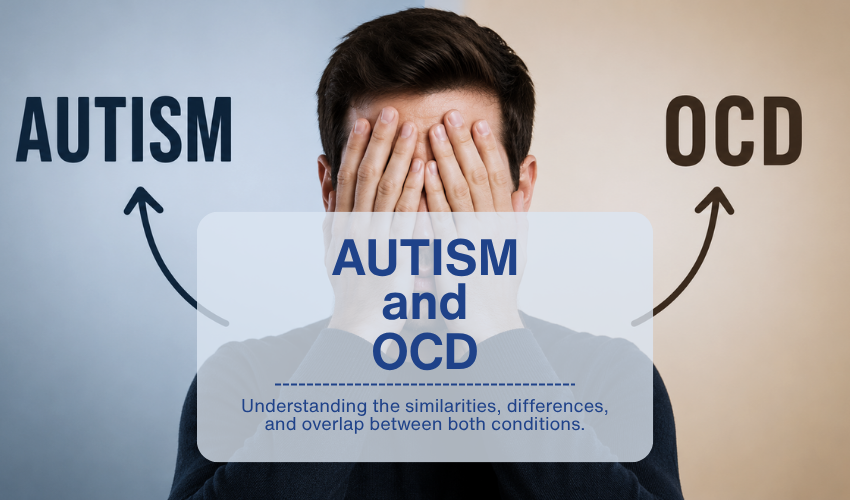
Here’s what nobody tells you about autism and OCD: they can look almost identical from the outside.
Repetitive behaviours. A need for routine. Anxiety that spikes when things don’t go to plan. Both conditions can produce every single one of these.
But here’s the crucial part most people miss:
Same behaviour, completely different cause. One person repeats an action because it feels good, it’s calming, it’s satisfying, it regulates something in their nervous system. Another person repeats the exact same action because they’re terrified of what happens if they don’t.
Look at the behaviour alone, and you’ll miss what’s actually going on.
This is where accurate assessment matters. A person might be autistic. They might have OCD. They might have both. They might have neither. You cannot diagnose from a single symptom in isolation, and any approach that tries to is going to get it wrong.
A clinically responsible assessment looks at the whole picture: developmental history, thoughts, emotions, behaviours, daily functioning, individual experience. Understanding why a pattern exists is what separates a rushed guess from a genuine diagnosis.
What Autism and OCD Actually Are
Autism Spectrum Disorder (ASD)
Autism is a neurodevelopmental condition. Not a mental illness, not something that appears out of nowhere in adulthood, a difference in how the brain develops and processes the world.
It shows up differently in every person, but it commonly affects:
- Social communication, reading social cues, understanding indirect language, navigating unfamiliar social situations
- Sensory processing, heightened sensitivity to sound, light or texture, or actively seeking out certain sensory input
- Behaviour patterns, repetitive behaviours, strong interests, routines, a preference for predictability
Here’s the thing: autism isn’t one look, one behaviour, one “type” of person. It’s a spectrum for a reason.
Obsessive-Compulsive Disorder (OCD)
OCD is a mental health condition. It runs on two engines: obsessions and compulsions.
Obsessions are unwanted, distressing thoughts, images or urges that force their way into someone’s mind. Contamination. Harm. Responsibility. Relationships. Morality. Uncertainty. The themes vary, but the distress is constant.
Compulsions are the response, repetitive behaviours or mental rituals performed to try to make the obsession go away. Checking. Washing. Counting. Repeating. Seeking reassurance.
Here’s the trap: compulsions work. For a moment. They bring relief. But that relief is exactly what reinforces the cycle, and makes it harder to break the longer it runs.
Why People Confuse the Two
Both conditions can involve repetition, routines, intense focus, and distress when things feel unpredictable. Someone lines things up a certain way. Someone follows the same routine every single day. Someone falls apart when plans change last-minute.
From the outside, it all looks the same.
But the motivation underneath is completely different.
An autistic routine often provides comfort, predictability, sensory regulation. An OCD ritual is usually driven by fear, a belief that something terrible happens if the ritual isn’t performed exactly right.
Same behaviour. Opposite reason. That’s why understanding the experience behind the action isn’t optional, it’s the whole assessment.
Where Autism and OCD Actually Overlap
Repetitive Behaviours and Patterns
Both conditions involve repetition. But repetition on its own tells you nothing about why.
An autistic person might repeat movements, sounds or actions, sometimes called stimming, because they’re enjoyable, calming, or help regulate sensory and emotional experience. Rocking. Hand movements. Repeating sounds. None of it is unwanted.
Someone with OCD repeats an action because of fear. Checking a door lock isn’t soothing, it’s driven by an intrusive thought that someone could get hurt if it’s left unlocked.
The behaviour can look the same. The internal experience rarely is.
A Preference for Routine and Predictability
Autistic people often prefer routine because predictability reduces overwhelm. Unexpected change demands rapid adjustment, and that can trigger real sensory and emotional stress.
OCD can produce rigid routines too. But these are usually tied to specific fears or rules. Complete the sequence in the wrong order, and the anxiety spikes immediately.
The line here isn’t always obvious. That’s exactly why a proper assessment exists.
Anxiety and Emotional Distress
Both conditions carry anxiety, just from different sources.
An autistic person might feel anxious from sensory overload, social demands, or sudden change. Someone with OCD feels anxious from the intrusive thought itself, and from the pressure to perform the compulsion that follows it.
Some people experience both forms of distress at once. Understanding which is driving what becomes critical.
Where Autism and OCD Are Genuinely Different
The Purpose Behind the Behaviour
This is the single biggest difference.
Autistic repetitive behaviour often supports regulation, sensory processing, or genuine enjoyment. The person may not experience it as unwanted at all, even if it creates friction in certain environments.
OCD compulsions are tied to distressing obsessions or a perceived need to prevent something feared. The person often knows the behaviour is excessive. They just can’t stop, because the anxiety underneath won’t let them.
This distinction isn’t absolute in every case. But it’s one of the clearest signals a clinician has to work with.
Intrusive Thoughts vs. Intense Focus
Intrusive thoughts sit at the centre of OCD. Unwanted, distressing, and repetitive, often about harm, mistakes, or feared events the person believes they need to prevent.
Autistic people can also experience repetitive thinking or intense focus, but a strong interest is not an obsession.
Here’s the difference: spending hours thinking about a favourite subject can be genuinely enjoyable and meaningful. An intrusive thought is the opposite, unwanted, distressing, and driving a compulsion to make it stop.
Routines and Change
Autistic routines usually connect to a need for consistency and structure in an overwhelming world.
OCD routines are usually governed by fear. Break the sequence, and it’s not just discomfort, it’s a belief that something harmful might happen.
Same surface pattern. Completely different meaning underneath.
Can Someone Have Both Autism and OCD?
Yes. And when both are present, recognising each one separately matters, because they interact.
Here’s an example: an autistic person already relies on routines for predictability. If OCD develops on top of that, compulsive rituals can quietly fold into existing routines, making them much harder to spot.
Sensory sensitivities or communication differences can also change how someone describes their intrusive thoughts and anxiety, adding another layer of complexity to the picture.
Why the Two Can Be Hard to Separate
Repetition, rigid routines, distress around change, intense focus, all of it can be read differently depending on context.
A thorough assessment asks the questions that actually separate the two:
- What happens if the person can’t complete the behaviour?
- Is the behaviour pleasurable, comforting or regulating?
- Is it driven by fear or an intrusive thought?
- Does the person believe the action prevents something bad from happening?
- Has the behaviour been present since early development?
- How does it affect daily functioning?
These questions build the clearer picture that a surface-level look never can.
How Dual Diagnosis Shapes Daily Life
When both conditions are present, education, employment, relationships and emotional wellbeing can all take a hit.
Sensory demands, routine changes and social pressure raise the baseline stress. Add OCD’s intrusive thoughts and compulsions on top, and everyday tasks become exhausting fast.
The bottom line: support has to address both, the autistic needs and the OCD symptoms. Assuming every repetitive behaviour has one single cause is where treatment plans fall apart.
How Autism and OCD Are Actually Assessed
The Autism Assessment Process
An autism assessment draws on multiple sources of information, not a single conversation.
Professionals explore developmental history: childhood experiences, long-standing patterns in social communication, behaviour and sensory processing. This usually involves questionnaires, structured interviews, and behavioural observation.
Where relevant, input from family members or people who knew the individual in childhood can also feed into the picture.
The goal isn’t one symptom. It’s the long-term pattern.
The OCD Assessment Process
An OCD assessment centres on a detailed clinical conversation covering intrusive thoughts, compulsive behaviours, anxiety, and functional impact.
A clinician will typically ask about:
- The nature of intrusive thoughts or fears
- Compulsions and mental rituals
- How much time the symptoms consume
- Levels of distress
- Avoidance behaviours
- The effect on work, education and relationships
- Previous mental health difficulties
Assessment also considers whether another condition might better explain the symptoms.
Why Comprehensive Assessment Actually Matters
Here’s the risk on both sides: assume every repetitive behaviour is OCD, and you’ll misread genuine autistic traits as pathology. Assume every routine is “just autism,” and clinically significant OCD symptoms slip through unnoticed.
Understanding why a behaviour exists, not just what it looks like, is what makes support and treatment actually work.
The Myths That Get in the Way
“All Repetitive Behaviour Means OCD“
It doesn’t.
People repeat behaviours for plenty of reasons, habit, enjoyment, sensory regulation, learning, stress management, personal or cultural preference. None of that is OCD.
OCD requires a specific pattern: obsessions and compulsions tied to distress, anxiety, or an attempt to prevent a feared outcome.
“Autistic Routines Are Always Compulsions”
Also not true.
A routine can simply provide comfort, predictability, and structure. It might be hard to interrupt, but that’s not the same as believing something catastrophic will happen if it’s broken.
Compulsions are specifically about reducing anxiety or neutralising a feared consequence. Structure for structure’s sake isn’t that.
“Autism and OCD Are the Same Condition”
They’re not, not even close.
Autism is a neurodevelopmental condition. OCD is a mental health condition built around obsessions and compulsions. Some experiences overlap on the surface. The underlying nature of each condition doesn’t.
A person can have one without the other. Some people have both.
Treatment: What Actually Works for Each
Evidence-Based Treatment for OCD
Treatment for autism and OCD is not one-size-fits-all, and it shouldn’t be treated that way.
For OCD, the evidence-based gold standard is Cognitive Behavioural Therapy (CBT), specifically Exposure and Response Prevention (ERP). ERP works by gradually facing the situations, thoughts or triggers that cause anxiety, while resisting the compulsive response used to find relief.
Medication, including SSRIs, may also be appropriate depending on individual circumstances. That decision should always come from a proper assessment and medical guidance, not guesswork.
Support for Autistic Individuals
Support here should be personalised, full stop.
Reasonable adjustments can strip out unnecessary stress in education, employment or healthcare settings, clearer communication, more predictability, sensory adjustments, flexibility in how appointments and support are delivered.
Here’s what this isn’t about: eliminating harmless autistic traits. It’s about reducing unnecessary distress and helping the person function in a way that supports their wellbeing.
Supporting Someone With Both
When both conditions are present, treatment has to adapt.
ERP, for example, may need to account for sensory sensitivities and communication preferences, and clearly distinguish compulsive rituals from behaviours that genuinely support regulation.
A personalised care plan targets the OCD symptoms directly, without dismantling coping strategies that matter for the person’s autistic wellbeing.
How Both Conditions Show Up in Everyday Life
Relationships and Social Experience
Both conditions affect relationships, just differently.
Autistic communication differences can create misunderstandings, particularly when others expect indirect or unspoken cues. Sensory overload and social demands add fatigue on top.
OCD can affect relationships through reassurance-seeking, avoidance, or time-consuming rituals. Family and partners don’t always understand why someone feels unable to simply stop.
When both are present together, these dynamics can get genuinely complicated.
Work, Education, and Daily Responsibilities
Concentration. Time management. Coping with change. All of it can take a hit.
An autistic person might struggle in unpredictable, high-stimulation environments. Someone with OCD might lose hours to compulsions and mental rituals.
Together, everyday responsibilities start to feel like a mountain.
Here’s the good news: the right adjustments, treatment and support can help someone manage symptoms while still recognising their genuine strengths.
Every Person’s Experience Is Different
No two people experience autism or OCD identically.
One person has highly visible repetitive behaviours. Another experiences distress almost entirely internally, invisible to everyone around them. Some need substantial support. Others have built strategies that mask the difficulty entirely.
Assessment and treatment should be built around the individual, never a stereotype of what either condition is “supposed” to look like.
When Should You Actually Seek Professional Support?
Signs an Assessment Could Help
Professional assessment may be worth pursuing if you’re experiencing:
- Persistent, distressing intrusive thoughts
- Repetitive behaviours that feel genuinely hard to control
- Routines that significantly interfere with daily life
- Overwhelming anxiety or distress
- Increasing avoidance
- Difficulties at work, in education, or in relationships
- Uncertainty about whether it’s autism, OCD, or something else entirely
Let’s be clear: seeking an assessment doesn’t mean a diagnosis is inevitable. The point is clarity, understanding what’s actually happening, and whether support could help.
Choosing the Right Pathway in the UK
In the UK, this conversation usually starts with your GP.
Depending on your circumstances, assessment may be available through NHS services or specialist private providers. Some people benefit from multidisciplinary evaluation, particularly where presentations are complex or overlapping.
The right pathway depends on your age, symptoms, local services, and individual circumstances.
Frequently Asked Questions
Can someone have autism and OCD at the same time?
Yes. Autism and OCD can occur together. Each condition should be assessed separately, even where symptoms appear similar, so that support and treatment reflect both.
Are autistic behaviours the same as OCD compulsions?
Not necessarily. They can look similar from the outside, but the motivation differs. Autistic repetitive behaviours often support regulation, comfort or sensory needs. Compulsions are typically performed to reduce anxiety or prevent a feared outcome.
Does having autism increase the chance of OCD?
Research has found an association between the two, meaning they may occur together more often than expected in some populations. That doesn’t mean every autistic person develops OCD, or that repetitive behaviour automatically signals it. Individual assessment remains essential.
Can OCD be mistaken for autism?
Yes. Repetitive behaviour, rigid routines and distress around uncertainty can create genuine confusion. A careful assessment explores whether the behaviours stem from developmental differences, intrusive fears, compulsions, anxiety, or some combination.
How are autism and OCD diagnosed in the UK?
Usually through a GP referral to NHS services, or an assessment with a suitably qualified private specialist. Autism assessment focuses on developmental history and long-term patterns. OCD assessment explores obsessions, compulsions, distress, and functional impact.
The Bottom Line
Autism and OCD are different conditions that can genuinely overlap. Repetitive behaviours, routines, anxiety, difficulty with uncertainty, both can produce all of it. The reasons underneath are what set them apart.
The reason behind the behaviour is everything. A repetitive action might be comfort. It might be regulation. Or it might be a compulsion driven by fear. You can’t tell which from the outside, you have to understand the person’s thoughts, history and experience.
Professional assessment brings clarity, not labels for the sake of it. If repetitive behaviours, intrusive thoughts, anxiety or rigid routines are significantly affecting daily life, a proper assessment can identify what’s actually going on, autism, OCD, both, or something else entirely, and point toward the support that genuinely fits.