
Types of OCD: Why Symptoms Can Look Different From Person to Person
February 9, 2026
PTSD Treatments and Therapy: What Actually Works, And What Nobody Tells You
March 25, 2026
Most people researching depression treatment London are doing it quietly. Late at night. When the weight of it has become impossible to ignore.
You’ve probably already Googled depression treatment london and the symptoms. Read the NHS page. Maybe closed the tab three times before finally landing here.
Here’s what this guide is going to do: give you a clear, honest map of your actual options, NHS and private, without the clinical detachment or the false promises. What each path looks like. What it costs. How long does it take? And what most people miss when they’re trying to figure this out. This isn’t a cure. It’s clarity. And right now, that’s where you start.
First: Depression Isn’t What Most People Think It Is
Let’s be honest about something.
Depression isn’t just feeling sad. It’s a clinical condition that reshapes how you think, feel, behave, and function physically. Some people can’t get out of bed. Others are getting up every day, making it to work, holding it together and feeling completely hollow inside.
Both are real. Both matter.
Symptoms can include persistent low mood, loss of interest in things you used to enjoy, disrupted sleep or appetite, crushing fatigue, difficulty concentrating, feelings of worthlessness, and in serious cases, thoughts of hopelessness or self-harm.
Here’s why this matters: because depression doesn’t look the same in every person, treatment for depression in the UK isn’t one-size-fits-all either. What works depends on severity, how long you’ve been struggling, whether anxiety or trauma is part of the picture, your history with previous treatments, and what you’re actually willing and able to do.
That context shapes everything that follows depression treatment london.
The NHS Route: What It Actually Looks Like
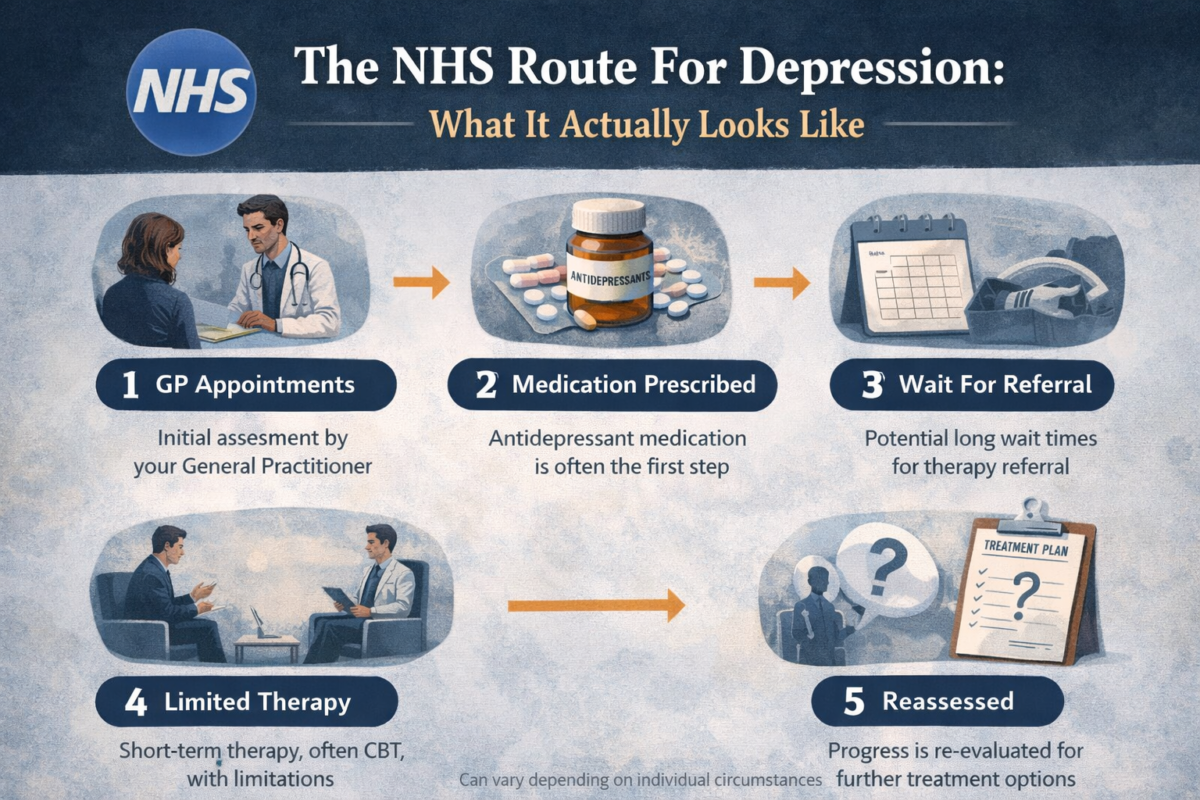
For most people, the starting point in depression treatment in London is their GP.
Your GP is the gateway. In that appointment, expect a conversation about your mood, sleep, and daily functioning, usually supported by screening questionnaires. They’ll assess risk, discuss whether medication makes sense, and refer you onward if needed.
GPs can prescribe antidepressants and monitor how you respond. They can also refer you to NHS Talking Therapies, the primary psychological treatment service in England, previously known as IAPT.
What NHS Talking Therapies offers: guided self-help, Cognitive Behavioural Therapy (CBT), counselling for depression, and online therapy programmes. The intensity of treatment is matched to your symptom severity. Mild to moderate depression typically starts with lower-intensity support. More complex presentations get more intensive input.
Here’s the part most people want to know: waiting times.
Demand for these services varies significantly depression treatment london. While urgent cases are prioritised, routine therapy referrals can take anywhere from a few weeks to several months. Self-referral is possible in many areas, and worth doing if you want to reduce that delay.
When the NHS Escalates to Specialist Care
If your depression is severe, recurring, or carries significant risk, secondary care services may step in.
NHS depression treatment london includes Community Mental Health Teams (CMHTs), specialist mood disorder clinics, and crisis resolution teams. These services handle complex or treatment-resistant cases and typically involve psychiatric review, medication adjustments, and coordinated multidisciplinary support.
You don’t self-refer to secondary care. You’re referred by your GP or another clinician. But knowing it exists matters, because if you’re in that category, your care pathway looks different.
Private Depression Treatment in London: The Honest Version
Private care for depression treatment london isn’t better than NHS care. It’s faster. And for some people, speed is the deciding factor.
What private clinics typically offer: comprehensive psychiatric assessment, rapid access appointments, flexible scheduling, integrated psychological therapy, and ongoing medication management. The assessment itself is usually more detailed, extended consultation time, full psychiatric and medical history, risk assessment, and collaborative treatment planning from the start.
Here’s the distinction you need to understand:
Psychiatrists are medically trained doctors. They diagnose, prescribe, and oversee complex treatment plans. Psychologists deliver structured talking therapies but don’t prescribe. In private settings, they often work together, which is where you get genuinely integrated care.
What Private Care Costs (And What It Doesn’t Cover)
Private depression treatment in London costs vary depending on the clinician, the appointment length, and the ongoing frequency of sessions.
There’s no universal price. Initial consultations, follow-up sessions, combined therapy packages, and location within London all influence what you’ll pay. Some people use private care for the initial assessment and then transition back to NHS services for longer-term therapy a practical approach that many clinicians support.
What private care cannot do: guarantee results, eliminate the need for patience, or replace the therapeutic work you’ll need to put in. It gives you faster access to a clearer picture. What happens after that depends on the treatment and the individual.
Talking Therapies: The Main Options and When They Apply
Psychological therapy sits at the heart of depression treatment london, regardless of whether you go NHS or a private.
CBT is the most widely recommended. It’s structured, time-limited (typically 8–20 sessions), and focuses on identifying negative thinking patterns, challenging unhelpful beliefs, behavioural activation, and practical coping strategies. It has the strongest evidence base for depression.
But CBT isn’t always the right fit.
Someone with a significant trauma history may need a different approach entirely. Someone with high anxiety alongside depression may benefit from combined methods. Other established options include Interpersonal Therapy (IPT), psychodynamic therapy, behavioural activation therapy, and compassion-focused therapy.
The right choice depends on your presentation, your history, and honestly, what you’re willing to engage with. A therapy you won’t actually do isn’t going to help.
Medication: When It’s Considered and What It Actually Does
Antidepressants are a standard part of depression treatment London pathways, particularly for moderate to severe symptoms.
Medication becomes more relevant when symptoms are significantly impairing your ability to function, when therapy alone hasn’t been sufficient, when depression is recurrent, or when risk is elevated.
Here’s what medication does: it works by regulating neurotransmitter systems involved in mood. SSRIs, SNRIs, and atypical antidepressants are the most commonly used classes. Each has a different profile of effects and side effects.
Here’s what it doesn’t do: change your personality. It’s not a shortcut past the psychological work. But for many people, it creates enough stability to make that work possible.
Medication decisions are individual. Benefits are always weighed against potential side effects, and it typically takes weeks before the full effect is clear. This is a conversation between you and a qualified clinician, not something to navigate alone.
Treatment-Resistant Depression: When the Usual Approaches Haven’t Worked
This is where most people get it wrong.
If you’ve tried medication and therapy and you’re still struggling, that doesn’t mean you’re unfixable. It means your case needs more sophisticated assessment and possibly a different approach.
Treatment-resistant depression refers to persistent symptoms despite adequate trials of medication and therapy. Specialist services in London, in both NHS and private settings, can offer medication optimisation, combination treatments, augmentation strategies, specialist psychotherapy, and referral for advanced interventions where appropriate.
The critical first step is a comprehensive reassessment. The label “treatment-resistant” should only come after a full clinical review of what’s actually been tried, at what doses, for how long, and in what combination.
NHS or Private? Here’s How to Actually Think About It
The decision usually comes down to four things: urgency, budget, complexity, and what you need right now.
NHS care is free at the point of access. It has robust pathways and skilled clinicians. The constraint is time, both in accessing it and in the pace of progression.
Private care gives you faster access, a more detailed initial assessment, and more flexibility. The constraint is cost, and it’s a real one.
Some people combine both. Private assessment to get clarity quickly, then NHS for ongoing support. This is a legitimate, practical approach, and many clinicians across both sectors are used to it.
There’s no universally right answer. There’s the right answer for your situation, right now.
What Most People Overlook While Researching About Depression Treatment London
This is where most guides stop. They shouldn’t.
Depression rarely exists in isolation. Effective depression treatment london looks at the whole picture, and that includes things like sleep stabilisation, physical health review, alcohol and substance use, social isolation, occupational stress, and whether anxiety disorders are playing a parallel role.
Treating the depression without addressing these factors is like bailing a boat without finding the leak. It’s not enough.
A good clinician will look at all of it. If yours isn’t, it’s worth raising.
When to Stop Reading and Get Help Immediately
If you’re experiencing thoughts of self-harm or suicide, severe agitation, psychotic symptoms, or you’re unable to care for yourself, this isn’t a situation for a routine appointment.
In England, urgent support is available through NHS 111 (select the mental health option), your local crisis team, or A&E if necessary. Immediate safety takes priority over everything else in this article.
Frequently Asked Questions About Depression Treatment London
How long does treatment take?
Mild depression may respond within months. Recurrent or severe depression can require longer-term management. There’s no honest one-size answer.
Is medication always necessary?
No. Many mild cases respond to therapy alone. Medication is considered when it’s clinically indicated, not as a default.
Can I switch between NHS and private?
Yes. Many people do, in both directions, depending on what they need at a given stage.
Is depression actually treatable?
Yes. With appropriate support, most people experience significant improvement. That’s not optimism, it’s what the evidence shows.
The Bottom Line
Depression treatment in London is not a single pathway. It’s a set of options, NHS and private, therapy and medication, immediate and longer-term, each with their own trade-offs.
What you need to know about depression treatment London:
Your depression won’t look exactly like anyone else’s. Your treatment shouldn’t either. The right path depends on severity, urgency, what you’ve already tried, and what you’re actually able to access right now.
Early assessment improves outcomes. Not because it’s a cliché, but because clarity about what you’re dealing with is what makes the right treatment possible.
If you’re considering depression treatment London, the next step isn’t complicated. It’s just the next step: speak to your GP, contact a private clinic, or call 111 if it’s urgent. You’ve already done the hard part by looking this up. Don’t stop here.