Managing Anxiety: What Actually Works (And What’s Just Noise)
January 25, 2026
Mixed Depression and Anxiety Disorder: What It Means and Why It Matters
January 30, 2026
Here’s what most people get wrong about social anxiety:
They think it’s about blushing. Or avoiding eye contact. Or going blank when someone asks you a question in a meeting.
It’s not.
Those symptoms are real. They’re distressing. But treating them like the problem is like mopping up water while ignoring the burst pipe.
If you’re searching for answers on overcoming social anxiety, you don’t need another list of symptoms. You already know what it feels like when your heart races before walking into a room. You know the mental replay of every conversation, dissecting what you “should have said.”
What you actually need is to understand why this keeps happening, and what genuinely changes it.
Here’s the reality: Social anxiety isn’t a collection of symptoms to suppress. It’s a process. A pattern, and once you understand how that pattern works, you can actually do something about it. No miracle cures. No “just be confident” nonsense. Just the truth about what maintains social anxiety and what helps people move past it.
Why Your Brain Keeps Doing This to You
Let’s separate two things most people confuse:
The symptoms of social anxiety and the process that keeps it going.
Two people can have identical symptoms—sweating, mind going blank, wanting to disappear, but for completely different reasons. One might fear being seen as incompetent. Another might fear being boring. A third might be terrified of showing visible signs of anxiety itself.
The symptoms look the same. The underlying fear is not.
This is why focusing only on symptoms misses the point. When you treat anxiety as something to hide or suppress:
You learn that the anxiety itself is the problem. You prioritize short-term relief over long-term change. You mistake avoidance for coping.
None of this gets you closer to overcoming social anxiety. It just makes you better at managing distress in the moment while the core pattern stays intact.
What Social Anxiety Actually Is (And What It Isn’t)
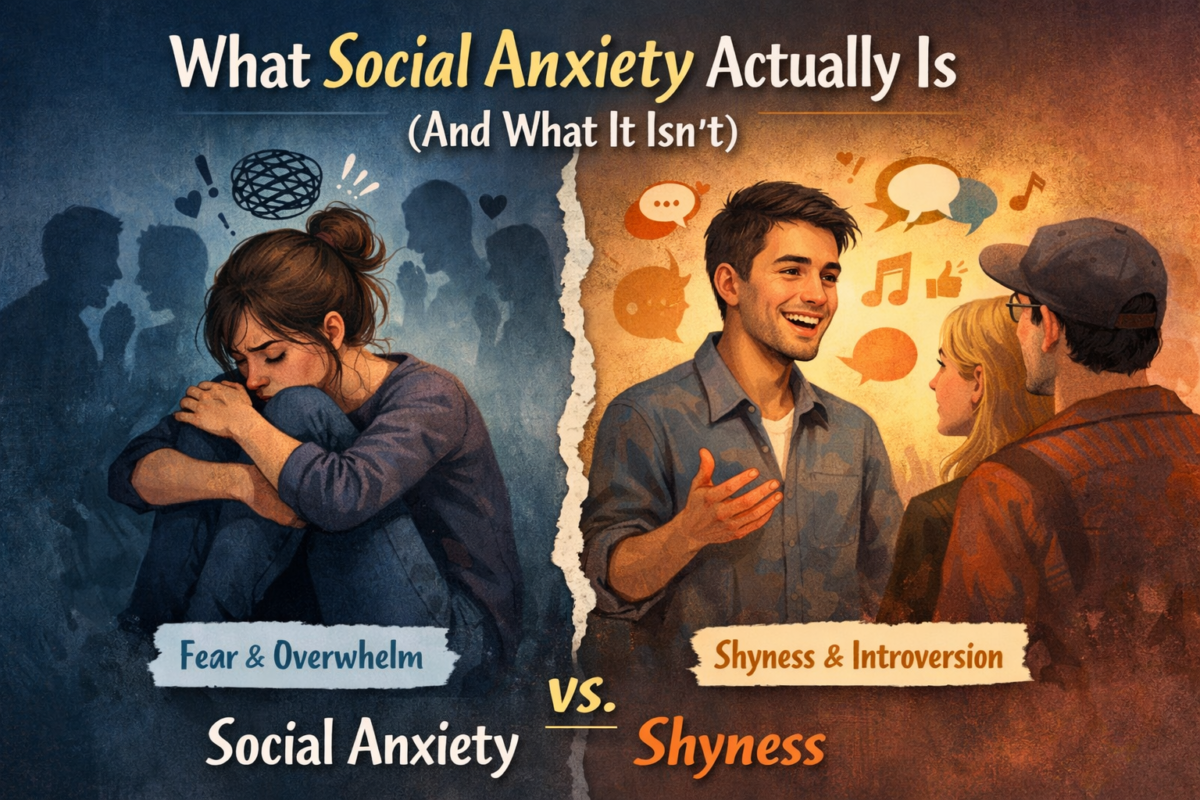
Social anxiety disorder isn’t about disliking people or preferring to be alone.
Many people with social anxiety desperately want connection. They enjoy relationships. They value social interaction.
Here’s what they don’t enjoy: Being evaluated.
The core fear in social anxiety is negative evaluation. It’s the persistent, grinding fear that others are judging you, finding you awkward, incompetent, boring, or visibly anxious.
This shows up as:
Intense self-consciousness in social situations. Fear of embarrassment or humiliation. Anticipatory anxiety before events (sometimes days in advance). Post-event rumination afterward, replaying every moment. Avoidance or endurance with significant distress.
These patterns persist over time. They interfere with work, education, relationships, and quality of life.
But here’s the crucial distinction most people miss:
The fear isn’t of social situations themselves. It’s of what you think others are thinking about you in those situations.
That difference matters. Because when you understand that, you realize the problem isn’t “out there” in social settings. It’s in the learned association between social situations and threat, an association your brain has gotten very good at maintaining.
How Your Brain Learned to Be Afraid (And Why It Keeps Believing It)
Social anxiety doesn’t appear overnight.
It develops gradually through a combination of temperamental sensitivity, early experiences with criticism or rejection, and learned patterns of self-monitoring.
Here’s what typically happens:
You have a few negative social experiences. Maybe you were criticized, rejected, or humiliated. Your brain, doing exactly what it’s designed to do, flags social situations as potentially dangerous. You start monitoring yourself closely in these situations, watching for signs of anxiety or mistakes. The more you monitor, the more anxious you feel. The more anxious you feel, the more you avoid or use safety behaviors to get through.
Over time, your brain gets very efficient at this pattern. Social situations trigger anxiety automatically, even when there’s no actual threat.
This is learning. Not weakness. Not a character flaw. Learning.
Your brain has associated social situations with danger the same way it might learn to flinch at a hot stove. The problem is the stove isn’t actually hot anymore, but your brain hasn’t updated its threat assessment.
The Difference Between Coping and Actually Overcoming Social Anxiety
Let’s be honest about something most advice gets wrong:
Coping strategies and overcoming social anxiety are not the same thing.
Coping aims to reduce distress in the moment. It helps you get through situations. It can be necessary and useful.
But it doesn’t change the underlying pattern.
Common coping strategies include avoiding social events entirely, staying quiet to avoid drawing attention, rehearsing conversations excessively, or using alcohol to manage anxiety.
Do these work? Sure. Temporarily.
The anxiety drops. You feel relief. Your brain learns: “See? That situation WAS dangerous. Good thing we avoided it.”
And the pattern gets stronger.
Overcoming social anxiety involves something different. It means gradually learning that anxiety can be tolerated, and that the feared outcomes are usually far less catastrophic than your brain predicts.
This doesn’t feel as good in the short term. But it’s what actually changes things long term.
Why Avoidance Feels Like Safety But Acts Like Quicksand
Avoidance is the single strongest factor that maintains social anxiety.
Here’s why it’s so powerful:
It works. Immediately. Reliably.
Avoid the party? Anxiety drops. Decline the presentation? Relief floods in. Stay quiet in the meeting? No one noticed you. Success.
Your brain registers this as: Problem solved.
But here’s what actually happened:
You prevented yourself from learning that the situation might not have been as threatening as you thought. You strengthened the association between social situations and danger. You narrowed your life a little bit more.
Avoidance isn’t always obvious. It doesn’t just mean canceling plans.
It can look like attending the event but staying silent. Making eye contact briefly then looking away. Leaving early. Staying on your phone. Positioning yourself near the exit. Deflecting questions. Letting others speak for you.
These subtle avoidances reduce anxiety in the moment but keep the problem alive.
Recognizing your specific avoidance patterns, both obvious and subtle, is a critical step in overcoming social anxiety.
Because you can’t change what you don’t see.
What Actually Changes Social Anxiety (It’s Not What You Think)
Most people expect change to look like this:
Wake up one day feeling confident. Anxiety gone. Walk into any social situation without fear.
That’s not how it works.
Real change in social anxiety happens through:
Gradual exposure to feared situations (not flooding yourself, but stepping toward discomfort deliberately). Reducing reliance on safety behaviors, even when it feels risky. Shifting attention outward rather than staying locked in self-monitoring. Learning to tolerate uncertainty and discomfort without needing to escape.
Here’s the part nobody warns you about: Anxiety often rises before it falls.
This is why many people feel worse initially when trying new approaches. They think something’s wrong. They think it’s not working.
It is working. It’s supposed to feel uncomfortable.
Your brain is updating its threat assessment. That process isn’t comfortable. But it’s necessary.
Progress doesn’t mean anxiety disappears. It means anxiety has less power over your behavior.
Psychological Approaches That Actually Work
Several evidence-based therapies are effective for social anxiety disorder:
Cognitive Behavioural Therapy (CBT) focuses on identifying and changing unhelpful beliefs and avoidance patterns. It’s structured, practical, and well-researched for social anxiety.
Acceptance and Commitment Therapy (ACT) helps people engage in valued actions despite anxiety. Instead of trying to eliminate anxiety, ACT teaches you to carry it with you while doing what matters.
Psychodynamic therapy explores deeper emotional themes and relational patterns. It looks at how past experiences shape current fears and relationships.
These approaches differ in style but share a common focus: understanding and changing the processes that maintain anxiety.
Some approaches are skills-based, behavioral experiments, attention training, exposure exercises. Others are insight-based, exploring how past experiences shape current fears.
For many people, a combination works best.
But here’s what you need to understand: No single method works for everyone.
Social anxiety varies widely in severity, triggers, and personal meaning. What works for one person may not work for another due to differences in personality, life experiences, current stressors, and readiness for change.
Effective treatment is collaborative and tailored, not prescriptive.
Anyone selling you a one-size-fits-all solution doesn’t understand how this works.
Where Medication Fits (And Where It Doesn’t)
Medication may be considered when social anxiety is moderate to severe, when psychological approaches alone haven’t been sufficient, or when anxiety significantly limits daily functioning.
It can reduce baseline anxiety, making psychological work more accessible.
But here’s what medication doesn’t do:
It doesn’t address avoidance patterns. It doesn’t change self-focus. It doesn’t eliminate fear of evaluation.
Medication can support the process of overcoming social anxiety. It can make exposure work more tolerable. It can reduce the physical intensity of anxiety enough that you can actually practice new behaviors.
But it doesn’t replace the need to face feared situations gradually.
This is why medication is most effective when combined with psychological therapy rather than used alone.
It’s a tool. Not a solution.
The Lies You’ve Been Told About Overcoming Social Anxiety
“You need to feel confident first, then anxiety will fade.”
This is backwards.
Confidence doesn’t lead to action. Action leads to confidence.
Waiting to feel confident before engaging socially keeps you stuck indefinitely. You build confidence by having repeated experiences of coping with anxiety, not by waiting for anxiety to disappear first.
“If you’re avoiding anxiety, you’re coping well.”
No. You’re maintaining the problem.
Avoidance reduces anxiety temporarily but increases it long term. True coping involves learning to stay engaged even when anxiety is present.
Overcoming social anxiety means changing your relationship with anxiety, not eliminating it entirely.
What Progress Actually Looks Like (It’s Messier Than You Think)
Progress is uneven. It’s subtle. It doesn’t follow a straight line.
You might notice:
Feeling anxious but attending social situations anyway. Recovering more quickly after interactions instead of ruminating for days. Less mental replay of perceived mistakes. Increased willingness to speak or be visible, even when it feels uncomfortable.
Here’s the key: Progress does not mean anxiety disappears.
It means anxiety has less control over your behavior. It means you can carry anxiety with you into situations that matter, rather than letting it dictate your choices.
Some days will feel like steps backward. That’s normal. Expected. Part of the process.
The trajectory is what matters, not individual moments.
When You Actually Need Professional Support in the UK
You might benefit from professional assessment if:
Social anxiety has persisted for months or years without improvement. Avoidance is limiting your work, education, or relationships. The anxiety causes significant distress beyond normal nervousness. Self-help strategies haven’t led to meaningful change.
Early assessment can prevent anxiety from becoming more entrenched.
In the UK, support options include GP referral, NHS psychological services, or private psychological or psychiatric assessment for anxiety.
The most appropriate route depends on severity, complexity, and how quickly you need access.
There’s no shame in getting professional help. Social anxiety is a recognised disorder with effective treatments. You don’t have to figure this out alone.
Common Questions About Overcoming Social Anxiety
What Causes Social Anxiety?
Social anxiety develops from a combination of biological, psychological, and environmental factors. Some people have a natural temperament that is more sensitive to social threat or evaluation, which can increase vulnerability.
Common contributing factors include early experiences of criticism, bullying, embarrassment, or rejection, as well as growing up in environments where mistakes felt unsafe or highly judged. Learning patterns also play a role — avoiding social situations can unintentionally reinforce fear over time.
There is no single cause, and social anxiety is not a personal weakness. It is a learned fear response that can be unlearned with the right support.
At What Age Does Social Anxiety Typically Start?
Social anxiety most commonly begins in early adolescence, often between the ages of 11–15, when social awareness and fear of judgement increase. However, it can also start in childhood or later in adulthood, particularly after stressful social experiences.
In many cases, symptoms are present for years before someone recognises them as anxiety. Early support can reduce long-term impact, but improvement is possible at any age.
What Is the 333 Rule of Social Anxiety?
The 333 rule is a simple grounding technique used to help manage anxiety in the moment. It involves naming 3 things you can see, 3 things you can hear, and moving 3 parts of your body.
This technique works by shifting attention away from anxious thoughts and back into the present moment. It does not treat social anxiety itself, but it can help reduce intensity during stressful situations such as conversations, meetings, or public settings.
The 333 rule is most helpful when used alongside longer-term strategies like therapy, skills training, or exposure work.
What Is Commonly Mistaken for Social Anxiety?
Social anxiety is often confused with shyness, introversion, autism, low self-confidence, or general nervousness. While these can overlap, they are not the same.
Shyness or introversion reflects personality preference, whereas social anxiety involves persistent fear, distress, or avoidance that interferes with daily life. Some people are wrongly labelled as “just quiet” when they are actually struggling internally with intense anxiety.
A proper assessment focuses on the level of distress, avoidance, and functional impact — not just behaviour.
What Does Crippling Social Anxiety Look Like?
Crippling social anxiety refers to anxiety that significantly limits daily functioning. This may include avoiding work meetings, phone calls, social events, eating in public, or speaking to unfamiliar people, despite wanting to do so.
People may experience intense physical symptoms such as racing heart, nausea, shaking, or mental blankness, alongside persistent fear of embarrassment or negative judgement. Over time, avoidance can shrink a person’s life, affecting relationships, education, and career opportunities.
With appropriate treatment and support, even severe social anxiety can improve. Seeking help is a sign of strength, not failure.
The Bottom Line
Social anxiety is driven by fear of evaluation, not social contact itself.
The symptoms you experience are part of a wider pattern—one that’s maintained by avoidance, safety behaviors, and learned associations between social situations and threat.
Overcoming social anxiety is a gradual process. Not a quick fix. Not a sudden burst of confidence. A process of learning that anxiety can be tolerated and that feared outcomes are usually less catastrophic than predicted.
Psychological approaches are central to long-term change. Medication can support the process but doesn’t replace it.
Progress looks like increased willingness to engage despite anxiety, not the absence of anxiety itself.
With the right support and approach, overcoming social anxiety is not only possible but achievable in a way that restores confidence, connection, and quality of life.
You don’t have to feel confident to start. You just have to start.