7 Types of Anxiety Disorders: How They Differ and Why It Matters
January 21, 2026
Managing Anxiety: What Actually Works (And What’s Just Noise)
January 25, 2026
Here’s what nobody tells you about Generalised Anxiety Disorder:
You won’t have a panic attack every day. You won’t hide in your house. You won’t necessarily look anxious to anyone around you.
But you’ll worry. Constantly. About everything.
Your health. Your performance at work. Money. Relationships. That email you sent three hours ago. Whether you turned the stove off. Whether your partner seemed distant this morning. Whether that headache means something serious.
And here’s the worst part: You know it’s excessive. You know it doesn’t make sense. But you can’t stop.
If this sounds familiar, you’re not alone, and you’re not broken.
Let’s talk about what Generalised Anxiety Disorder (GAD) actually is, why your brain won’t shut off, and what you can actually do about it.
Why Your Worry Feels Different (And Why It Matters)
Everyone worries. That’s normal.
You worry about a job interview, you prepare, you do the interview, the worry stops. That’s healthy anxiety doing its job.
GAD is different.
With GAD, the worry doesn’t stop. It just moves.
You resolve one concern, and your brain immediately finds another. Health becomes work. Work becomes finances. Finances become relationships. The target changes, but the anxiety never leaves.
Here’s how everyday worry and GAD differ:
Normal worry connects to a specific situation, feels proportionate to the actual risk, and settles when the situation resolves.
GAD worry persists regardless of circumstances, feels excessive even when you recognize it, and shifts constantly between different areas of life.
People with GAD often describe feeling anxious “all the time,” even during calm periods, even during good news, even when nothing is objectively wrong.
This isn’t a personality flaw. This isn’t you being dramatic or high-strung.
This is a recognized mental health condition with specific treatment options.
What Generalised Anxiety Disorder Actually Is?
Let’s get clinical for a moment.
GAD is characterized by excessive anxiety and worry about multiple areas of life, occurring more days than not, for at least several months.
The worry typically focuses on:
Health and physical symptoms, work or academic performance, finances, relationships, everyday responsibilities like household tasks or appointments.
But here’s what makes GAD particularly exhausting: the anxiety moves. Just when you’ve calmed down about one thing, your brain latches onto something else.
There’s always something to worry about.
The “Generalised” Part Explained
The term “generalised” doesn’t mean your anxiety is mild or vague, it means it’s widespread.
Unlike a specific phobia (fear of spiders) or social anxiety (fear of social situations), GAD spreads across multiple domains of your life. Your anxiety isn’t picky. It’ll worry about anything.
And here’s the internal conflict that defines GAD: You recognize the worry is excessive. You know it’s not helping. But you can’t stop it.
That gap between knowing and feeling is where GAD lives.
How GAD Hijacks Your Thinking
The Mental Loop You Can’t Escape
The defining feature of GAD is persistent, uncontrollable worry that loops, replays, and escalates.
Your mind operates in “what if” mode constantly.
What if I get sick? What if I lose my job? What if they’re upset with me? What if I’ve made a mistake? What if something happens to someone I love?
You’re constantly scanning for problems, even when everything is objectively fine.
Reassurance helps. Briefly. Then the worry comes back, often within minutes or hours.
Your brain stays on high alert even in safe, familiar situations.
Why Everything Feels Like a Disaster Waiting to Happen
People with GAD tend to anticipate negative outcomes automatically.
You expect the worst-case scenario. You overestimate how likely bad things are to happen. You underestimate your own ability to cope if something does go wrong.
This isn’t pessimism. It’s how your anxious brain has learned to process information.
And it makes even small decisions feel overwhelming. Choosing a restaurant, sending a text, making a phone call, these things shouldn’t be hard, but when your brain is predicting catastrophe at every turn, they are.
The Mental Fog That Won’t Lift
Chronic worry is mentally exhausting.
GAD commonly affects concentration, memory, problem-solving, and decision-making. Many people describe feeling mentally “foggy” or like they’re thinking through mud.
This isn’t laziness. This isn’t lack of intelligence.
This is your brain spending so much energy on worry that there’s not enough left for everything else.
How GAD Makes You Feel (Beyond Just “Anxious”)
The Constant Edge You Can’t Shake
Emotionally, GAD doesn’t usually feel like panic or terror.
It feels like permanent unease.
You’re “on edge” all the time. You can’t fully relax. Even during rest, even during fun activities, there’s a background sense that something is wrong.
Your body doesn’t know how to settle anymore.
When Everything Becomes Too Much
Living with constant anxiety is draining. Over time, this leads to irritability, reduced emotional tolerance, and feeling easily overwhelmed.
Small frustrations hit harder. A minor inconvenience feels like a major problem. Someone’s tone bothers you more than it should.
This isn’t you being difficult. This is what happens when your mental and emotional resources are constantly depleted by anxiety.
The Confusion of Feeling Anxious for “No Reason”
Here’s what makes GAD particularly frustrating: Sometimes you feel anxious without a clear trigger.
Nothing bad is happening. Everything should be fine. But you still feel that familiar tension, that sense of dread.
This is confusing. It’s frustrating. It makes you question yourself.
“Why am I anxious when nothing is actually wrong?”
The answer: Because GAD doesn’t need a specific trigger. The anxiety exists independently of your circumstances.
What GAD Does to Your Body
The Physical Tension That Won’t Release
Your body reflects what’s happening in your mind.
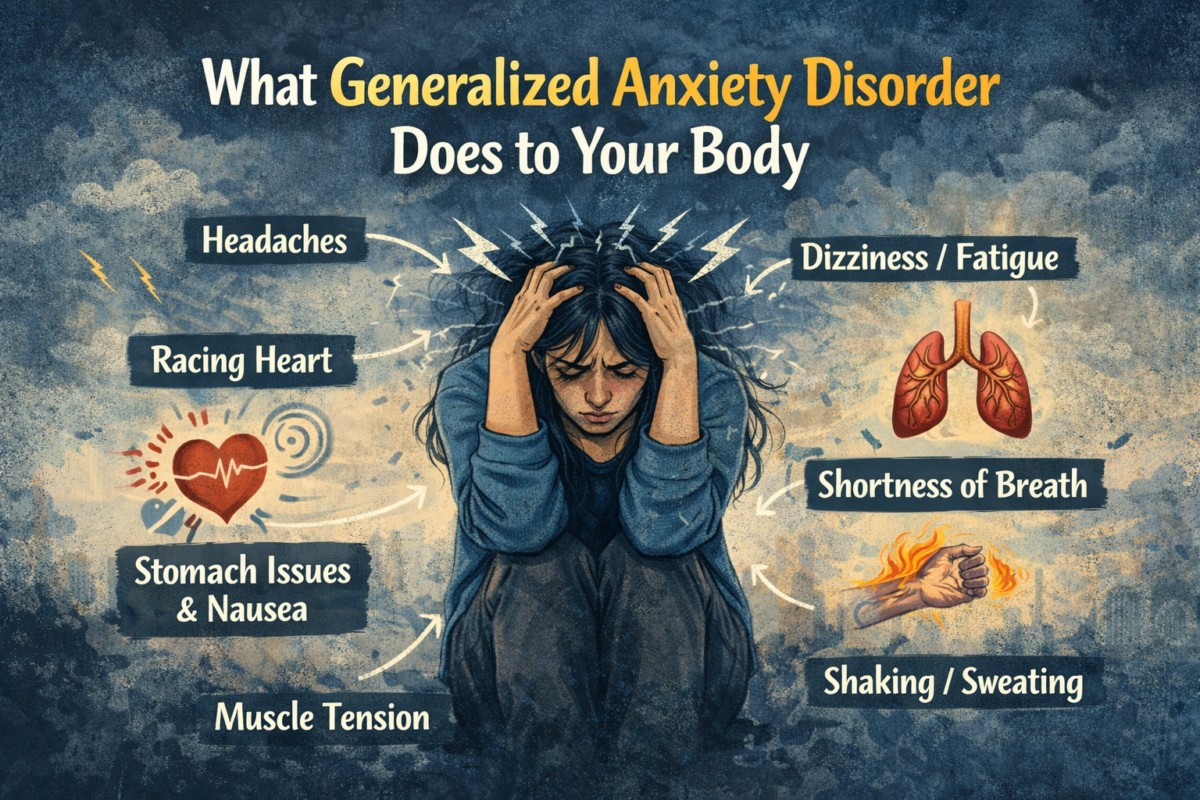
With GAD, you’re in a prolonged state of physical alertness. This shows up as tight shoulders, clenched jaw, tension headaches, neck pain, and restlessness, an inability to sit still or feel physically comfortable.
Your muscles are constantly braced for a threat that isn’t coming.
The Sleep Problems That Make Everything Worse
Sleep is one of the first casualties of GAD.
You lie in bed, and your brain starts racing. You review the day, anticipate tomorrow, worry about things you can’t control. You finally fall asleep, then wake at 3 AM with your mind already spinning.
Even when you sleep, it’s not restorative. You wake up tired.
Poor sleep worsens anxiety. Worse anxiety makes sleep harder. And round and round you go.
The Physical Symptoms That Feel Very Real
Anxiety directly impacts your nervous system, creating physical symptoms that are genuine and physically experienced not “all in your head.”
Nausea or stomach discomfort, changes in appetite, heart palpitations, sweating, lightheadedness, digestive issues.
These symptoms are real. They’re your body responding to constant psychological stress.
How GAD Infiltrates Your Daily Life
Work and Productivity: The Perfectionism Trap
GAD significantly affects performance, but not always in the way people expect.
You might spend excessive time checking and rechecking your work. You might avoid tasks because you’re afraid of making mistakes. You might procrastinate because starting feels overwhelming.
Despite working hard, sometimes harder than everyone around you, you feel constantly behind, constantly underperforming.
The anxiety convinces you that you’re failing even when you’re not.
Relationships: When Worry Becomes a Third Person
Anxiety spills into your relationships.
You seek reassurance repeatedly. You struggle to be present in conversations because your mind is elsewhere. You’re more irritable than you want to be. You overanalyze texts and interactions.
Loved ones may not understand why you can’t “just relax” or why reassurance doesn’t stick. This creates strain, which creates more anxiety, which creates more strain.
The Simple Tasks That Suddenly Aren’t Simple
Everyday responsibilities become disproportionately demanding.
Making phone calls. Running errands. Responding to emails. Keeping appointments.
Even simple tasks trigger worry about doing them “wrong” or overlooking something important.
How GAD Differs From Other Anxiety Disorders
Let’s separate GAD from conditions it’s often confused with.
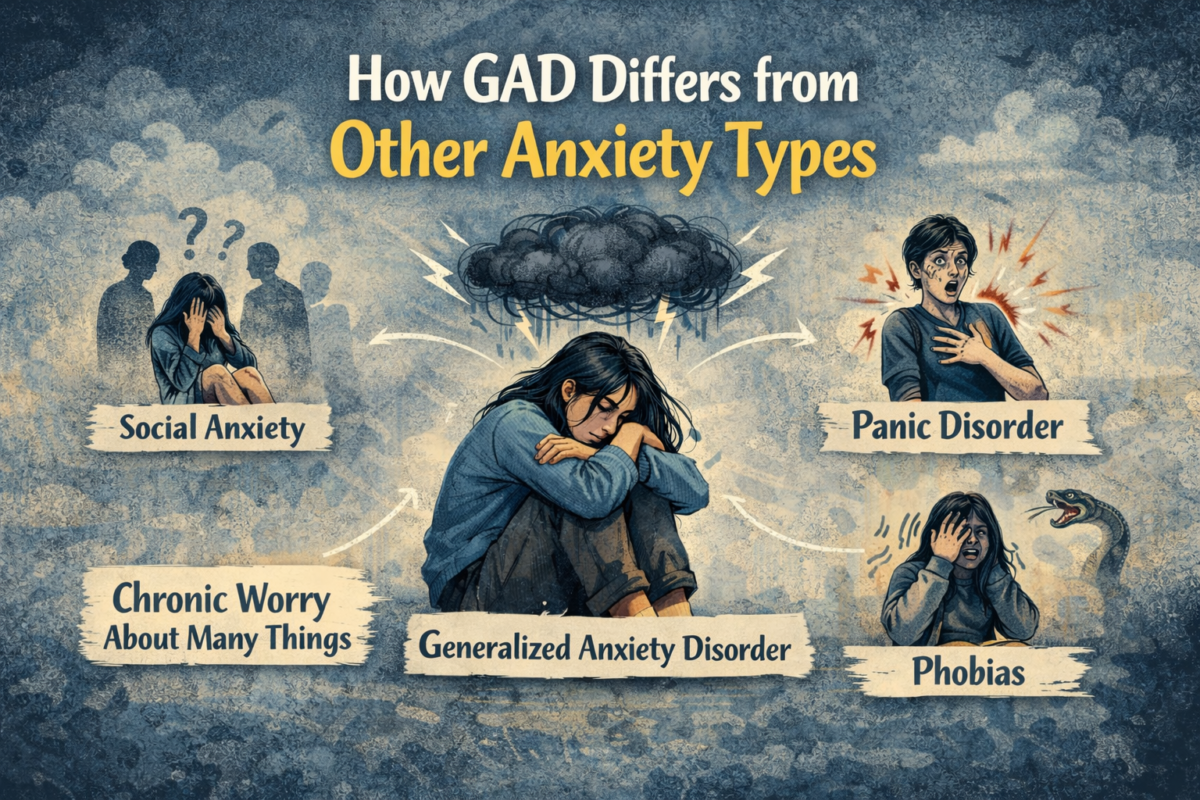
GAD vs Panic Disorder: Panic disorder involves sudden, intense panic attacks and fear of having more attacks. GAD is ongoing worry without discrete panic episodes.
GAD vs Social Anxiety: Social anxiety centers on fear of negative evaluation in social situations. GAD worries about everything, social situations, health, work, responsibilities, relationships, not just social contexts.
GAD vs Specific Phobias: Specific phobias involve fear of particular objects or situations (spiders, heights, flying). GAD lacks a single trigger and spreads across multiple life areas.
The bottom line: GAD is generalized precisely because it isn’t limited to one type of situation or trigger.
What Causes GAD? (The Honest Answer)
Here’s the truth: We don’t have a single, definitive cause.
GAD typically develops from a combination of factors including genetic vulnerability, early life experiences, personality traits like high sensitivity to uncertainty, chronic stress, and learned patterns of worry from family or environment.
GAD often develops gradually, which makes it harder to recognize. Many people live with it for years, assuming “this is just how I am” before realizing it’s a treatable condition.
You didn’t cause this. You didn’t choose this.
But you can do something about it.
How GAD Is Actually Diagnosed
There’s no blood test for GAD. No brain scan that shows it.
Diagnosis involves a comprehensive clinical evaluation exploring the nature and duration of symptoms, impact on daily functioning, personal and family history, and physical health factors that might contribute to or mimic anxiety.
A mental health professional will look at the clinical picture, how long you’ve been experiencing symptoms, how they affect your life, and whether they meet established diagnostic criteria.
This is why proper assessment matters. Self-diagnosis based on internet articles (including this one) isn’t enough.
Living With GAD: What You Need to Know
Living with GAD is exhausting, especially when anxiety becomes so normal that you forget what feeling calm actually feels like.
Many people adapt to chronic worry without realizing that effective help exists. They assume this is just their personality, their baseline, their reality.
Let’s be honest: GAD won’t disappear overnight. Recovery isn’t linear. Some days will be harder than others.
But with appropriate support, it is absolutely possible to reduce anxiety, improve quality of life, and regain a sense of control.
You don’t have to live like this forever.
What Actually Works for GAD
Psychological Therapies That Have Evidence Behind Them
The gold-standard treatments include Cognitive Behavioural Therapy (CBT), which helps identify and change thought patterns maintaining anxiety; Acceptance and Commitment Therapy (ACT), which focuses on accepting anxiety while pursuing valued actions; and psychodynamic approaches, which explore underlying patterns and early experiences.
Therapy isn’t just talking about your feelings. It’s learning concrete skills to manage worry, identifying patterns that keep anxiety going, and building new ways of relating to your thoughts.
Medication: When and Why It Might Help
Medication may be considered when symptoms are moderate to severe, when therapy alone isn’t sufficient, or when anxiety is significantly impairing daily functioning.
This isn’t about “taking the easy way out.” This is about using available tools to improve your quality of life.
Decisions about medication are individualized and carefully monitored. What works for one person may not work for another.
Self-Management Strategies (That Actually Help)
These approaches support professional treatment but don’t replace it:
Improving sleep routines and sleep hygiene, reducing caffeine intake (yes, that morning coffee might be making things worse), regular physical activity (which reduces baseline anxiety levels), and learning relaxation and grounding techniques.
These aren’t miracle cures. They’re supportive strategies that can reduce symptom severity alongside professional treatment.
When to Actually Seek Help
You should seek professional assessment if anxiety persists for several months, worry feels genuinely uncontrollable, daily functioning is affected (work, relationships, responsibilities), or physical symptoms are ongoing.
Early support often leads to better outcomes. Waiting until you’re completely overwhelmed makes treatment harder, not easier.
How to Access Support in the UK
You have options:
Start with your GP, who can provide initial assessment and refer you to NHS psychological services. Consider NHS psychological services (IAPT), though waiting times can be significant. Or pursue private psychiatric or psychological assessment for faster access.
The right route depends on symptom severity, urgency, and your personal circumstances.
The Bottom Line on Generalised Anxiety Disorder
Generalised Anxiety Disorder is more than everyday worry. It’s not a character flaw, and it’s not something you can just “snap out of.”
GAD affects your thoughts, emotions, physical body, and daily life in persistent, uncontrollable ways. But here’s what you need to know: Effective treatments exist. Clear assessment leads to appropriate support. Recovery is possible.
Understanding what GAD actually is recognizing that what you’re experiencing has a name, a pattern, and evidence-based treatments is the first step toward meaningful improvement.
With the right care, people with GAD can experience significant relief and regain confidence in their daily lives. You don’t have to keep living with constant worry. You just need to take the first step toward getting help.