

Is a Private Mental Health Clinic Worth it? What Patients Actually Get
January 13, 2026Here’s what most people don’t understand about private psychiatric assessment UK:
They’re not a cure. They’re not a shortcut. And they won’t magically solve your mental health problems.
But here’s what they are:
A clear, professional evaluation that gives you answers when NHS waiting times stretch 6-18 months ahead.
Look, I’m not going to promise you miracles. A private psychiatric assessment is a clinical tool—nothing more, nothing less. It’s a comprehensive evaluation by a qualified consultant psychiatrist who has the time to actually understand what you’re dealing with.
That’s it.
I understand that waiting for a year to find answer to your mental health struggles sounds FRUSTRATING.
This is where private assessment becomes a practical option—not because it’s better than NHS care, but because it’s available now.
The reality? A private psychiatric assessment costs £300-800. And before you book anything, you need to understand exactly what you’re paying for.
So, let’s break it down.
What a Private Psychiatric Assessment UK Actually Is
Let’s start with the fundamentals.
A private psychiatric assessment is a comprehensive clinical evaluation conducted by a consultant psychiatrist. The appointment typically runs 60-90 minutes—sometimes longer for complex cases.
Here’s what happens in that time:
The psychiatrist evaluates your mental health difficulties using recognized diagnostic frameworks like ICD-11 or DSM-5. They combine clinical expertise with evidence-based medicine to build a complete picture of what you’re experiencing.
But here’s the crucial part most people miss:
This isn’t just about slapping a diagnostic label on you and calling it done.
The assessment focuses on understanding:
- How your symptoms actually affect your daily life
- Why these difficulties may have developed in the first place
- What forms of support are most likely to help based on clinical evidence
Think of it less like a medical test and more like a detailed investigation. The psychiatrist is gathering information, connecting patterns, and applying years of specialized training to understand your specific situation.
That’s the value proposition: professional expertise, adequate time, and a thorough evaluation.
Not magic. Not miracle cures. Just competent medical practice delivered when you actually need it.
Who Should Actually Consider Private Assessment (And Who Shouldn’t)
Not everyone needs a private psychiatric assessment. Some people genuinely should wait for NHS services. Others are in situations where private assessment makes complete sense.
Let’s separate the two.
When Private Assessment Makes Sense
You should consider a private psychiatric assessment if:
You’re experiencing persistent symptoms that genuinely interfere with functioning. We’re talking about depression that’s affecting your work performance, anxiety that’s limiting your social life, or concentration issues that are sabotaging your career. Real, measurable impacts on your daily life.
You need clarity about a possible diagnosis. Maybe you suspect ADHD, bipolar disorder, autism, PTSD, or another condition, but you need professional confirmation. Self-diagnosis from internet articles doesn’t count as a medical assessment.
NHS waiting times are genuinely too long for your situation. If you’re on a waiting list and your mental health is deteriorating, that’s a legitimate reason to consider private options.
Previous treatment hasn’t worked, and you need a second opinion. Sometimes a fresh perspective from a different psychiatrist reveals something the first one missed.
You need formal documentation. Whether it’s for workplace adjustments, educational accommodations, or legal purposes, a detailed psychiatric report from a consultant psychiatrist carries weight.
You want continuity and depth. Private assessments offer longer appointments with named consultant psychiatrists. That’s not available in most NHS pathways.
When You Shouldn’t Use Private Assessment
Private psychiatric assessment is NOT appropriate if:
You’re in immediate crisis or at high risk. If you’re actively suicidal or experiencing severe mental health emergency, you need NHS crisis services or A&E. Private assessment cannot provide emergency care.
You’re expecting guaranteed outcomes. If you’re coming in demanding a specific diagnosis or particular medication, you’re wasting your money. Ethical psychiatrists won’t provide diagnoses that aren’t clinically justified.
You think confirmation of your self-diagnosis is guaranteed. The psychiatrist’s job is clinical assessment, not validation of what you’ve decided you have from online research.
You can’t afford it without financial hardship. Private assessment costs £300-800. If that money is coming from your rent fund or emergency savings, reconsider.
The bottom line: Private psychiatric assessment is for people who need professional evaluation now and can afford to pay for it without creating other problems in their lives.
What Happens Before Your Appointment
Most private psychiatry clinics run a reasonably standardized pre-appointment process. Here’s what you should expect:
Initial Information and Booking
When you first contact a private clinic, you’ll receive:
- Clear information about appointment length and format (video or face-to-face)
- Transparent fee structure with no hidden costs
- Confidentiality policies and data protection information
- Honest explanation of what the assessment can and cannot provide
Good clinics are upfront about limitations. If someone’s promising guaranteed diagnoses or miracle outcomes, that’s your red flag to walk away.
You’ll also get more flexibility than NHS services: shorter waiting times, evening and weekend appointments, and the ability to choose your preferred consultant.
Pre-Assessment Questionnaires
Before your appointment, expect to complete some paperwork:
- Symptom questionnaires that help quantify what you’re experiencing
- Personal history forms covering childhood, development, and life events
- Medical history including previous diagnoses and treatments
- Current and past medication details
Why does this matter?
Because it allows the psychiatrist to prepare properly. Instead of spending 20 minutes of your 90-minute appointment gathering basic information, they can dive straight into the clinical evaluation.
You’re paying for expertise and time. Pre-assessment forms ensure that time is used effectively.
The Assessment Itself: What Actually Happens in the Room
This is what you’re really paying for.
Format and Length
Standard private psychiatric assessments run 60-90 minutes. Complex cases might require longer initial appointments or follow-up sessions.
Appointments happen either:
- Face-to-face in clinic
- Online via secure video consultation
Both formats are clinically effective when conducted properly. The idea that online assessments are somehow “less valid” is outdated. What matters is the psychiatrist’s competence and the thoroughness of the evaluation, not the medium.
What the Psychiatrist Actually Explores
Here’s what a comprehensive assessment covers:
Your current symptoms and primary concerns. What brought you here? What’s actually going wrong in your life right now?
Mental health history. Previous diagnoses, treatments that worked, treatments that didn’t, medication history, therapy experiences.
Physical health and medication. Medical conditions can affect mental health. Some medications cause psychiatric symptoms. This matters.
Developmental and childhood background. Certain conditions have developmental origins. Understanding your early years provides crucial context.
Family psychiatric history. Many mental health conditions have genetic components. Knowing what runs in your family helps with diagnostic accuracy.
Current life functioning. How are your relationships? Your work? Your social life? Your daily routines? Real-world functioning matters more than checkbox symptoms.
Significant life events and trauma. Major losses, traumatic experiences, chronic stress—these shape mental health in profound ways.
Risk factors, where relevant. In some cases, the psychiatrist needs to assess safety concerns. This is standard clinical practice.
The assessment is structured but conversational. You’re not being interrogated—you’re talking with a medical professional who’s trying to understand your situation.
The Psychiatrist’s Role
Here’s what consultant psychiatrists actually bring to the table:
Medical and psychiatric expertise. They’ve completed medical school, foundation training, and years of specialized psychiatric training. They understand how different conditions present, how they overlap, and how to differentiate between them.
Diagnostic frameworks. They’re applying ICD-11 or DSM-5 criteria, not guessing based on gut feeling.
Biological, psychological, and social perspective. Good psychiatrists understand that mental health isn’t just brain chemistry—it’s the interaction between biology, psychology, and life circumstances.
Independent professional opinion. They’re not invested in confirming what you think you have. They’re providing an objective clinical assessment.
This is collaborative work, not a test you pass or fail.
What You Get After the Assessment
The assessment itself is just the beginning. Here’s what happens next:
Diagnosis and Clinical Formulation
Following your assessment, you’ll receive either:
A formal psychiatric diagnosis (when clinically appropriate and evidence-based)
OR
A clinical formulation explaining your difficulties, even if a single diagnosis doesn’t fully capture what you’re experiencing.
Here’s the truth about diagnosis: Not every assessment results in a definitive diagnostic label.
Sometimes symptoms overlap between conditions. Sometimes, difficulties are better explained by life circumstances than psychiatric illness. Sometimes the picture needs more time to become clear.
Ethical psychiatrists don’t force diagnoses where they don’t fit. They tell you what they can conclude based on clinical evidence.
But formulation is often more valuable than diagnosis anyway.
A good formulation explains:
- What factors contribute to your difficulties
- How different elements interact
- Why you’re experiencing these problems now
- What’s maintaining the difficulties
- What might help
This understanding is actionable. It guides treatment decisions. It helps you make sense of your experience.
Written Psychiatric Report
Most private assessments include a comprehensive written report containing:
- Your presenting difficulties and symptoms
- Relevant personal, developmental, and medical history
- Mental state examination findings
- Diagnostic conclusions or clinical formulation
- Risk assessment where relevant
- Professional recommendations for treatment
This document has real-world utility.
With your consent, it can be shared with your GP, therapist, employer (for workplace adjustments), or educational institution (for academic accommodations).
It carries weight because it comes from a qualified consultant psychiatrist who’s conducted a proper assessment.
Treatment Recommendations
Based on the assessment, you’ll receive evidence-based recommendations that might include:
Psychological therapies like CBT, trauma-focused therapy, or other specialized approaches suited to your difficulties.
Medication options if appropriate (more on this below).
Lifestyle and support strategies that complement formal treatment.
Further assessments or referrals if specialist evaluation is needed.
Coordination with NHS services for ongoing care.
These recommendations are tailored to your specific situation, not generic advice copied from a template.
The Medication Question
Let’s address this directly because there’s confusion here.
Private psychiatric assessment does NOT automatically mean medication.
Medication is recommended when:
- Clinical evidence supports its use for your condition
- Potential benefits outweigh risks
- You understand and consent to the treatment
- It’s part of a broader treatment approach
Medication is NOT recommended when:
- Your difficulties are better addressed through therapy or life changes
- Risks outweigh benefits
- You’re opposed to medication
- There’s insufficient evidence for its use in your case
Ethical psychiatrists don’t push pills. They discuss options, explain evidence, and make collaborative decisions.
What You DON’T Get (And Why This Matters)
This section is crucial. Understanding limitations prevents disappointment and wasted money.
No Guaranteed Diagnosis
Some assessments don’t result in definitive diagnoses. Here’s why:
- Psychiatric conditions often overlap in symptoms
- Some difficulties don’t fit neatly into diagnostic categories
- The clinical picture may need time to evolve
- Further assessment or observation might be necessary
A psychiatrist who admits diagnostic uncertainty is being honest, not incompetent.
Forcing inappropriate diagnoses causes more harm than acknowledging clinical complexity.
Not Ongoing Therapy
A psychiatric assessment is a one-off evaluation (or short series of appointments). It’s not long-term psychotherapy.
Here’s the distinction:
- Psychiatric assessment: Medical evaluation, diagnosis, treatment recommendations
- Psychotherapy: Ongoing therapeutic work to address psychological difficulties
If you need ongoing therapy, the psychiatrist will recommend appropriate therapists. But the assessment itself is diagnostic work, not treatment.
Not Automatic Medication
We covered this, but it bears repeating:
Assessment doesn’t equal prescription. Medication recommendations are made based on clinical need, not patient demand or clinic profit margins.
Not a Replacement for Crisis Services
If you’re in acute crisis, private assessment cannot provide:
- Emergency psychiatric care
- Immediate inpatient admission
- 24/7 crisis support
- Urgent safety management
For those needs, NHS crisis teams and A&E remain the appropriate services.
Private Assessment vs NHS: The Honest Comparison
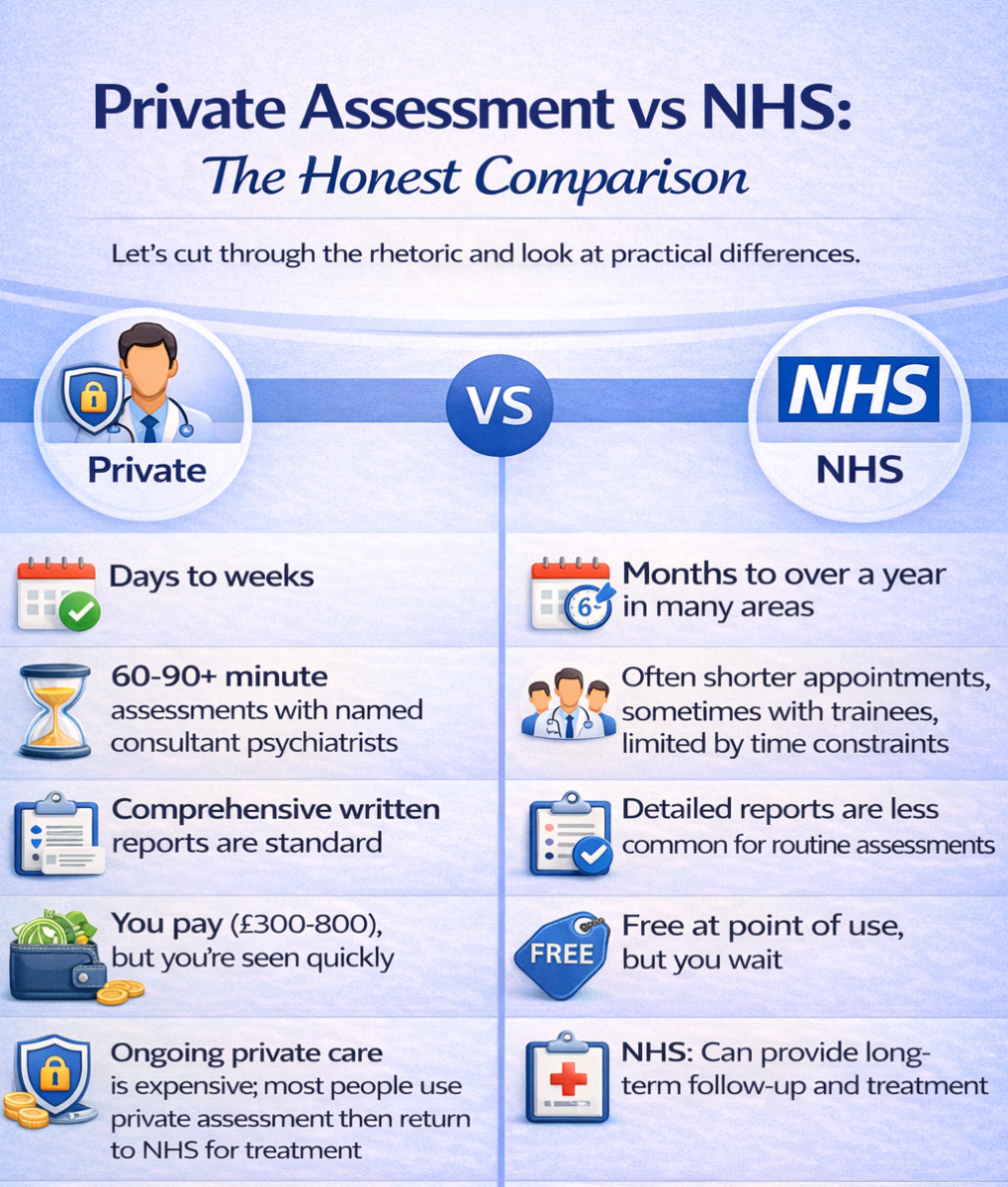
Waiting Times
Private: Days to weeks
NHS: Months to over a year in many areas
This is the primary driver for most people choosing private assessment. When you’re struggling now, waiting 18 months isn’t viable.
Appointment Length and Depth
Private: 60-90+ minute assessments with named consultant psychiatrists
NHS: Often shorter appointments, sometimes with trainees, limited by time constraints
Private assessment offers more time and depth. That doesn’t make NHS psychiatrists less competent—they’re working within system limitations.
Written Reports
Private: Comprehensive written reports are standard
NHS: Detailed reports are less common for routine assessments
If you need formal documentation, private assessment reliably delivers this.
Cost vs Access
Private: You pay (£300-800), but you’re seen quickly
NHS: Free at point of use, but you wait
This is the fundamental trade-off. Neither option is objectively “better”—it depends on your circumstances, urgency, and financial capacity.
Ongoing Care
NHS: Can provide long-term follow-up and treatment
Private: Ongoing private care is expensive; most people use private assessment then return to NHS for treatment
The common strategy: Private assessment for diagnosis and recommendations, then NHS for ongoing treatment. This combines speed with sustainability.
What Private Psychiatric Assessment Actually Costs in the UK
Let’s talk numbers.
Standard Assessment Fees
Expect to pay £300-800 for an initial psychiatric assessment. The range depends on:
- Appointment length (60 vs 90+ minutes)
- Complexity of assessment
- Consultant experience and reputation
- Report requirements and detail
- Clinic location and overhead
Most people pay £400-600 for a standard comprehensive assessment.
Follow-Up Appointments
If follow-up is needed, subsequent appointments are typically:
- Shorter (30-45 minutes)
- Less expensive (£150-300)
- Focused on specific issues
Hidden Costs to Watch For
Some clinics charge extra for:
- Detailed written reports
- Sharing reports with third parties
- Prescription services
- Administrative tasks
Get full pricing upfront before booking.
Is It Worth the Money?
Here’s the honest assessment:
If you’re in genuine distress, functioning poorly, and facing 12+ month NHS waits, £400-600 for professional clarity and a treatment roadmap is reasonable value.
If you’re mildly worried but managing fine, or if £500 creates financial hardship, it’s probably not worth it.
Value is context-dependent. For some people, this investment is life-changing. For others, it’s an unnecessary expense.
How to Actually Book a Private Psychiatric Assessment
The process is straightforward:
1 – Research clinics and psychiatrists
Look for:
- GMC-registered consultant psychiatrists
- Clear pricing and service descriptions
- Transparent about limitations
- Professional websites with verifiable credentials
2 – Contact the clinic directly
- Most accept self-referrals (no GP referral needed)
- Ask about waiting times, fees, and what’s included
- Confirm appointment format (online or face-to-face)
3 – Complete pre-assessment paperwork
- Fill out forms thoroughly and honestly
- Provide relevant previous medical records if available
- List current symptoms and concerns clearly
4 – Attend your assessment
- Be prepared to discuss difficult topics openly
- Bring questions you want answered
- Take notes if it helps you remember recommendations
5 – Receive your report and recommendations
- Review the report carefully
- Discuss anything unclear with the psychiatrist
- Share with your GP (with consent) for coordinated care
A Note on Dr Musa Sami’s Psychiatric Clinic
Dr Musa Sami’s clinic offers online psychiatric assessments conducted with clinical rigor and genuine empathy. The approach focuses on understanding the individual person, not just checking diagnostic boxes.
If you’re struggling and need professional psychiatric evaluation, you can book an appointment online. It’s a straightforward step toward getting clarity about what you’re dealing with and what actually might help.
Frequently Asked Questions About Private Psychiatric Assessments in the UK
Is a private psychiatrist assessment UK recognised by the NHS?
Yes. NHS clinicians generally accept private psychiatric reports as valid medical documentation. However, NHS doctors make their own independent clinical decisions about ongoing treatment.
Do I need a GP referral?
No. Private psychiatric services accept self-referrals. You can book directly without GP involvement, though informing your GP afterward is usually beneficial for coordinated care.
Are online assessments as valid as face-to-face?
Yes, when conducted properly by qualified psychiatrists. Clinical assessment doesn’t require physical examination in most psychiatric cases. What matters is thorough evaluation and professional competence.
Can I use the assessment for workplace or educational accommodations?
Yes. A formal psychiatric report from a consultant psychiatrist can support requests for reasonable adjustments at work or in educational settings.
The Bottom Line
A private psychiatric assessment in the UK isn’t a miracle cure. It’s not therapy. It’s not guaranteed to give you the diagnosis you think you have.
What it IS:
A comprehensive medical evaluation by a qualified psychiatrist who has adequate time to understand your difficulties, apply evidence-based diagnostic frameworks, and provide professional recommendations for treatment.
When it’s worth considering:
- You’re experiencing genuine functional impairment
- NHS waiting times are too long for your situation
- You need professional clarity about diagnosis
- You want a second opinion
- You need formal documentation
- You can afford £400-600 without financial hardship
When it’s not worth it:
- You’re in immediate crisis (use NHS emergency services)
- You’re expecting guaranteed outcomes
- The cost creates financial problems
- You’re managing reasonably well and can wait for NHS
The decision comes down to urgency, need, and resources.
For many people, getting professional psychiatric evaluation within weeks rather than waiting 12+ months is worth the investment. It provides clarity, validates their concerns, and creates a pathway forward.
Just go in with realistic expectations.
You’re buying professional expertise and timely access—not miracles, not guarantees, not magic solutions.
If that’s what you need right now, private psychiatric assessment serves that purpose effectively.
If you’re ready to take that step, book your appointment and move forward. If you’re still unsure, that’s fine too—not every situation requires immediate private assessment.
The point is to make an informed decision based on your actual circumstances, not fear, confusion, or desperation.
That’s what this article aimed to provide: information that helps you decide clearly and without hype.
Now you know what private psychiatric assessment actually delivers. The rest is up to you.